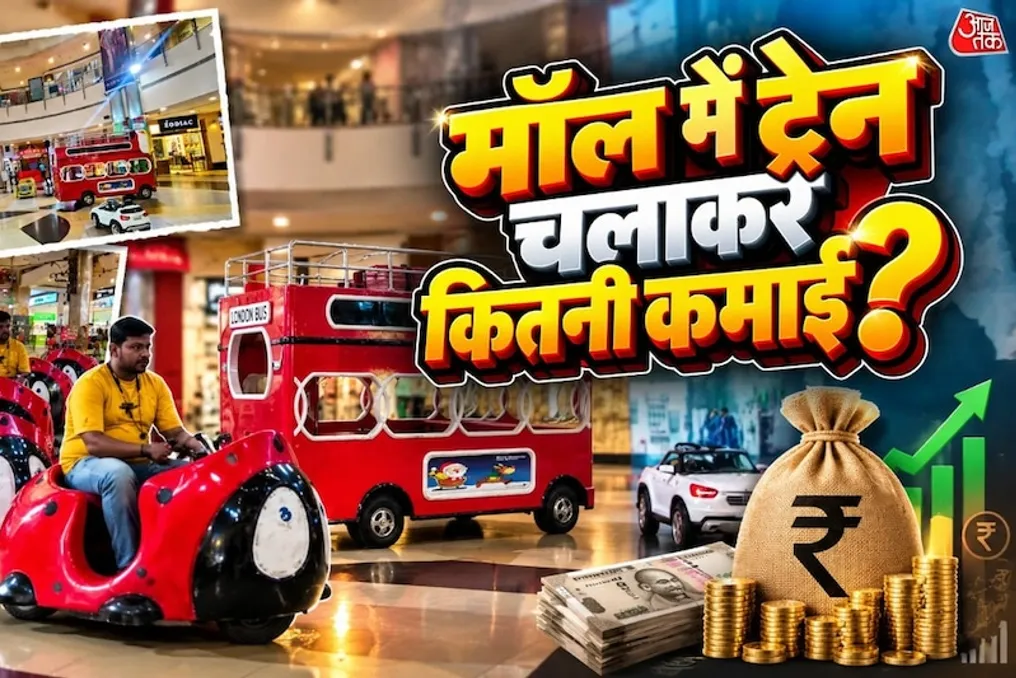
Shopping malls, where people come for purchases, often have small children. Small trains or carriages circulating through the mall are a special entertainment for children. Children insist on rides, and parents buy tickets for their joy. If the ticket price for one child is 100 rupees, the potential income can be easily estimated.
However, the number of children daily is not constant. On ordinary days when mall attendance is low, the number of children using the train rides can be small. Suppose that from Monday to Friday, 30 children ride every day. At a price of 100 rupees per ticket, the daily earnings will be 3,000 rupees. Thus, over five days, the total income can reach 15,000 rupees.
At a rate of 100 rupees per ticket, the daily income is 3,000 rupees. If the trains operate 25 days a month, the total income can reach 75,000 rupees. It is important to note that this is the gross revenue from tickets, from which expenses such as train operation, maintenance, and rent in the shopping center must be deducted.
On Saturdays and Sundays, the flow of families into the shopping center increases. People come there not only to shop but also to entertain and amuse their children. If 70 children ride in one day, the income at a price of 100 rupees per ticket will be 7,000 rupees.
During festivals such as Diwali, Dasara, Christmas, and other celebrations, the number of mall visitors increases. Thanks to decorations and holidays, the number of families with children may also increase. If 150 children ride in the train on a festive day, the daily income at a price of 100 rupees per child will be 15,000 rupees.
What happens if 100 children come in a day? If 100 children ride in the mall every day, and 100 rupees are charged for each, the daily earnings will be 10,000 rupees. If the trains operate 30 days a month, the total income can amount to 300,000 rupees. Nevertheless, this amount represents the gross revenue, not the net profit. Expenses such as the cost of the train, electricity, maintenance, staff salaries, and rent or commission paid to the shopping center must be deducted from it. Only then can one find out the actual amount remaining per month.
Operators managing children's trains at Modi shopping center note that mall attendance on ordinary days is lower than on weekends. If 100–150 children ride on cars, motorcycles, or trains during the day, and 100 rupees are charged for each, the income calculation will be as follows. If 100 children ride, the income will be 10,000 rupees (100 × 100). If 150 children ride, 15,000 rupees will be earned (150 × 100). Thus, according to this estimate, the daily income on ordinary days can range from 10,000 to 15,000 rupees.
On Saturdays and Sundays, more people often come to shopping centers for walks and shopping. The increase in the number of children at this time can lead to an increase in the number of children using cars, motorcycles, and trains. Suppose that 150–300 children ride on these vehicles across the country on weekends. At a price of 100 rupees per child, the income will be 15,000 rupees for 150 children and 30,000 rupees for 300 children. Thus, on weekends, the income can range from 15,000 to 30,000 rupees. However, this depends on the level of mall attendance and the desire of children to ride on these vehicles.
During festivals such as Diwali, Christmas, and New Year, mall attendance grows. People come with families for shopping and children's entertainment. At this time, the demand for children's rides on cars, motorcycles, and trains may increase. If 500 children ride in these vehicles on a festive day, the income at a price of 100 rupees per child will be 50,000 rupees. If 1,000 children ride, the total income can reach 100,000 rupees. Nevertheless, it is not necessary for every shopping center to have such a crowd or for everyone to be charged exactly 100 rupees; these figures are provided only to illustrate calculations.
Consider a simple example. If 100 children ride on cars, motorcycles, or trains in the mall every day, and 100 rupees are charged for each, the daily income will be 10,000 rupees. If the same number of children comes throughout the month (30 days), the total number of passengers will be 3,000 people. In that case, 3,000 × 100 = 300,000 rupees. That is, according to this estimate, the total monthly income can be 300 thousand rupees.