The food accessibility crisis in South Africa is increasingly forcing families to choose between the cost of food and its nutritional value. Financially strained households tend to purchase cheaper and more filling foods, even if they offer less dietary variety.
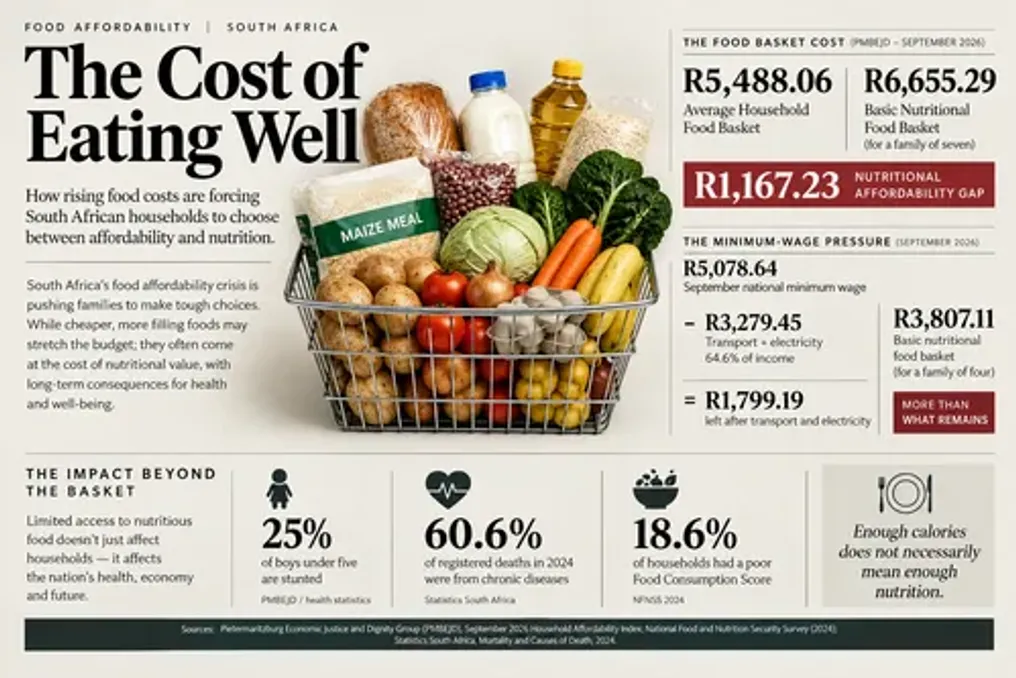
According to the Household Food Accessibility Index for September, prepared by the Pietermaritzburg Economic Justice and Dignity Group (PMBEJD), it is evident how financial status affects family nutrition monthly. The average cost of a household's food basket was R5,488.06, while the basic nutritional basket for a family of seven cost R6,655.29, which is R1,167.23 more.
Mervyn Abraham from PMBEJD noted that the rising cost of living is reflected in consumer decisions. He stated that people are starting to buy less food and lower-quality products, becoming more selective in their choices to manage their budget.
PMBEJD found that transport and electricity expenses amounted to R3,279.45, or 64.6% of the national minimum wage in September, which reached R5,078.64. This leaves R1,799.19, less than half, while the basic nutritional basket for a family of four requires R3,807.11.
Abraham emphasized that health statistics demonstrate the consequences of households being unable to afford sufficient and nutritious food. He pointed to a very high rate of growth stunting in children in South Africa, noting that twenty-five percent of boys under five suffer from this, which is a direct consequence of protein deficiency.
Furthermore, high rates of diabetes and non-communicable diseases are observed, which are directly linked to prolonged inadequate nutrition. Abraham added that the problem affects the entire country, as the South African economy is forced to spend more on healthcare to treat problems caused by insufficient or low-quality food.
Dr. Heinrich Vollmink, CEO of the South African Association of Nutrition Doctors, considers it critically important to distinguish between consuming enough calories and receiving adequate nutrition. He explained that with limited budgets, people may naturally prefer affordable, filling, and practical food, but calorie saturation does not guarantee nutritional adequacy. A diet can provide enough energy without having sufficient variety, fiber, vitamins, minerals, and other essential substances.
Vollmink warned that regular consumption of high-energy, low-nutrient foods can hinder the achievement of a healthy eating pattern. When foods high in added sugar, salt, and unhealthy fats regularly replace healthier alternatives, it contributes to excessive energy intake and increases the risk of obesity, hypertension, type 2 diabetes, and cardiovascular diseases.
According to the National Report on Food and Nutrition Security for 2024, 58.1% of households had an acceptable food consumption score, while 23.3% were classified as borderline, and 18.6% as poor. Vollmink cautioned that a poor score does not prove nutrient deficiency, but limited dietary diversity can increase the risk of malnutrition.
Statistics South Africa registered 474,366 deaths in 2024, with chronic diseases accounting for 60.6% of all deaths. Diabetes accounted for 6.1%, followed by hypertensive diseases (5.5%) and cerebrovascular diseases (5.4%).
The National Department of Health has identified unhealthy eating as one of the risk factors contributing to the burden of non-communicable diseases (NCDs) in South Africa, including excessive consumption of salt and sugar, as well as high-fat foods. The department's latest mortality data shows that NCDs accounted for 60.6% of registered deaths in South Africa in 2024. Minister of Health MP Joe Pahla noted that preventing these diseases largely depends on a healthy lifestyle, which includes a balanced diet.