UBTECH has unveiled details of Thinker-WM, a world model developed by its Thinker team. This model is capable of encoding RGB video, metric depth, and robot actions into a single unified representation. Technical documentation for this development is available on arXiv.
According to the company's statements, Thinker-WM ranked first in three embodied world model benchmarks. These rankings are based on results available at the time of the announcement.
Model Testing Results
According to UBTECH, the Thinker-WM model achieved an overall score of 0.740 on WorldOlympiad. This benchmark is built on real-world robot interaction data and covers over ten robots and several camera configurations. Furthermore, the model reached the highest individual scores for 3D consistency (0.531) and interaction accuracy (0.765).
On the EWMBench platform, the model demonstrated a cumulative score of 4.66, surpassing models such as Qwen-RobotWorld and Sora 2, with leading results achieved in the dynamics and trajectory matching metrics. On the WorldArena 1.0 Track-1 simulation benchmark, the company claims it led across 12 different evaluation criteria.
Architecture and Operating Principle
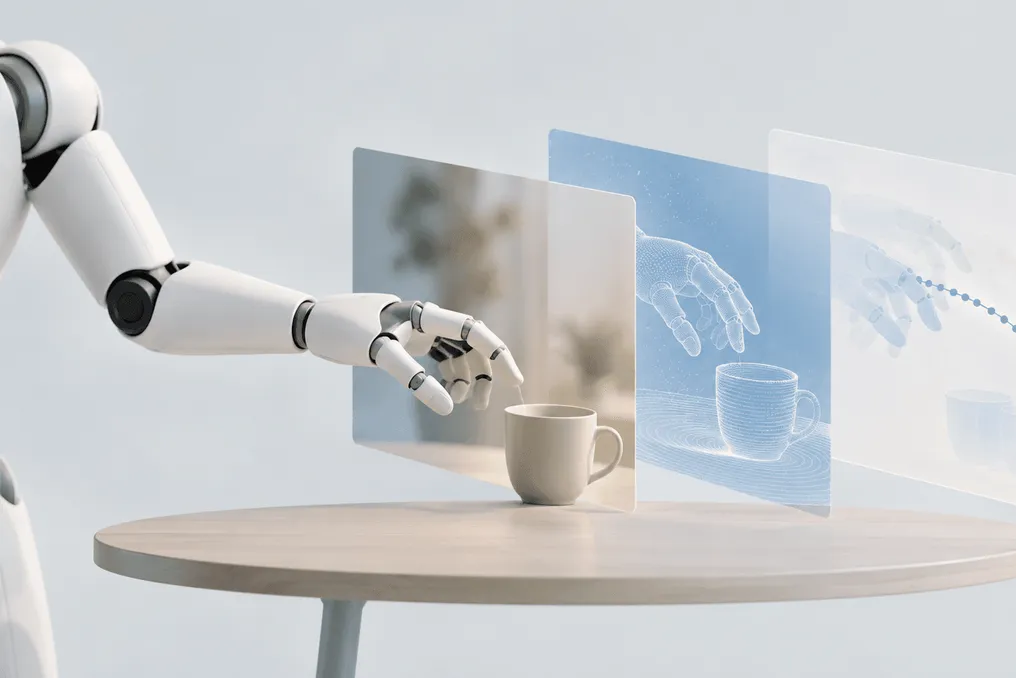
The main argument for developing Thinker-WM is that many existing world models consist of separate components: video generation handles pixels, the policy network handles actions, and a separate module predicts geometry. UBTECH believes this approach separates physically related signals. Instead, Thinker-WM passes each modality through its own encoder into a common latent space and jointly models them within a Unified Dynamics Transformer before decoding video, depth maps, and executable actions. Depth is treated as an integral output signal, not an auxiliary one.
In single-task experiments on RoboTwin, adding depth increased manipulation success by 15 percentage points compared to the baseline model where depth was absent.
Because all modalities utilize a single set of weights, the model can function in six different modes, including joint video and action generation, future prediction, policy inference, video-to-action translation, and inverse dynamics, simply by changing the input data and generated outputs.
Training Data
The total volume of training data amounts to approximately 30,000 hours. Of this, about 20,000 hours consists of first-person video shot in home environments, retail stores, and factories; about 10,000 hours comprises real robot data from various types; and about 1,000 hours is simulation data. All robot actions are represented as end-effector poses with a body-specific tag, allowing different machines to use the same generation space. A data pipeline called Data Factory handles sampling, multi-level quality checking, and depth-video alignment.
To verify whether the shared space truly connects the modalities, the team trained a small test motion mechanism on frozen visual features to recover end-effector offset, which UBTECH presents as evidence of cross-modal binding.