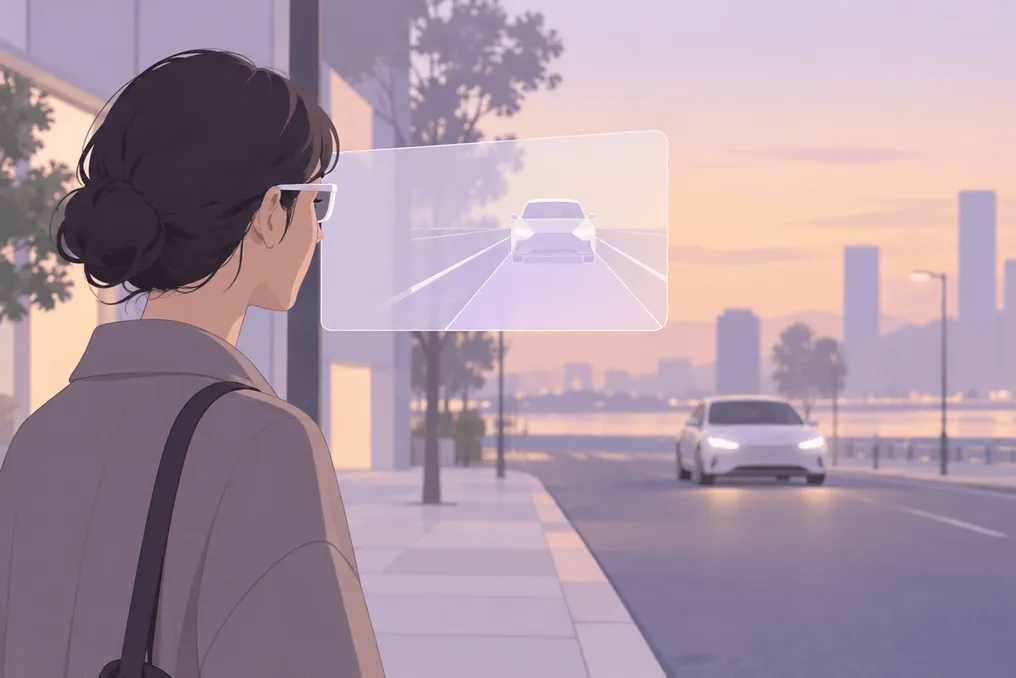
Rokid, in collaboration with Tencent Mobility, has launched a service to order taxis directly within its AI glasses, allowing users to book a ride using their voice without needing to take out their smartphone. Rokid claims this is the first native ride-hailing service for AI glasses in the industry.
After connecting to the Tencent Mobility agent, the user only needs to state their desired destination. The glasses then manage the entire process autonomously: they interpret the request, suggest pick-up and drop-off points, check for nearby vehicles, calculate the cost, compare vehicle types, place the order, and handle payment.
While the user waits, information such as the license plate number, vehicle details, and estimated time of arrival is displayed in the user's field of view, accompanied by voice reminders. According to the Chinese tech publication Leikeji, Android and iOS users must update the Rokid AI application to version 1.15 to use this feature.
The integration is implemented as a division of functions between two agents. The Rokid glasses agent is responsible for understanding the user, managing the dialogue, and displaying information on the lens. In turn, the Tencent Mobility agent provides the actual ride-hailing service. These two agents interact directly via the Agent-to-Agent (A2A) protocol.
Tencent Mobility has prepared its ride-hailing functions for wearable devices as standard services, which include location suggestions, pick-up point selection, finding nearby vehicles, fare estimation and comparison, one-click booking, real-time order status tracking, and passwordless payment. The glasses call upon these services as needed.
Rokid emphasizes that the main advantage is realized at the point of pickup. Users no longer need to constantly check their phone to find the car's location, its plate number, or its arrival time; all this information remains visible, simplifying the search for the vehicle in crowded areas like stations, shopping malls, or roadside shoulders. Furthermore, the company notes that voice ordering lowers the barrier to entry for elderly people, children, and other users who find it inconvenient to operate smartphones.
Rokid makes it clear that the glasses are not intended to replace the phone. For issues like payment problems, changing destinations, or canceling orders, the phone remains a more reliable backup option. In the company's view, the glasses should initiate requests, provide live reminders, and manage environmental interaction, while the phone should handle complex confirmations, payments, and exceptions.
The companies have not yet disclosed which specific models of glasses or cities support this feature.