The President of Uzbekistan, Shavkat Mirziyoyev, met with Jamil Kazanci, Chairman of the Board of Directors of the Turkish company Aksa Enerji. This meeting took place during the first investors' meeting in the fuel and energy complex sector.

Similar stories
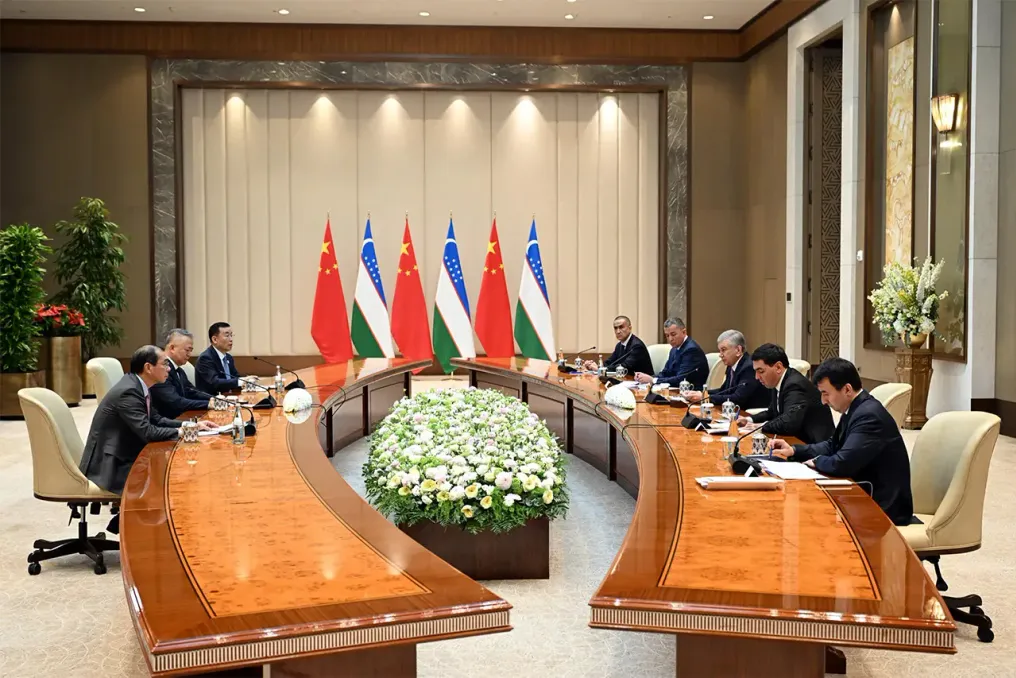
Uzbekistan discussed energy projects with Chinese companies
President of Uzbekistan Shavkat Mirziyoyev held negotiations with leaders of Chinese companies CAMCE, China Energy, and Sinoma Energy on October 16. These meetings took place during the session of the Council of Investors in the fuel and energy sector in Tashkent.
During the discussions, participants reviewed the progress of joint initiatives. These include projects in renewable energy, energy storage systems, waste processing, and water supply development.
Furthermore, within the framework of the negotiations, the initiative of Chinese companies to create a logistics center in the Andijan region was supported. The implementation of agrivoltaics projects, combining agriculture with solar generation, and the expansion of cooperation in the oil and gas sector were also discussed.
Shavkat Mirziyoyev held an open dialogue with investors in the fuel and energy complex sector
Shavkat Mirziyoyev held an open meeting with investors working in the fuel and energy sector. The creation of an Investor Council for this industry was announced, which will be responsible for promptly resolving problems faced by capitalists.
Today in Tashkent, Shavkat Mirziyoyev met with investors in the energy system. The head of state emphasized that energy is the heart of development, playing a crucial role in stable energy supply, attracting private investment, and strengthening public trust in the future.
Achievements of the Past Period and Plans for the Future
In the past, $35 billion in investments were directed to the sector, and the number of partner countries increased from 2-3 to more than 10. The share of renewable energy in the total generation volume was raised to 31% thanks to solar, wind, and hydroelectric power plants. The volume of 'green' capacity reached 11.1 gigawatts, and electricity production per capita exceeded 28%, amounting to 2300 kilowatt-hours.
During the meeting, agreements on six major projects totaling $4.7 billion were signed. These projects will ensure a generation capacity of 3000 megawatts and energy storage capacity of 400 megawatts. The goal until 2030 is to generate 22 thousand megawatts of new capacity, allowing the annual electricity production volume to exceed 129 billion kilowatt-hours, and the share of renewable energy to reach 54%.
Currently, projects will be put up for open tender taking into account regional needs. Previously, 'green' capacity projects were often located in areas proposed by the investors themselves, which helped attract capital. However, problems have arisen in some places regarding capacity accumulation and costs for transmitting electricity to other regions.
For each project put up for tender, conditions regarding land plots, grid connection points, timelines, as well as rules for purchasing and paying for electricity are announced in advance. Requirements will be the same for all investors, and mechanisms for risk reduction and ensuring payment discipline will be strengthened.
State Concept of Energy until 2050
The National Basic Energy Concept until 2050 was developed and unveiled for the first time. A map of grid connection opportunities will be presented by March 1st of next year, and the full basic concept by July 1st. These documents will show where electricity demand is growing in various regions, what infrastructure is needed, and where new capacities can operate most effectively. Based on this, investors will be able to plan their projects for the long term.
The President also stressed the need to develop networks that will deliver electricity to consumers along with new power plants. Generation, transmission, and energy storage systems must function interdependently. Currently, part of the demand in Fergana, Andijan, and Namangan regions is covered by electricity generated in other regions. The launch of new industrial zones and large enterprises further increases the load on the networks.
Areas for Data Centers Will Be Determined in Advance
The demand for electricity is rapidly growing in the fields of artificial intelligence and data centers. For these, sites with available land, grid connection capability, and sources of 'green' energy will be determined in advance. In every large data center, the main and backup power supply, energy storage, and cooling systems will be planned jointly. Investors are expected to provide solutions that allow for the efficient use of electricity and water.
Networks will be modernized, and energy storage capacities will be created. Over the past five years, more than $2 billion has been invested in the modernization of electrical grids. The next major task is the renewal of networks and the development of energy storage systems. It is planned to build 5000 kilometers of networks and 16 large substations by 2030, as well as increase energy storage capacity to 4.5 gigawatts. A significant portion of the projects is located in the Karakalpakstan, Bukhara, Jizzakh, Samarkand, Namangan, Kashkadarya, and Tashkent regions.
Priority will now be given to integrated projects covering generation, storage, and networks. Cooperation with investors is also planned for the construction of pumped-storage power plants for long-term energy storage. Private sector participation in distribution networks will be expanded. The approach initiated in Samarkand, Jizzakh, and Tashkent regions is planned to continue to reduce electricity losses and improve service quality for consumers. The President noted: 'The cheapest energy is saved energy.'
Energy Export
Uzbekistan's energy sector is not limited to the domestic market. The project to supply 'green' energy to Europe via the Caspian Sea with Azerbaijan and Kazakhstan is moving into a practical phase. The markets of Afghanistan and South Asia are also recognized as promising directions. There is high demand for copper products, cables, transformers, metal structures, and building materials in energy projects. The President noted that local enterprises can compete in terms of quality, price, and standards.
China Energy from China used nearly 40% local raw materials in the construction of eight energy storage plants, the cost of which approached $200 million. Last year, the volume of local goods and services in energy projects reached $740 million. The President emphasized the potential to increase this figure threefold or fourfold. The Agency for Industrial Cooperation and local associations work with enterprises to determine the quality and volume of necessary products for investors.
Currently, components for high-voltage equipment, control system modules for energy storage, and wind turbine parts are being imported in large quantities. 12 promising projects worth $850 million have been prepared for the localization of these components. A special industrial zone with tax and customs benefits will be created for the production of necessary products for the nuclear power plant under construction in the Forish district of Jizzakh region. The head of state called on investors to cooperate in these projects.
Searches are underway in 6 investment blocks in the Ustyurt region, and another 128 blocks have been prepared in other regions to offer to foreign partners. According to preliminary estimates, they contain gas resources of 5 trillion 800 billion cubic meters and liquid hydrocarbons—560 million tons. The President emphasized the importance of not just obtaining gas for electricity, but deeply processing it to create greater added value. The synthetic fuel complex in Kashkadarya annually produces up to 1.5 million tons of fuel and other products. It was also noted that the MTO project for producing polyethylene, polypropylene, and PET is being implemented in Bukhara region, as well as the modernization of oil refineries in Bukhara and Fergana.