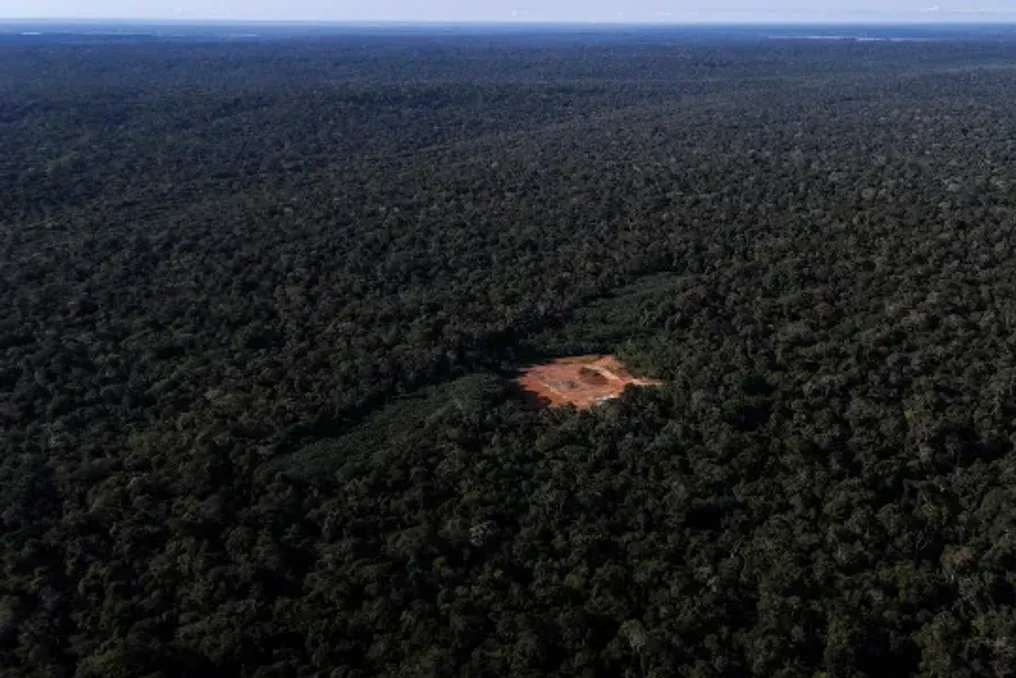
Data released by the Brazilian Government indicates that deforestation in the Amazon and Cerrado biomes reached the lowest level recorded since the beginning of the historical series.
This data was compiled by the Satellite Monitoring Project for Deforestation in the Legal Amazon (Prodes) for the period between August 2025 and July 2026. Prodes functions as the annual system for monitoring native vegetation suppression through remote sensing, conducted by the National Institute for Space Research (INPE), which is the body responsible for determining the official deforestation rate in the country.
In the Amazon, the volume of deforestation totaled 3,335 square kilometers (km²) during this interval. This represents a significant decrease of 41.8% compared to the same period last year, which registered 5,731 km² of deforestation. This index is the lowest ever documented in the Amazon's historical series by Prodes since 1988, according to information from the Ministry of Environment and Climate Change, using data processed by INPE.
Among the Amazonian states that presented the largest area of biome suppression last year, Pará stands out with 1,130 km²; Mato Grosso with 849 km²; and Amazonas with 525 km².
Regarding the Cerrado, deforestation totaled 5,516.69 km². There was a reduction of 23.8% compared to the 7,235.27 km² registered in the corresponding previous period, constituting the lowest rate in the historical series for this biome, which began in 2001.
The regions with the highest incidence of deforestation in the Cerrado last year were Maranhão, with 1,718.59 km²; Tocantins, with 1,263.06 km²; and Piauí, with 625.24 km². Together, these three areas accounted for 74.3% of the total biome suppression.
The Climate Observatory, a non-profit organization composed of a network of research institutes and environmental entities, expressed its celebration over the reduction in deforestation in the Amazon, classifying the results as a 'historic achievement for Brazil.' In a statement, Márcio Astrini, executive secretary of the Climate Observatory, stated that these figures position Brazil as a central agent in the forest preservation agenda, demonstrating that it is feasible to contain the advance of chainsaws and greenhouse gas emissions through political will.
The organization also highlighted that the initiatives of the Brazilian Institute of Environment and Renewable Natural Resources (Ibama) were crucial in achieving these results. Among these actions, they cite collective embargoes in deforested areas, satellite monitoring, and the expansion of financing mechanisms, such as the Amazon Fund.
hel