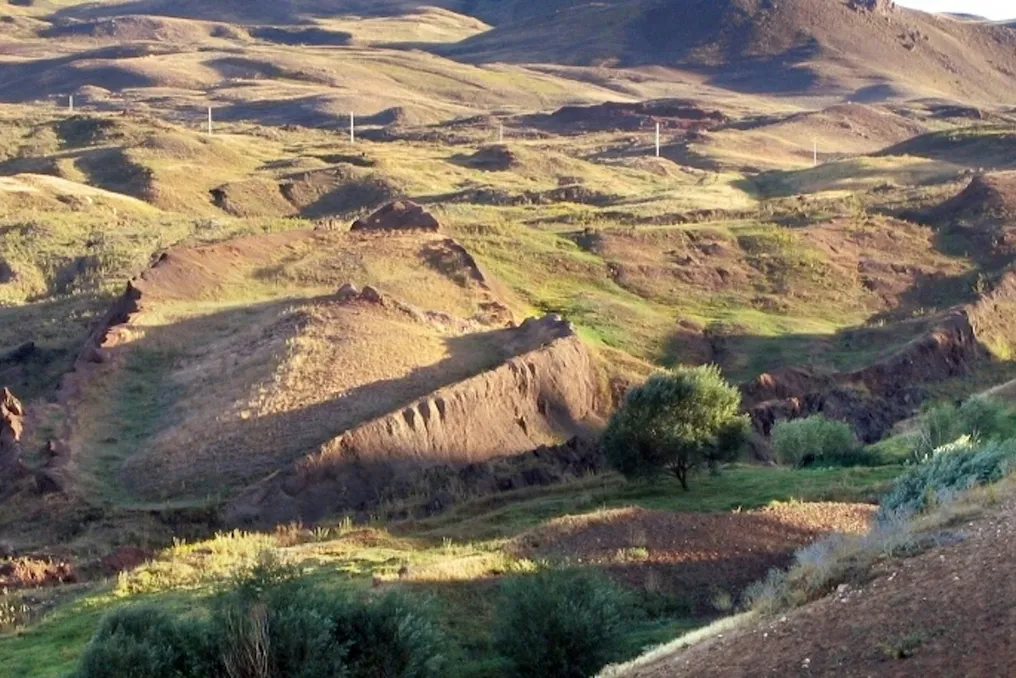
A team of scientists from Cumhuriyet University of Sivas, Turkey, is examining an old claim that a boat-shaped geological formation located in eastern Turkey might contain traces of Noah's Ark.
The biblical book of Genesis narrates that God decided to destroy the planet with a flood, and Noah built a large wooden ark to save his family, himself, and various animals, following divine orders.
The formation in question, named Durupınar, has been linked to Noah's Ark for about seven decades. Recently, this new research team gained attention on social media through a collaboration with Noah’s Ark Scans, a Christian organization based in the United States, which has promoted Durupınar as the resting place of Noah's Ark since at least 2021.
Durupınar is a natural geological structure, composed of sedimentary material rich in iron oxides, and is located near the city of Doğubayazıt, a few kilometers from the border with Iran.
Preliminary Discoveries and Claims
The researchers involved in the project stated that laboratory analyses are still underway. However, they described some initial findings as possibly compatible with a ship-like structure. In contrast, claims spread on social media are more emphatic, asserting that scan images have proven the formation has human origin and is '100% non-geological.'
Claims of human origin have also been reported by British and American press. A scholar of primitive Christianity, who analyzes biblical texts and their interpretations, observes that certain speculations about Durupınar have circulated for decades, offering an opportunity to analyze how people read and interpret the biblical narrative of the flood.
To understand the current claims, it is important to go back and check how this formation began to be associated with Noah's Ark. The name Durupınar derives from the Turkish Army captain, İlhan Durupınar, who noticed the boat-like shape while inspecting aerial photographs of the area in 1959.
Due to its proximity to Mount Ararat, a peak known since the Middle Ages as the resting place of Noah's Ark, according to the Genesis flood account, the question arose whether Durupınar could be the petrified remains of the ark, preserved over time in the landscape.
First Expeditions and Scientific Conclusions
The following year, Durupınar was part of an expedition funded by the United States Archaeological Research Foundation. This mission was led by George Vandeman, a television evangelist, and Arthur Brandenberger, an expert who used aerial photos to map and measure the landscape, with the clear objective of confirming if it was the petrified remains of the legendary Noah's Ark.
This event was covered in a brief article in LIFE magazine, September 5, 1960 edition. The article recorded that although one member of the expedition maintained skepticism about nature being responsible for such a shape, the research conducted 'revealed no indication that the object was of human origin,' leading the expedition to conclude that it was a natural geological formation, meaning it was not the petrified remains of the biblical Ark of Noah.
After the 1960 expedition, interest in Durupınar decreased, and the case was neglected for a period. However, the site regained public attention in the late 1970s when Ron Wyatt, an anesthesiology nurse and amateur archaeologist, visited Durupınar to investigate independently, inspired by the LIFE article.
During his stay, Wyatt conducted several tests and claimed that the formation was indeed the remains of Noah's Ark. He argued that radar readings and other scans indicated the presence of walls, decks, petrified wood, metal fittings, and other materials expected in the ruins of a wooden ship. Wyatt was also intrigued by large nearby rocks, which he claimed were used to stabilize the boat while floating.
Initially, Wyatt managed to persuade another amateur archaeologist from the US, David Fasold, that his claims were true. In 1988, Fasold published a book arguing that Durupınar was Noah's Ark. However, Fasold's fervor was short-lived; less than ten years after publication, he co-authored a scientific paper with geologist Lorence Collins, refuting his previous conclusions. After a meticulous analysis of the available evidence, Fasold concluded that 'the supposed Ark near [Doğubayazıt] is a completely natural rock formation. It could not have been Noah's Ark, nor even a man-made model.'
Specialized geologists tend to agree with the assessment of Fasold and Collins: Durupınar is a natural geological formation, not the wreckage of a wooden ship. Geologist Murat Avcı, for example, identifies the boat-shaped structure as a large block of limestone that slid down the slope in a landslide and was subsequently shaped by earth flows and other geological processes.
Geological analyses classified the material Wyatt described as petrified wood as common rock, and the items described as iron supports as weathered volcanic material. The patterns interpreted as ark compartments correspond to the natural structure and fractures of the formation, while the supposed 'anchor stones' are, in reality, composed of local volcanic rock.
Currently, all results from the most recent research project are preliminary and inconclusive, as samples await laboratory analysis, and official university statements indicate that the evaluation of the evidence will extend until 2027.
Biblical and Mythological Interpretations
As a Bible scholar, the main focus lies in the continued fascination with the narratives of the flood. Most biblical experts understand the story of the flood in Genesis as part of a much older mythological tradition of the Ancient Near East. Scribes of ancient Mesopotamia told various versions of a story where gods provoke a catastrophic flood but warn a man, who then builds a large ark to save his family and the animals.
In the Epic of Atrahasis, whose manuscripts date back to the second millennium BC, the survivor is Atrahasis. A similar version also appears in the Epic of Gilgamesh, where Utnapishtim, the survivor of the flood, builds a large vessel to withstand the storm.
Genesis does not merely replicate these ancient accounts; it reworks them. In Atrahasis, noisy humans annoy the gods, resulting in their drowning. Genesis, on the other hand, points to violence and corruption as the central problem. Furthermore, the ending of Genesis diverges: instead of imposing new restrictions on human procreation, God blesses Noah's family, commanding them to be 'fertile and multiply,' and establishes a covenant with all humanity and all living beings.
A fascinating aspect of the flood story in Genesis is that the flood does not solve the initial problem. Before the flood, humanity already tended toward evil, and after the event, the problem remains. However, the narrative, in essence, is not about the eradication of human evil, but rather about how life continues despite persistent human failings.
The current investigation into Durupınar, like previous ones, starts from the premise that behind the biblical story, there are concrete pieces of evidence awaiting discovery. This boat-shaped geological formation has kept this possibility alive for almost seventy years.
Ancient stories about the flood and their cultural transformations can offer insights into how societies interpreted catastrophes, human violence, and the possibility of a fresh start.