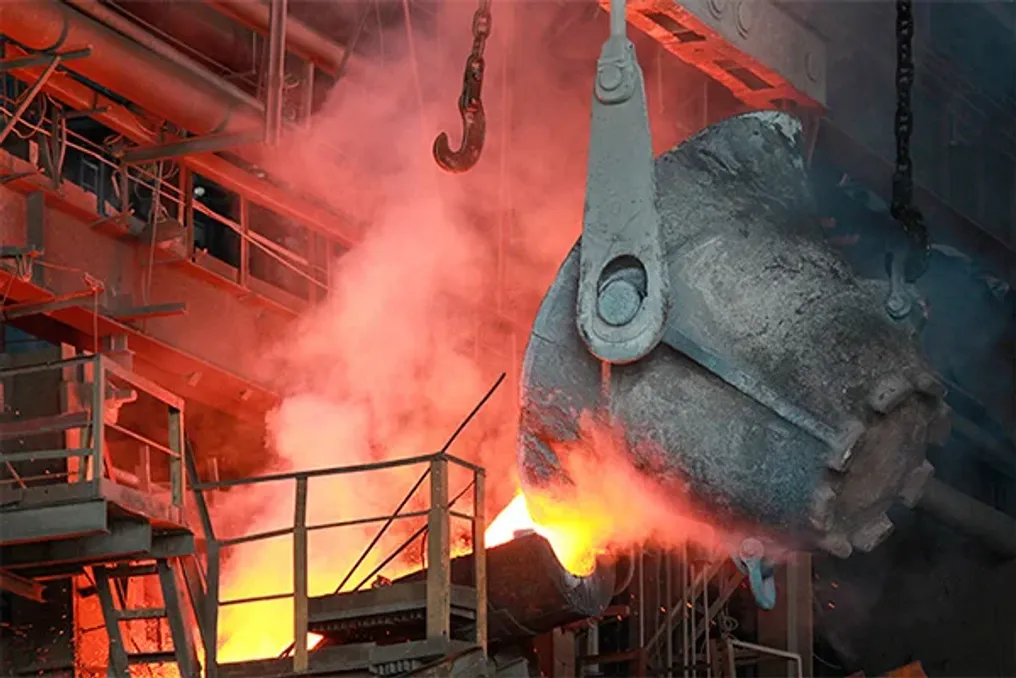
Uzbekistan's metallurgical industry grew by 7.8% in 2026
Read more
UzDaily
uzdaily.uz

Uzbekistan's metallurgical industry grew by 7.8% in 2026

According to the National Statistical Committee, from January to August 2026, Uzbekistan's metallurgical industry produced goods worth 243.6 trillion soums, representing a 7.8% increase compared to the same period last year.

The Navoi region accounted for the largest share of production, with output reaching 157.6 trillion soums. The Tashkent region was the second most significant with a figure of 62 trillion soums, and the city of Tashkent itself registered 14.5 trillion soums in metallurgical products over eight months.

Results from other regions were also noted: the Samarkand region reported output of 6.2 trillion soums. Production in the Namangan region amounted to 898.3 billion soums, and in the Syrdarya region—875.9 billion soums.

In other parts of the country, figures were significantly lower. The Jizzakh region reported 403.8 billion soums, the Fergana region—347.3 billion soums, and the Bukhara region—258.8 billion soums.

Production in the Surkhandarya region reached 145.8 billion soums, while the Karakalpakstan Republic recorded 114.5 billion soums. Among the listed regions, the lowest figures were recorded in the Andijan region (50 billion soums), Khorezm region (36.2 billion soums), and Kashkadarya region (23.8 billion soums).

The National Statistical Committee emphasized that the Navoi and Tashkent regions provided the main volume of metallurgical products in Uzbekistan during the first eight months of 2026.
Similar stories

IMF forecasts Uzbekistan's economy to grow by 7.8% in 2026
Read more
uzdaily.uz

IMF forecasts Uzbekistan's economy to grow by 7.8% in 2026

The International Monetary Fund (IMF) has forecast that Uzbekistan's economy will grow by 7.8% in 2026, which is higher than the expected 7.7% in 2025. Growth rates are projected to slow to 6.5% in 2027.

These estimates are presented in the IMF's October report, 'World Economic Outlook,' titled 'Resilience Under Pressure, Urgent Choices.' According to the IMF, inflation in Uzbekistan will continue to decline. The average annual consumer inflation rate was 8.8% in 2025 and is projected to reach 6.9% in 2026 and 5.7% in 2027.

Unemployment is also expected to decrease: from 4.8% in 2025 to 4.3% in 2026, and then to 3.8% in 2027.

However, the outlook for the external sector appears less favorable. Uzbekistan's current account deficit is projected to increase from 3.9% of GDP in 2025 to 5.1% of GDP in 2026, before narrowing to 4.6% of GDP in 2027.

Uzbekistan is expected to grow significantly faster than the average for the Caucasus and Central Asia. For this group, the IMF forecasts growth at 5.2% in 2026 and 5.0% in 2027, up from 6.2% in 2025. Average inflation in the region is forecast at 8% in 2026 and 6.7% in 2027.

Among neighboring countries, only Kyrgyzstan is forecasted to grow faster than Uzbekistan in 2026, with a figure of 9%. The IMF expects Tajikistan to grow by 7.3%, Georgia by 7.2%, Armenia by 5.5%, and Kazakhstan by 4.4%. Turkmenistan's economy is expected to expand by 2.4%, while Azerbaijan's expected growth is 1.7%.

The report notes that countries in the Caucasus and Central Asia continue to benefit from commodity prices, remittances, and ongoing reforms.

The IMF takes a much more cautious stance regarding the broader Middle East and Central Asia region. The economy of this region is projected to contract by 0.3% in 2026, before growing by 6.3% in 2027.

Compared to the April forecast, the IMF has lowered its regional growth estimate by 2.2 percentage points for 2026 and raised it by 1.7 percentage points for 2027. The Fund explains this adjustment by stating that the Strait of Hormuz remained closed longer than anticipated in the spring.

The IMF forecasts global economic growth at 3.1% in 2026 and 3.4% in 2027. For emerging markets and developing economies, it forecasts growth of 3.7% and 4.4%, respectively.

Popular