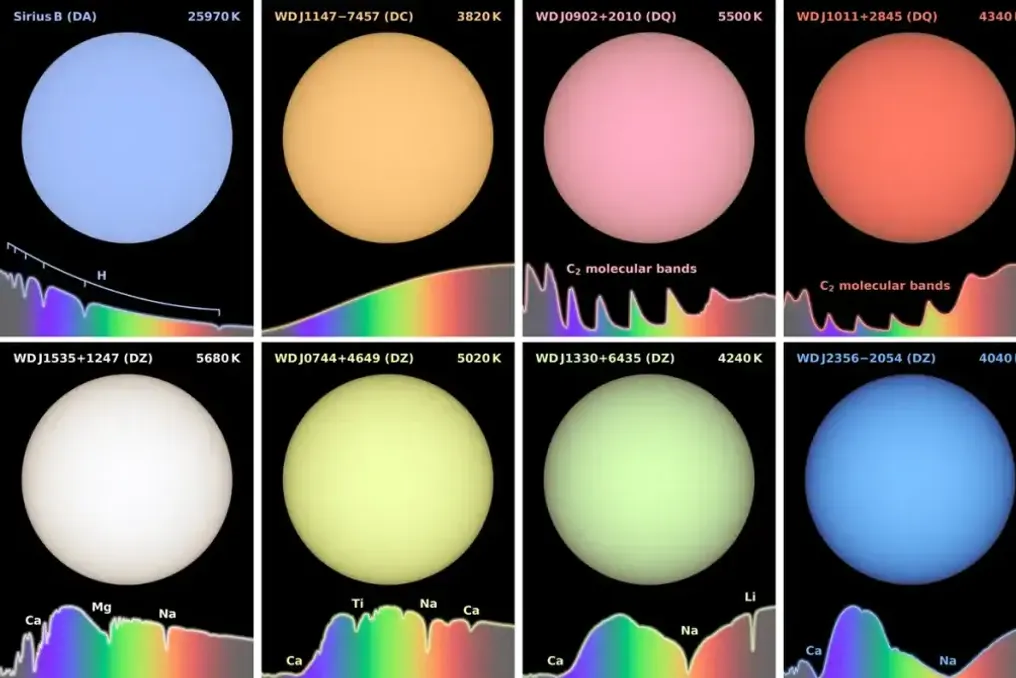
The white dwarf star WD J1330+6435, located approximately 326 light-years from Earth, is potentially the first identified green star. Its unusual hue is attributed to the presence of sodium in its atmosphere, which has been enriched by absorbing material from a planetary body.
This discovery demonstrates that stellar remnants can exhibit colors significantly different from the traditionally associated white-blue shade; the chemical composition of the atmosphere plays a key role in explaining this diversity.
White dwarfs are dense remnants of stars that have exhausted their fuel. When they cease to support their own weight, their cores collapse under gravity, forming extremely dense objects.
Temperature usually serves as the primary indicator of a star's color: the coolest have an orange tint, Sun-like stars appear white, and the hottest can take on blue tones. However, for white dwarfs, the chemical composition also influences the emitted light.
Research conducted by Mark Holland from the University of Warwick in the UK shows that elements such as carbon, calcium, and sodium are capable of absorbing different parts of the light spectrum under the extreme conditions of these objects.
Holland stated: 'We found that these incredibly dense stars can produce colors no one expected, and some of them truly surprised us.'
The atmospheric composition helps explain other shades predicted by researchers. WD J1330+6435 accumulates rocky material from a nearby planetary body. This process, called accretion, has increased the content of calcium, lithium, and sodium in its atmosphere.
Sodium is responsible for the unusual coloration. According to the team's model, this element absorbs part of the orange light spectrum, allowing the green glow to stand out.
Holland explained: 'The sodium residue in the atmosphere of this white dwarf star absorbs the orange part of the spectrum, leaving a ghostly green luminescence.' He added: 'Imagine you are on a planet looking up and seeing a green star. It's like something out of science fiction.'
Researchers also discovered another unusually colored star—WD J1011+2845, located 48 light-years from Earth. Its pinkish-peach glow is linked to a deep convection zone that transports carbon from the interior to the outer layers, altering the light emitted by the element's molecules.
Despite these hues, white remains the predominant color. Of 151 white dwarf stars located approximately 65 light-years from Earth, only five have demonstrated extraordinary colors. Based on analysis, scientists suggest that about one in every 30 white dwarfs has an unusual color.
Boris Gansik from the Department of Physics at the University of Warwick noted: 'One in thirty may seem like a small proportion, but considering the entire population of white dwarfs in the universe, it still represents many stars with unusual colors.'
The findings indicate that the chemical composition of these stellar remnants is capable of altering their appearance in ways that go beyond predictions based solely on temperature.