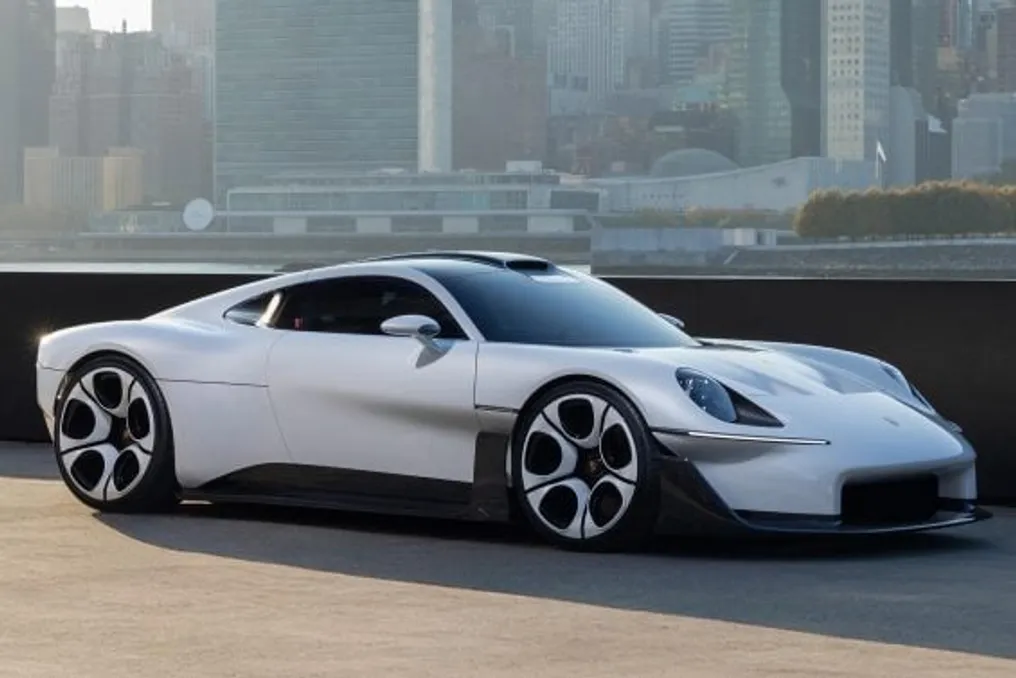
Porsche will introduce, for the first time, a fixed supercar model in its catalog, positioned above the 911. This new plan was presented through the Mission S, a prototype displayed this Thursday, the 15th, in New York, an event that also served to preview the look of the manufacturer's future vehicles.
Previously, Porsche supercars, including the 959, Carrera GT, and 918 Spyder, were produced in limited editions. The 918, for example, had its production ended in 2015, totaling 918 units.
Michael Leiters, Porsche's president since January and former technical director of Ferrari, explained that the Mission S was not conceived merely as an exclusive hypercar, but rather as a mid-engine platform intended to permanently expand the brand's portfolio.
Although the brand has not yet disclosed the vehicle's engine, sources from the website Carscoops indicate that Porsche is developing an eight-cylinder boxer engine for this future top-of-the-line model.
The global presentation of the prototype took place on a pier in Queens, New York, a location that was once the scene of the first photographs of the 550 Spyder in 1953.
The Mission S design project references Porsche icons. The round headlights and torpedo-shaped fenders evoke the 911, while the door joining lines connecting to the lights pay homage to the G-series 911, produced between the 1970s and 1980s. The flat front end and the 'car within a car' rear configuration are inspired by the competition 911 GT1, and the roofline refers to the 959.
The wheels were redesigned based on the 928 telephone disc pattern, with a renewed focus on lightness. Additionally, a visible fan in the center of the body mimics that of the 917 radiator, the prototype responsible for Porsche's first overall victory at the 24 Hours of Le Mans in 1970.
In the interior, Porsche opted to move away from the trend of large digital screens. The prototype eliminates both the fixed central screen and the passenger display. In its place, a retractable mount for cell phones compatible with MagSafe was installed, allowing the user to use the device to obtain information and navigate.
Next to the steering wheel, there are five circular gauges, following the style of the 911. Depending on the selected driving mode, the central tachometer, which has an analog pointer and screen, moves closer to the driver, while the other indicators remain arranged side-by-side or one behind the other. Through the My Porsche app, it is possible to select gauge patterns inspired by older models.
Other notable features include the seatbelt buckle integrated into the center console, push-and-pull physical controls, and an updated version of the Sport Chrono timer. The key, specifically designed for the vehicle, fits to the left of the steering wheel, maintaining Porsche's tradition.
The interior color palette combines white, gray, and red, colors used in the brand's racing cars. Tobias Sühlmann, Porsche's head of design, stated that these solutions will soon be implemented in the company's upcoming models.