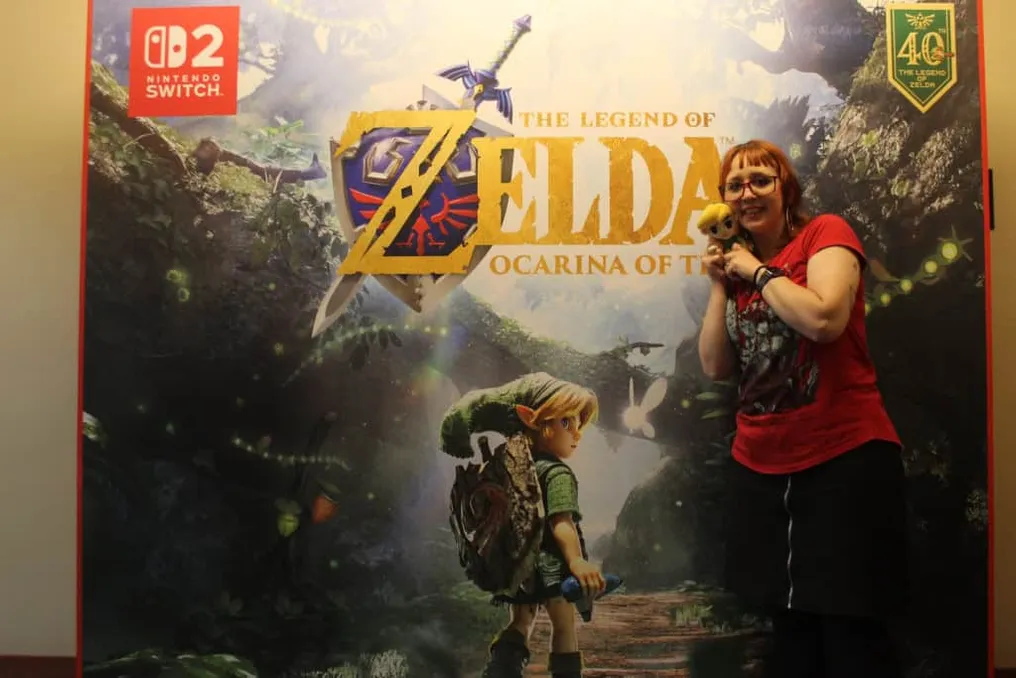
The remake of The Legend of Zelda: Ocarina of Time will be released for the Nintendo Switch 2 on November 5, 2026. While it maintains the structure of the original 1998 title, it features changes in visualization and gameplay. After playing for approximately 90 minutes, the first impression is that the game does not appear dated or outdated. For those new to Ocarina of Time, the difficulty level was considered high.
The author of the text, who had never played Ocarina of Time but had played Zelda II: The Adventure of Link on the NES, discusses the experience without resorting to nostalgia and avoids spoilers, including those that might not surprise experienced players. Comparisons with the original version were made based on reports from colleagues who tested the same demo.
Olhar Digital invited the author to experience this firsthand, which led him to Mexico along with other influencers and press members. During the session, three distinct sections were played, selected to showcase various mechanics, items, and moments. Initially, the gameplay started in the Kokiri Forest, followed by an exploration of Hyrule Field and Castle Town, culminating in the Forest Temple, where the player reported facing difficulties.
Originally released for the Nintendo 64 in 1998, Ocarina of Time received its first remake on the Nintendo 3DS in 2011. The new version of Zelda: Ocarina of Time is exclusive to the Switch 2 and coincides with the franchise's 40th anniversary.
In Brazil, the digital version of the game is available on the official Nintendo store for R$ 329.90 and has an approximate size of 27 GB. It can be played in TV, semi-portable, or handheld modes, and already comes with audio and texts in Brazilian Portuguese.
Users familiar with other Nintendo releases, such as Mario Kart World, know that the Switch 2 has robust processing power. In the case of Zelda, this is reflected in the excellent graphical quality. Colleagues who know the original stated that the character details are faithful to the 1998 version, but with an addition of modernity.
When playing on TV, the cinematic scenes (cutscenes) presented fluidity and charm. The most striking aspect was the integration between the graphic art, the soundtrack, and the Portuguese dubbing, creating deep immersion. In one specific scene, the Great Tree Deko asks Navi to find Link, allowing one to feel the weight of Deko's voice, the fairy's urgency, and the atmosphere of anticipation.
Although a trailer has already revealed more details about the scenery and crisp outfits running at 60 FPS, Nintendo has not provided official resolution or frame rate numbers, and the Brazilian store page also does not display such data. In TV mode, the player observed fluid movement and scenes.
Link's controls are relatively simple, encompassing running, jumping, and aiming using the gyroscope for projectile weapons, such as the slingshot. Original players will notice the inclusion of a jump button, as Link previously jumped automatically on edges, in addition to the implementation of free camera. These two modifications were communicated by Nintendo.
The combat system has a strong visual and auditory impact. It is possible to ask Navi for help in various situations, at which point she points out monster weaknesses. Colleagues who know the original commented that Navi is less intrusive than in the 1998 version, a useful feature to prevent freezes. The player advised using this assistance.
The experience was conducted with the Pro Controller, although it was mentioned that the Joy-Con should also offer a good experience. The full report on handheld mode will be presented later.
The first stage consisted of the tutorial in the Kokiri Forest. Link needs to collect initial items to locate the Great Tree Deko and begin the journey. Mido prevents Link from advancing until he has a sword and shield. For those who already know the game, this segment is a direct path to challenges.
Due to time constraints, the player hesitated to explore excessively, prioritizing objectivity and not talking to all the villagers, since the tutorial already served to learn basic movements.
After the tree, Link is directed to his adventure in the forest. Here, the player found the first carnivorous plants and was startled by giant spiders descending from the cave ceiling. In addition to other initial items, the most crucial was finding the slingshot.
A warning was issued to people with arachnophobia: this phase contains many spiders. The player managed to control themselves, despite not looking for options to change this aspect, due to the fantastic nature of the creatures.
Hyrule Field offered a moment of exploration, but it was brief due to the time available. The field is extensive, and the player's focus was more on Hyrule Castle Town than on the field itself.
The town was described as beautiful, with people interacting and details reminiscent of films. The player visited some shops, dedicating himself mainly to the insect shop mission.
The final section was the Forest Temple. This dungeon contains multiple rooms, each requiring the solving of a puzzle to progress. There were four doors, and the player managed to solve one and a half.
The puzzles are considered challenging and engaging, covering area block movement, hitting strategic spots, collecting minor keys, and navigating corridors, characteristic of a traditional dungeon. This is why the game demonstrated it aged well, reviving the challenge of old titles.
In personal opinion, the use of the ocarina constitutes the most captivating challenge. The player can play for the console, whisper, or use a musical instrument. The Switch 2 microphone captures the sound, identifies the melody, and makes Link play it in the game. Nintendo confirmed that the songs learned by Link in the remake work, keeping the control buttons available. This functionality was demonstrated by producer Eiji Aonuma in a Nintendo Direct, and the author believes it makes the game more dynamic, facilitating the pace for those who struggle with controls.
Official ocarinas are planned for this year, including an electric model from HORI.
The Portuguese dubbing was praised for being very well adapted and accessible, highlighting Nintendo's team's care for localization. Details such as iconic phrases, spellings, and adapted names contribute to immersion and ease of understanding. Nintendo Brazil confirmed the presence of Brazilian Portuguese text and dubbing since launch.
The announced cast includes Flávia Narciso (Navi), Sicília Vidal (Saria), Bianca Lua (Zelda and Sheik), Junior Nanneti (Darunia), Mayara Stefane (Ruto), Fábio Azevedo (Ganondorf), and Fernanda Keller (Impa). Link remains without dialogue. Voices of other iconic characters yet to be announced are expected.
Colleagues who know the original noted that the structure underwent few changes. However, for those who already have experience, the remake offers more than just enhanced graphics and PT-BR localization.
For those experiencing the adventure for the first time, like the author, the Zelda: Ocarina of Time remake does not appear obsolete or irrelevant in the current context. This is due not only to its fantastic nature but also to generational changes. The game incorporates old puzzle mechanics, such as pushing blocks, jumping in specific places, and rhythms with the ocarina; unlike more modern games, it does not constantly require repetitive actions. It is fun and enjoyable to play, promising many hours of exploration and enjoyment.
