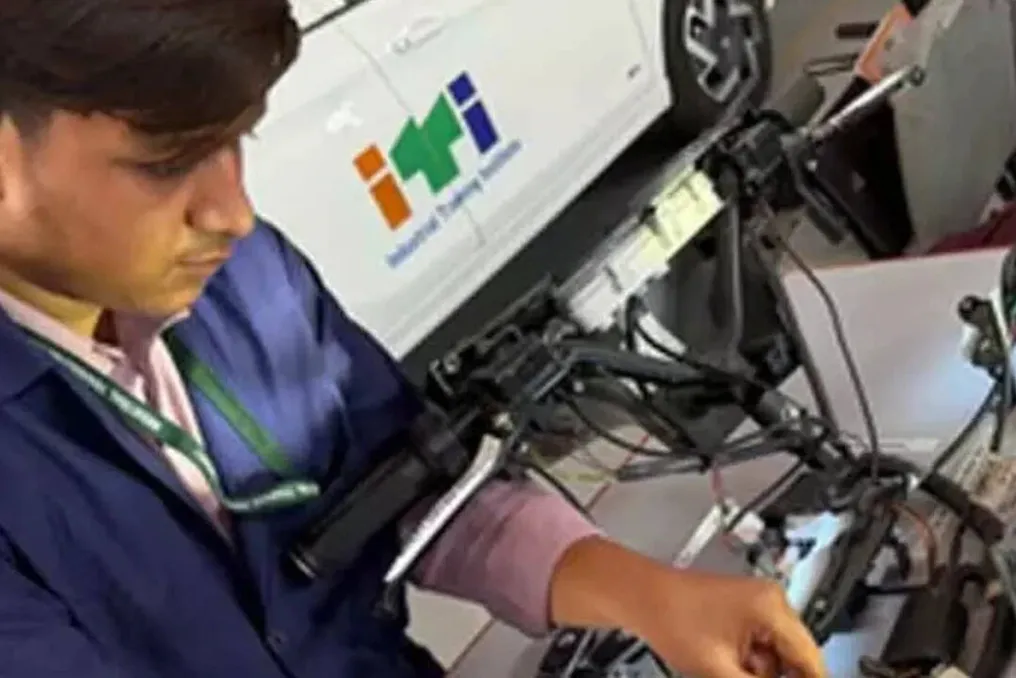
The central government has approved an investment of 1,194.92 crore rupees for the modernization of five Industrial Training Institute (ITI) clusters located in the states of Maharashtra, Odisha, and Jammu and Kashmir. This decision increases the total amount of investments approved under the PM-SETU scheme to 3,687 crore rupees.
Similar stories

NuSynth Technologies raises ₹36.5 million in seed round with participation from Avaana Capital and Shastra VC
NuSynth Technologies, a joint platform focused on research and development for innovations in complex chemistry, has successfully raised ₹36.5 crore (equivalent to approximately $4 million) in seed funding. This round was co-led by the funds Avaana Capital and Shastra VC.
The capital raised will be used to develop NuSynth's R&D and technological capabilities, build an initial portfolio of patented processes, scale up capacity, and strengthen the company's team.
Despite significant growth in chemical manufacturing, India continues to rely on complex multi-step synthetic routes for many critical molecules. This leads to increased costs for raw materials and energy, dependence on imported intermediates and hazardous reagents, and creates difficulties in commercial scaling. This situation opens opportunities for deepening domestic R&D and building indigenous innovation capabilities in chemical processes.
NuSynth addresses this problem by redesigning chemical processes from scratch, rather than making minor adjustments. The company re-evaluates starting materials, reaction pathways, and process economics to develop synthetic routes that improve cost efficiency, product yield, cycle time, safety, sustainability, and scalability.
Experimental data feeds into NuSynth's artificial intelligence mechanism, forming its own knowledge base. This accelerates the selection of future molecules, experimentation, and commercial scaling, thereby shortening traditional R&D cycles.
Starting with high-yield sectors such as pharmaceuticals and electronic chemicals, the company is gradually expanding its process innovation capabilities across numerous chemistry-related sectors.
According to Poorvank Purohit, Co-founder and CEO of NuSynth Technologies, 'We believe the next chapter will be defined by our ability to innovate in the underlying chemistry itself. Our goal is to create patented processes in India that can provide superior economics and sustainability while serving global market customers.'
The founders of NuSynth bring expertise in scientific research and development, commercialization, and business building. Poorvank Purohit, former CFO and CEO of Solara Active Pharma Sciences, brings industry experience and connections with global clients. Dr. Ramesh A R, a postdoctoral researcher at NIH, Washington, and an IISc graduate, provides scientific and research expertise.
Abhishek Deo and Dipak Bajaj possess commercial and operational experience from Zetwerk, Mstack, Ola, JPMorgan, BlackBuck, and SUN Mobility. Their team has led numerous projects from idea to scale, including companies that have achieved unicorn and public market status.
Shruti Srivastava, Partner at Avaana Capital, noted: 'We believe NuSynth's approach will improve the economics, resource efficiency, and sustainability of chemical manufacturing in critical sectors, while simultaneously creating globally competitive technology platforms from India.'
Avijeet Alaghati, Managing Partner at Shastra VC, emphasized that the NuSynth founders have assembled a rare combination of scientific depth, industry experience, and execution capability. He added: 'We believe this combination, along with the data and AI mechanism, strongly positions NuSynth to create a differentiated process innovation platform from India for global markets.'

IT Sector Forecast for Q2: Moderate Growth and Stable Margins Expected Amid AI Influence
Research firm UnearthInsight forecasts that the top five IT companies will show quarter-over-quarter growth of 0.5–1 percentage point in the second quarter of fiscal year 27, which will not be the best performance compared to the April-June period.
Analysts note that leading Indian IT companies are likely to report moderate revenue increases and generally stable margins in July-September, as clients maintain tight control over discretionary budgets. The main focus is on the speed of converting strong leads into actual revenue and the degree of demand reduction for traditional services due to artificial intelligence.
Gaurav Vasu, CEO and founder of UnearthInsight, stated that 'the second quarter will not be better than the first, as we do not see a revival in client budgets or spending. Discretionary spending remains stalled amid geopolitical tensions, and decision-making cycles also remain lengthy.'
Gartner assesses this quarter as 'somewhat stronger' compared to the previous one, explaining that previously approved contracts are beginning to generate revenue. However, according to Gartner, market conditions remain largely unchanged, with cautious discretionary spending and a constant focus on performance results influencing purchasing decisions.
Gartner Senior Analyst Bishwajit Maiti noted that, based on current market trends, growth among leading IT service providers is expected to remain modest. Vasu added that while deals will remain strong, their conversion into revenue will take longer, and decision-making cycles, he predicts, will remain long for the next 12–18 months.
The Q2 earnings season will begin with Tata Consultancy Services (TCS) on October 8, followed by HCLTech on October 12, and Infosys will present its results on October 23.
Vasu does not expect major changes in the FY27 forecasts, although some companies may raise the upper bound by about 0.5 percent. UnearthInsight maintains its full-year growth forecast for leading firms at 3–4 percent, indicating that most of this growth will be driven by inorganic growth rather than increased demand. He also reported that during FY27, the technology services industry spent $3.6 billion on 14 mergers and acquisitions.
Regarding margins, Vasu warned that they will remain under pressure. Recent wage increases have been accounted for, and investments in AI platforms and partnerships must now be included in deals to close them. Furthermore, efficiency gains from AI are being passed on to clients. He emphasized that 'true margin support will come from selling applications and platforms, not just services.'
UnearthInsight expects a slight margin improvement for individual top-tier players such as TCS, Infosys, and HCLTech, while mid-tier firms will maintain current margins, absorbing M&A integration costs.
Gartner forecasts that margins will remain generally stable, with limited potential for expansion. The company notes that productivity gains from automation and improved resource utilization are offset by AI investments, wage inflation for in-demand skills, and customer demands for price reductions. Maiti stated that customer technology spending remains cautious, as organizations continue to prioritize initiatives that deliver measurable business results, cost optimization, and risk reduction.
He added that 'most organizations remain selective in their investment decisions, focusing on projects with clear ROI, productivity gains, and operational resilience. Demand continues to be stimulated by AI, cybersecurity, and modernization initiatives, while discretionary transformation programs remain subject to stricter budget controls and longer approval cycles. Consequently, spending is gradually improving, but the overall demand environment remains disciplined, not fully recovered.'
Vasu noted that the banking sector is under pressure, while retail and manufacturing are strained due to the lack of inflation reduction. He named the US as the weakest market. He suggested that Europe will grow through cost optimization deals, the Asia-Pacific region will grow faster, and the Middle East will slow down significantly due to the war.
Gartner sees the strongest demand in the BFSI, healthcare, manufacturing, and telecommunications sectors, while retail, oil, and gas show relatively weaker results. The company believes the US remains the strongest market, supported by investments in AI, cloud technologies, and digital transformation. Europe maintains resilience thanks to spending related to regulation, security, and sovereignty.
Regarding the impact of AI on overall revenue, Vasu reported that AI-driven revenue remained below 5 percent of the total industry volume. He added that the growing share of client budgets in the US and Europe is directed towards native AI platforms and startups. He also mentioned that software vendors like SAP and Oracle are selling more products with built-in AI, reducing the need for traditional services.
Gartner forecasts that generative and agentic AI are beginning to 'significantly reduce' demand for labor-based services, especially in managed services and service support functions. According to Gartner estimates, up to 50 percent of opportunities in traditional managed services will become difficult for existing providers by 2030.
Companies have started disclosing AI revenue data. In June, Infosys reported that AI-related revenue was 8.2 percent of total revenue, and TCS reported an annual AI revenue of $2.6 billion.
Vasu believes that mid-tier firms will continue to outperform larger companies, although their growth will also slow down. He noted that acquisitions by companies like Coforge and Persistent will impact growth. UnearthInsight expects a slight recovery in FY28, with growth around 6 percent.