The creative process, which previously required significant time and resources—from clipping and music selection to adding subtitles and dubbing into other languages—can now be automated. For young creators with big ideas but limited funds, turning these ideas into quality video content presents a serious challenge.
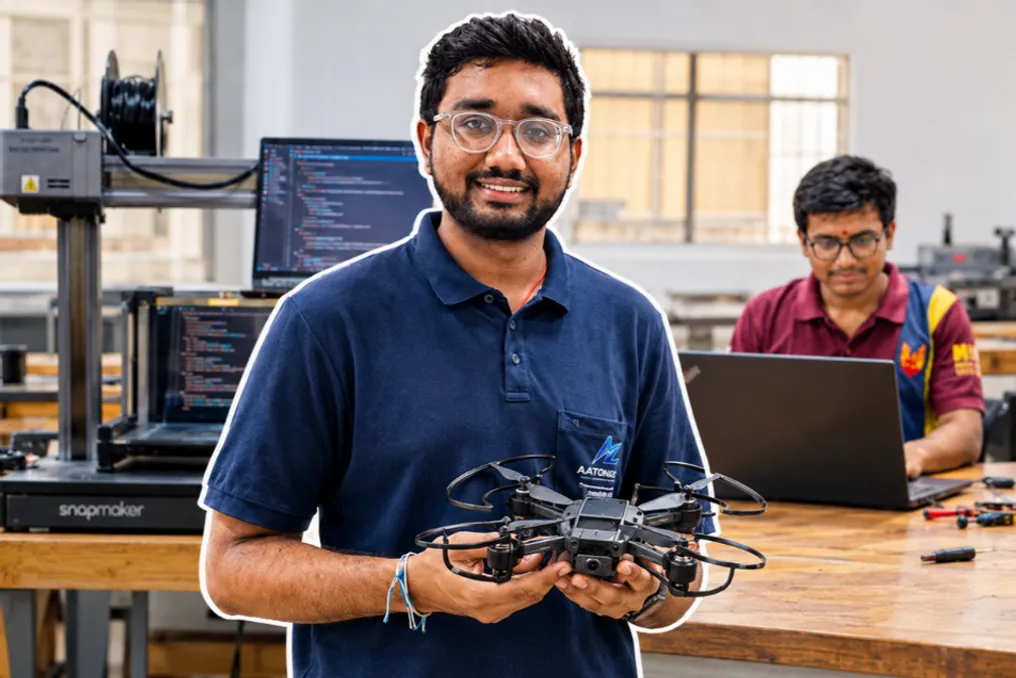
However, it has become possible to use voice commands to control a drone, delegate material editing to AI, and perform dubbing into another language. This is what 21-year-old Kosinepalli Arjun Sai from Tirupati is working on.
Arjun, a graduate of Mohan Babu University in Artificial Intelligence and Machine Learning, founded the startup AatonovaZ Technologies Pvt Ltd. This company develops AI-based tools designed to simplify the creation, editing, and localization of videos for creators, especially those working independently.
The initial idea arose after Arjun wanted to watch the film 'Swades' dubbed in Telugu but encountered difficulties finding such a version. He noted that he does not fully understand native Hindi and discovered that without a dubbing studio and large expenses, finding the desired version was impossible. This led to the creation of JusDub—an AI-powered multilingual dubbing tool that became part of AatonovaZ.
Digging deeper into this problem, Arjun realized that dubbing was only part of a more complex process. He observed that creators have to use many different programs for shooting, editing, audio generation, and subsequent translation or dubbing. Arjun believed that a more seamless approach was necessary, where the entire ecosystem handles all steps based on user command.
One Company, Three Tools for Video Creation
Unlike standalone applications for editing or generative AI, AatonovaZ integrates various technologies into a single workflow. Currently, the startup focuses on three main products:
GarudaOne
: An intelligent drone capable of shooting videos based on simple voice commands, such as 'follow me' or 'shoot a 360-degree shot'.Editra
: An AI-based video editor that compiles raw footage, adds music and transitions, preparing the edited video.JusDub
: An AI dubbing tool that translates videos into different languages while attempting to preserve the speaker's emotional tone.
These tools aim to integrate tasks typically performed by operators, editors, sound engineers, and voice actors into one connected system. The company calls this approach a 'cyber-physical ecosystem,' meaning the combination of physical devices and AI-based software to function as a whole.
Arjun explains that most modern AI systems exist only on laptops or in data centers, whereas his drone is a physical AI system that makes decisions, avoids obstacles, understands commands, and interacts with cloud software.
Drone That Takes Commands in Hindi and Telugu
GarudaOne is perhaps the most futuristic product of AatonovaZ. Instead of manually controlling the drone via joysticks or complex flight settings, the system is configured to respond to natural voice instructions. The creator, using a microphone, can give commands like 'fly around me' or 'take a 360-degree shot,' and the drone automatically plans the trajectory, avoids obstacles, and captures the footage.
A special advantage of the drone, according to Arjun, is its multilingual compatibility. It can be controlled in Indian languages, including Hindi and Telugu, and understands what needs to be done. Behind the scenes, AI helps the drone interpret commands, calculate routes, bypass obstacles, and exchange data with other connected programs.
However, creating such a system proved to be a difficult task. Arjun admits that the main difficulty is engineering. While talking about AI capabilities is easy, running powerful AI models on compact hardware like a drone is one of the most challenging problems they are solving.
An Hour of Footage Edited in 20 Minutes?
If GarudaOne handles the production stage, Editra manages post-production. While many modern AI editing tools only offer suggestions for clips, Editra aims to do more. Arjun describes it as a system capable of understanding context, organizing material, generating background music, and preparing a draft with minimal human intervention.
The team believes that one of the useful features for creators is AI-generated, royalty-free music. Arjun emphasizes that sound is critical for engagement, and automatic music generation allows creators to avoid copyright issues.
According to Arjun's estimates, editing a typical one-hour recording using Editra can take only 10 to 20 minutes, depending on the video length and user preferences. If desired, creators can add human control to achieve a specific editing style.
Can AI Dubbing Preserve Emotion in Words?
Even after editing, there remains the task for creators aiming to reach a multi-lingual audience. This is a problem Arjun personally recognized when he could not find 'Swades' in Telugu. This prompted him to create JusDub, his first product. The platform solves a problem faced by millions of Indian creators: creating content in multiple languages without losing emotional authenticity.
Traditional text-to-speech systems can produce fluent speech but often fail to retain emotional expression. Arjun notes that 'the missing element was emotion'; joy, excitement, or sadness in one language is often lost when translated into another.
JusDub is designed to capture emotions in the original recording and adjust the voice, pace, and tone in the dubbed version to match the source. For example, for a creator filming in Telugu, the goal is for the Hindi viewer to feel the same degree of excitement, humor, or sadness. In a country with many languages, this can help creators share content with a wider audience without high costs for dubbing studios.
Mentors Who Helped Turn Ideas into a Startup
When Arjun began working on solutions for shooting, editing, and dubbing, he had numerous ideas. However, deciding which ones to develop and how to turn them into working products presented a separate complexity. His mentors played a crucial role here, helping to narrow the focus and concentrate on the goal.
Yudhisth Jain, who oversees student entrepreneurs within the university's incubation ecosystem, noted that Arjun's strength lies in his deep understanding of the problem before starting to develop solutions. In his opinion, the team knows its product inside out, has conducted market research, and understands user sentiment. Their competitive advantage lies in technology and clarity of purpose.
Jain believes that such tools can facilitate the start of creative endeavors for a larger number of people who possess talent and ideas but struggle to enter the creator ecosystem. He emphasizes that what Arjun is building fills a significant untapped market.
For Arjun himself, mentorship was equally important. He mentioned that many founders get distracted by numerous opportunities, and his mentors constantly helped him stay within the original vision and maintain focus.
University support also opened doors for Arjun and his team, providing access to other entrepreneurs and startup programs, including introductions to NSRCEL at IIM Bangalore. These experiences helped them understand how to transform their ideas into a business.
From Campus Idea to 20 Lakhs in Funding and Global Recognition
During its development, the startup received funding and recognition. AatonovaZ attracted 20 lakhs under the Startup India Seed Fund Scheme and received support from government incubators. Furthermore, the company entered the top 25 global teams in the Samsung Solve for Tomorrow competition. AatonovaZ also won ANVESHAN 2025–26 after winning in the Southern Zone, which is a student research and innovation contest organized by the Association of Indian Universities.
Dr. Padmaja, Deputy Dean for Innovation at Mohan Babu University, believes that these achievements demonstrate the potential when students receive the right environment and support. She recalls when Arjun approached her with nearly ten raw ideas and noted that their mentorship changed the team's trajectory.
Today, AatonovaZ is in the pilot implementation and validation stage. The company has tested its vision through numerous prototypes and is working towards commercialization. The company's ambitions go beyond creating individual AI tools. Arjun compares his vision to the Apple ecosystem model, where hardware and software work together to provide a seamless experience. His ultimate goal is to create an 'iPhone for content creators.'