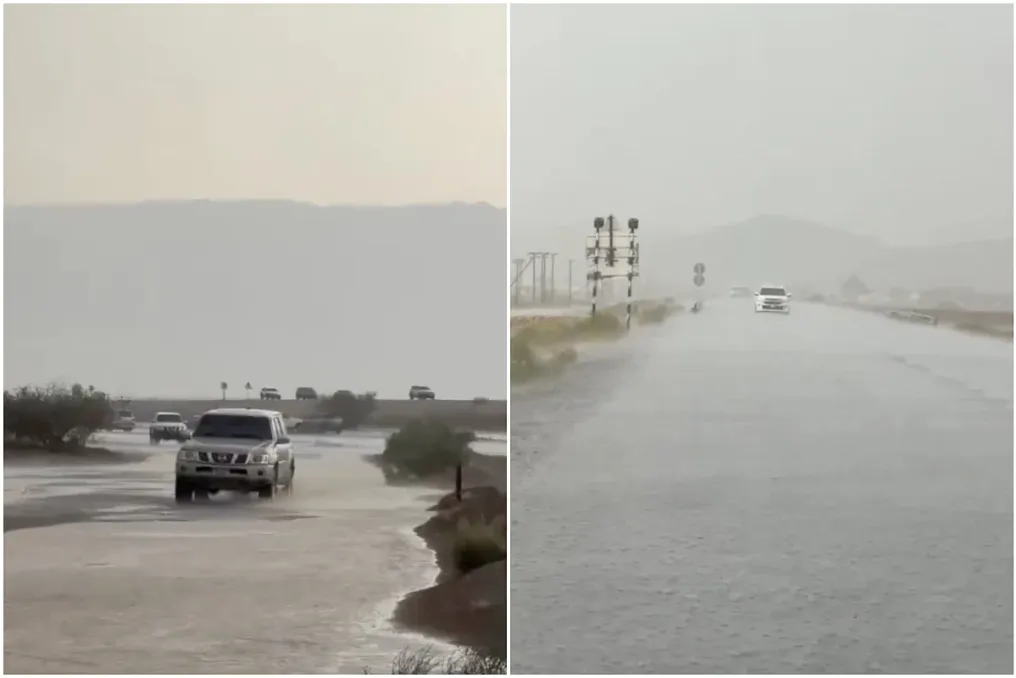
As rain-bearing clouds move deeper into the UAE this week, residents should expect not only rain but also sporadic heavy downpours, thunderstorms, and gusty winds that could affect ground conditions.
The National Center of Meteorology (NCM) warned that downdrafts from developing clouds are capable of lifting dust and sand, leading to reduced visibility, especially in open areas. Residents are also advised to exercise caution near mountainous terrain.
Meteorologist Ahmed Habib from NCM told Khaleej Times on Monday that the forming weather system could bring precipitation of varying intensity as clouds spread from the eastern and northern parts of the country to coastal areas. He specified that rain is expected from Monday until the end of the current week.
There is a possibility of convective clouds forming, which will begin to develop in the eastern and northern parts of the country before spreading to the inland areas between Al Ain, Dubai, and Abu Dhabi, and then moving towards Ad Dhafra.
Rain may reach the inland areas of Dubai, including areas near Miraf, as well as sections along the routes between Dubai and Al Ain, and between Abu Dhabi and Al Ain. Other areas where downpours may occur include Suwaeihan and parts of Ad Dhafra, including Madinat Zayed and Zayed City.
Habib explained the forecast conditions by stating that the expansion of low pressure from the Arabian Sea combined with another low-pressure system moving from the southwest brings additional moisture into the atmosphere. Atmospheric updrafts also contribute to the formation of convective clouds, which are expected to first develop in the eastern part of the UAE and then spread inland.
Precipitation may vary in intensity, and some areas may experience thunderstorms and stronger winds as these clouds develop. Fresh winds are also possible due to downdrafts from these clouds, which could potentially cause dust and sand to be lifted and visibility to worsen, especially in open territories.
NCM advised residents to exercise caution, especially where visibility is deteriorating, and to avoid dangerous places, particularly near mountains.
Despite the expected rain in some parts of the country, no significant temperature changes are forecast in the near term. Habib noted that the same air mass will remain over the UAE, although cloud cover may cause local temperature fluctuations.
However, the country is already experiencing a gradual cooling as autumn sets in. Between the end of September and the first week of October, temperatures have dropped by approximately four to five degrees Celsius. Habib emphasized that maximum temperatures are gradually falling, and nighttime and early morning temperatures are also decreasing. Some stations in inland areas and mountains are recording temperatures of 20°C or below.
Temperatures are expected to continue to decrease slowly, although readings this year have been 'slightly above average for this time of year.' Habib stressed that this difference is not substantial.
These variable conditions are typical for the UAE autumn season. Habib added that it is currently autumn, when weather conditions can change rapidly from stable to unstable. During the day, conditions may become relatively unstable, while at night humidity tends to increase, especially in coastal areas. Fog may also form in some localized spots. These are typical signs of autumn, which is a transitional period where weather conditions can change abruptly.
An experienced forecaster reported that NCM monitors conditions around the clock using meteorological radar, satellite imagery, and data collected at its monitoring stations. He concluded that since downpours may affect various parts of the country in the coming days, 'residents should remain vigilant regarding official weather updates, especially when traveling through open areas or near mountainous terrain.'