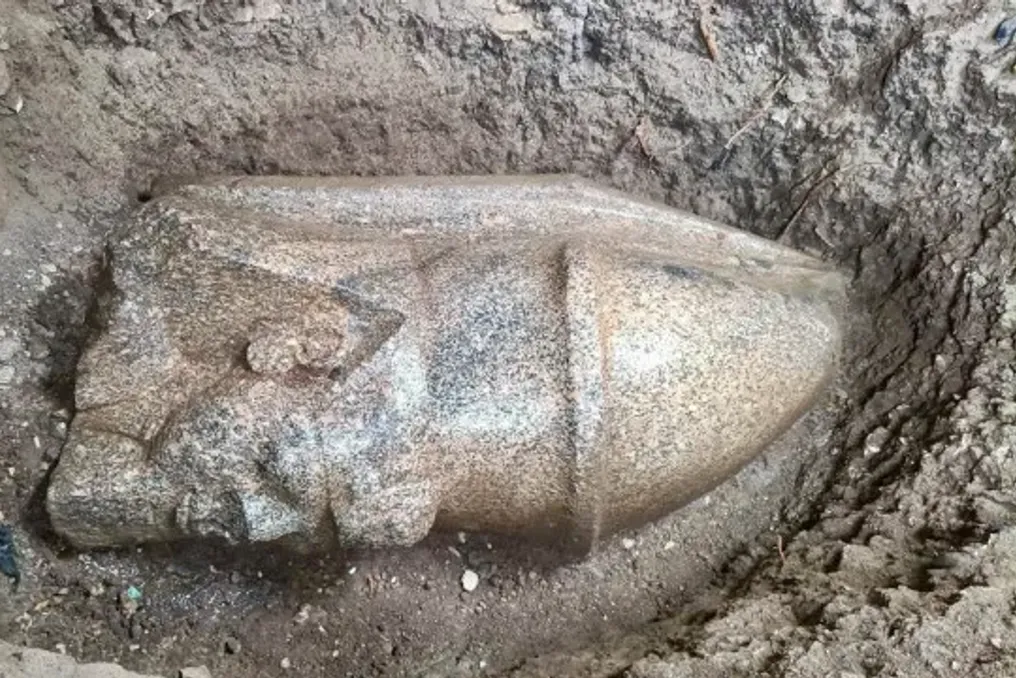
A farmer discovered two statues depicting Pharaoh Ramses II while working in the fields in the village of Behbait El-Hagar, Gharbia Governorate, Egypt.
The Egyptian Ministry of Tourism and Antiquities reported on Thursday that the find was made near the banks of the Nile River. The Ministry specified that the discovery occurred after a citizen found a block with hieroglyphic inscriptions on his property, located in front of his house in the village of Behbait El-Hagar.
The farmer immediately notified the archaeological inspection service, and specialists promptly arrived at the site for an initial assessment, which confirmed the archaeological nature of the block.
Subsequently, an archaeological commission and a specialized working group from the Supreme Council of Antiquities were formed to begin excavations in the area.
The work led to the discovery of the remains of two statues: one is a stone head about 1.6 meters high, adorned with the double crown of Ramses II, which once symbolized the unification of Upper and Lower Egypt; the other is a statue 2.4 meters high, without legs or a base. Experts believe they may belong to a much larger complex measuring 8.5 meters in height.
The Minister of Tourism and Antiquities, Sherif Fathy, expressed gratitude for this archaeological find in his statement, emphasizing that it is a significant contribution to a series of discoveries in Egypt and will help better clarify the history of the Behbait El-Hagar region, as well as its archaeological and civilizational importance.
Ramses II, one of the most famous pharaohs of the 19th Dynasty, ruled for 67 years. He was known as a great warrior and prolific builder who ordered the construction of temples throughout Egypt.