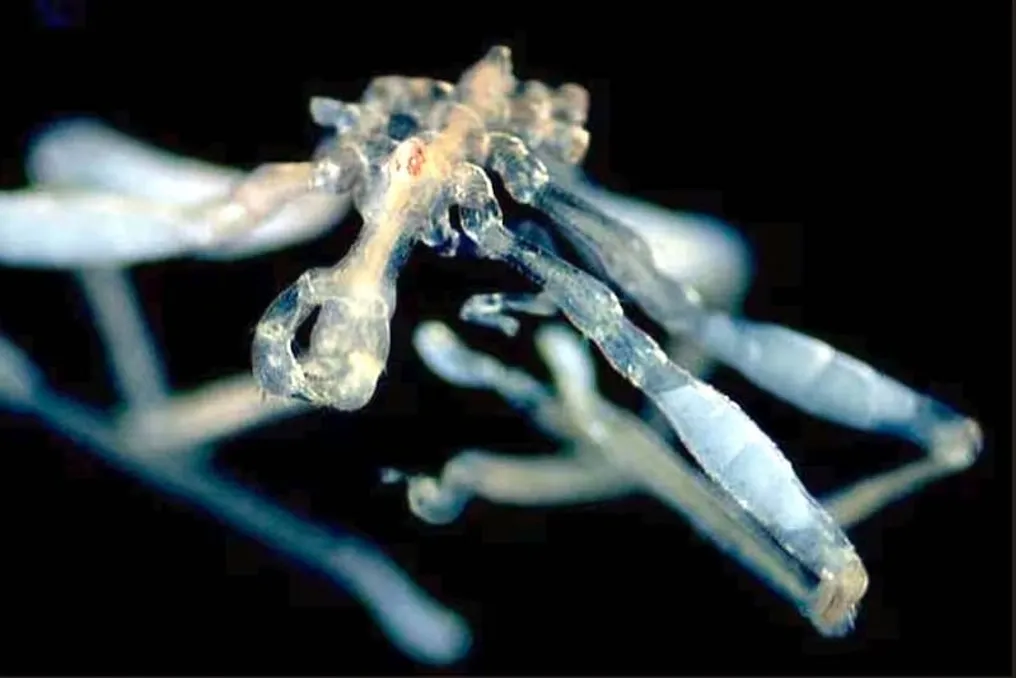
Scientists have discovered two new species of sea spiders in Salish Bay, located near Canada. These organisms were found during scuba diving expeditions between September 2023 and August 2024 at a depth of about 18 meters (approximately 59 feet). One of these new varieties has red eyes and long hair-like spines on its limbs, while the other is often covered in small parasites.
The scientists named these two species Callipallene pilosuspedes and Tanystylum kiixin. Despite structural similarities, they possess several distinct features. This discovery provides new information about small marine inhabitants, and researchers believe that many more unknown species may exist in this region.
The first species, named Callipallene pilosuspedes, is characterized by long, curved hairs resembling spines on the underside of its legs. Its body is slender, and its eyes are red. It also has a tripartite structure near its mouth. Small appendages are present on its body. A special feature of this organism is its limbs, which are not used for locomotion. Instead, they aid in cleaning the body and legs. Microscopic observation showed that the animal wraps these appendages around its legs, using tiny bristly structures to clean the limbs.
The second species, Tanystylum kiixin, has black eyes, and the posterior part of its body resembles a shell. Its appendages are small protrusions. Compared to the first species, its egg-laying organs are smaller and less mobile. Because of this, it cannot effectively clean its body. Scientists noted that small parasites frequently attach to this species' body, feeding by inhabiting another organism. The word 'kiixin' in the name of this species is related to the sound of ocean waves; it was given based on the noise from wave impacts near a former local settlement.
Despite the name, sea spiders are different from true spiders. Nevertheless, they are related to animals such as spiders, scorpions, and whip crabs. Their body consists of four parts, and they usually have eight long legs, although some species can have up to twelve legs. Many sea spiders living in shallow waters have four eyes. Their mouth is sometimes larger than their entire body. They feed by sucking juice from small marine animals with soft bodies. Inside their bodies, the organs responsible for digestion and reproduction are distributed along the limbs. Male sea spiders lay eggs on a special pair of legs and keep them with them until the young hatch.
According to scientists, Salish Bay is home to many different types of marine organisms. However, previously documented information only included 17 species of sea spiders living in shallow water. The discovery of these two new species indicates that there may be even more undiscovered organisms here. The main author of this study is Cormac Toller-Scott, who is interested in studying the impact of climate change and human activity on marine life. He noted that due to the lack of information about local residents and their lifestyle, it is difficult to understand how the environment affects them.
As the population along the coast of Salish Bay grows and construction work is actively underway, it is crucial to identify the local inhabitants. This will help scientists determine which areas of the sea require the most protection, and this discovery may contribute to a better understanding and conservation of marine organisms.