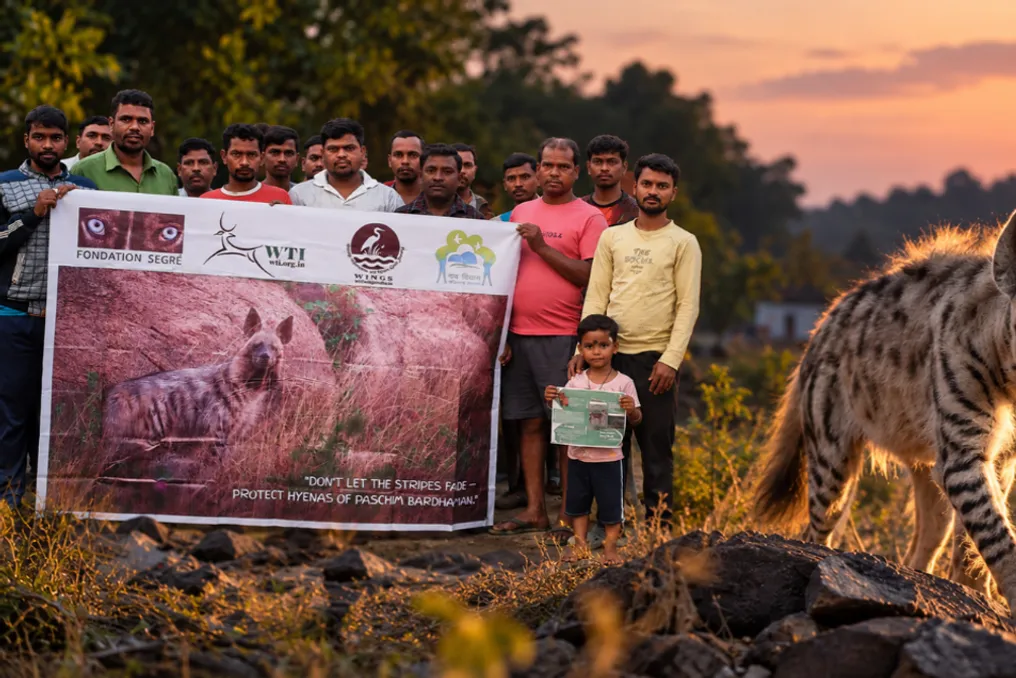
In February 2026, a resident of Kalipur village in Paschim Bardhaman district, West Bengal, was allegedly affected by a rabid dog. However, as rumors spread in the village, the story began to change: people started claiming that a striped hyena had committed the attack.
Imagine the anxiety caused by the appearance of a wild animal near a home. Upon seeing such an animal, a person might perceive it as a threat, even if it posed no danger. This is the concern observed in Kalipur: an animal that did not attack anyone became the cause of an incident related to a dog. There is a risk that rumors could lead to the hyena, simply passing through the village, being chased or harmed out of fear.
Since people rarely see or understand this habitat, such misunderstandings can have serious consequences. Nevertheless, a group of wildlife conservation specialists in West Bengal is working to change this situation, addressing each village in turn.
Dog bite, rumors, and teaching the truth
On February 19, members of the WINGS organization (Durgapur Wildlife Information and Nature Guide Society) visited Kalipur to help residents understand what happened. With support from the Wildlife Trust of India (WTI), Fondation Segré, and the West Bengal Forest Department, they conducted an awareness event for residents and students.
The team explained that the reported attack was caused by a dog. Furthermore, they introduced residents to the striped hyena—an animal that lives near them but is rarely seen. Unlike spotted hyenas often shown in nature documentaries, striped hyenas are usually solitary and most active at night. They feed mainly on animal remains, helping to clean up carcasses in the environment.
The most important lesson learned by the residents was the rules of conduct when encountering a hyena: maintain a safe distance, do not chase, do not surround, and do not attempt to harm the animal, and also report sightings to the Forest Department. The main idea was for people to know how to protect themselves without endangering the animal.
Soon, another village had a reason to apply this knowledge.
When hyenas appeared on surveillance cameras in the village
Several weeks later, surveillance cameras in Jamuria, also located in Paschim Bardhaman, recorded striped hyenas moving through streets and areas regularly used by people. This time there was no mistaken identification; the animals were indeed passing through human settlements.
However, the question arose as to why the hyenas were approaching homes? In this part of West Bengal, forests and bushes coexist with coal mines, industrial zones, roads, and villages. Hyenas move through this mosaic landscape of habitats, often at night when the likelihood of spotting them is lower.
For a person unfamiliar with this animal, seeing a hyena on the street captured on camera can cause understandable fright. Therefore, on April 14, WINGS and its partners organized another awareness event in Poniyati, Jamuria, which was attended by over 50 people. As before, the focus was on helping residents identify hyenas, understand their behavior, and react safely.
Why are we afraid of an animal we barely know?
A study published in the journal Oryx in 2026, based on interviews with 104 residents of West Bengal, helps explain the significance of this work. Researchers found that many residents are unfamiliar with striped hyenas and misunderstand their behavior. Some referred to the animal as Gaadha, a relatively harmless scavenger, while others associated it with Kuey, a ferocious creature believed to attack humans and livestock. Thus, the same animal held two completely different reputations.
Because striped hyenas are secretive and mostly nocturnal, people rarely get the chance to observe them independently. Instead, their perceptions are formed based on stories, rumors, and accidental sightings. This gap is what conservation specialists are trying to bridge.
In the Paschim Bardhaman area, the Rapid Response Project conducted 15 awareness events, reaching over 1000 people. These programs help communities realize that an encounter with a hyena does not automatically mean danger, while also providing them with practical safety advice.
Of course, knowing about an animal does not mean people should approach it or ignore the risks of wildlife encounters. It means understanding when to keep a distance, how to avoid provocation, and whom to contact for help. In Kalipur, the animal responsible for the bite was a dog. And the animals caught on camera in Jamuria were indeed hyenas. Neither of these incidents is related to a confirmed hyena attack. Nevertheless, both cases demonstrate how easily uncertainty can turn into fear, and why having the correct facts is important.
Next time a striped hyena passes by someone's house, the hope is that people will be able to identify it, maintain distance, and let it pass. Because sometimes wildlife protection starts with something as simple as understanding the animals that share our environment.