
Arish Sirkissoon's Story: From Pop Star Dreams in Durban to Becoming a Film Director
Read more
IOL
iol.co.za

Arish Sirkissoon's Story: From Pop Star Dreams in Durban to Becoming a Film Director

Before 42-year-old Arish Sirkissoon became LX Seth, before the appearance of films, premieres, awards, and the drive to build an industry around himself, there was a boy living in Durban whose desires seemed almost unrealistic to those around him. He dreamed of becoming a pop star, not just a singer.

When he openly declared his goal, people laughed. He recalls: 'I remember voicing my ambitions and telling people that I wanted to be a pop star. I was ridiculed. Many people laughed at this idea and probably decided it was an unattainable dream.'

He grew up on North Coast Road in North Durban, where almost his entire family lived. His parents, Anita and Angat Sirkissoon, had a younger daughter Aileen and a son whose imagination was far broader than the surrounding world. He noted that 'there were not many Indian celebrities or artists who were mainstream figures I could look up to.'

Bollywood offered great stars like Amitabh Bachchan and Shah Rukh Khan, but the idea of an Indian boy from Durban creating his own mainstream entertainment career was another matter.

He attended Avoca Secondary public school, which he described as 'basic in amenities but rich in quality teachers.' By the age of 21, Sirkissoon began acting on his ambitions. Instead of celebrating his birthday, he decided to use the money to register a company and start his first business—Fusion Records.

His parents agreed to let him invest in the venture, although they held a more modest celebration. He emphasized that this demonstrated his ambition even at a young age. Although his parents wished for him to pursue education, they did not hinder his creative aspirations, supporting him on the condition that he continued his studies and self-development.

After school, he earned a Bachelor of Social Sciences degree from the University of KwaZulu-Natal, followed by a Master's in Psychology through UNISA, and completed an MBA at MANCOSA. He admits that he did not formally study film; although his bachelor's included a dramatic component, he never went to film school in the traditional sense, instead studying the works of great masters like Steven Spielberg and George Lucas, as well as producers like Jerry Bruckheimer, absorbing the mechanics of filmmaking.

His stage name, LX Seth, came from a traditional tree associated with his family's ancestral home in India. He drew inspiration from the carving on the tree, turning this connection into a pseudonym. Music already occupied a significant part of his life, and he built a recording studio in a small house in Windzy near the family residence.

His sister Aileen became an unintentional participant in the process, listening to recordings while trying to fall asleep, and eventually became one of the first people whose opinion he valued. Soon, his first song, 'Off the Hook,' was signed by T-Series in India after being heard by Darham Sevraj, and then it reached Universal Music. Music videos appeared on MTV and Channel O, and singles topped the charts.

However, the music business quickly transformed due to Napster and LimeWire, which facilitated illegal music sharing, as well as digital piracy. For Sirkissoon, this change led to an unexpected path into another area of entertainment. He started with dubbing foreign films into English and composing music for them, but gradually turned his attention to storytelling, production, sound, visuals, and the entire creative process.

Film ceased to seem like an unattainable field. He aimed not just to participate in others' projects but to understand the entire process and control the presentation of his own stories, wanting to write, produce, and direct them himself because he had a very clear vision.

His interest in cinema arose even earlier when James Bond introduced him to the combination of action, comedy, suspense, and character that holds the viewer's attention. Horror also attracted him, especially the works of Wes Craven, whose films simultaneously frightened and sparked curiosity about how that fear was created. He was also interested in films like 'Scream,' 'The Blair Witch Project,' and 'I Know What You Did Last Summer,' developing an interest in psychological thrillers and horror.

His first major film project was 'Tokoloshe: The Calling,' created in 2020. He wrote, shot, composed the music, and edited the film, although he did not direct it. The film intentionally left the ending ambiguous. It became one of the early South African works on Prime Video, but its release coincided with the beginning of Covid-19, which halted the film industry. During this time, people working with him advised him to move into directing.

He followed this advice. 'The Castle' was his directorial debut in 2022, followed by the psychological thriller 'You're Next' in 2023. In 2024, 'Highway Sheila: Resurrection' was released, where he took on even greater responsibility by writing, shooting, and producing the film. It ran in theaters for eight weeks and attracted about 20,000 viewers, while two versions later released on YouTube garnered around 100,000 views, which he felt cemented him as a serious player in the industry.

By 2025, his activities expanded to documentary filmmaking with 'The Bengal Tiger: The Rajbansi Story,' which he wanted to create because he felt his hero's story deserved preservation. He also founded LX Seth Academy in collaboration with Nu Metro Cinema. Sirkissoon recognizes the small number of known Indian South African filmmakers, but the academy is not only for youth; he wants to provide opportunities for those who have long been outside the industry and are now looking for a way in, offering practical experience rather than just another diploma.

He believes that a creative person needs to diversify their brand. Filmmaking coexists with work at the academy, creating projects for others, his podcast Behind the Brand: The LX Seth Podcast, and the magazine The LX Factor Magazine. Music remains part of his work: he still writes music for his films and claims that his latest film was entirely composed and orchestrated by him. He concludes that one cannot rely on a single field of activity, and he has been doing this since the age of 14.

Perhaps this explains why, when answering the question about advice for his younger self, Sirkissoon does not list a long series of lessons or avoided regrets. His answer is simple: 'Keep moving forward.' He acknowledges that the industry has its ups and downs, but his instinct has always been to keep moving, rather than looking too long in the rearview mirror.

His ambitions have changed drastically since the boy from North Coast Road declared his desire to become a pop star. Today, he wants to be remembered as one of the great cinematographers to emerge from South Africa. He also wants to be known as someone who supported young talent. He emphasizes that you don't need to start with millions or have the biggest institution; you can start almost from scratch, keep moving, learn as you go, develop skills, surround yourself with the right people, and ultimately create something much bigger than what you started with.

A new chapter awaits: 'Highway Sheila 2' is scheduled for release on December 4th, and other projects include a documentary about businesswoman Viviane Reddy, 'Love Has No Boundaries' based on the book by dermatologist Dr. Raja Singh, and a reality show project. Off-camera, scripts, and business meetings, Sirkissoon describes himself as an introvert who feels happy in a small circle of friends. He watches horror and psychological thrillers, follows documentaries about real crimes, and has even become interested in animation again thanks to X-Men '97. Sirkissoon loves cooking, plays Fortnite on PS5, listens to music, and unsurprisingly, is still constantly brainstorming ideas and stories because 'I have always wanted to create. That is who I am.'

_
Similar stories

Architecture as an expression of Africanfuturism in folklore, cinema, and speculative art
Read more
archdaily.com.br

Architecture as an expression of Africanfuturism in folklore, cinema, and speculative art

Architecture functions as a translation mechanism, manifesting Africanfuturism across various fields, including folklore, cinema, and speculative art. In films like Pumzi, the initial narrative establishes an order to break away from ancestral memories and hopeful futures, forcing the focus onto the perpetual present of a heterotopia within the Maitu Community. The aerial representation of this community shows a sterile, drone-like structure with a centralized panoptic sphere where human behavior is medicalized. The physical arrangement is based on closed-circuit recycling systems, designed to be self-sustaining and escape a toxic terrestrial environment, collecting human waste to generate water, thus assimilating functions of nature and the State. The film's architecture faithfully translates its message.

This movement of translating an 'other place'—whether ancestral, spiritual, or speculative—into a visible or accessible form repeats itself in folklore, cinema, and art. The following analyses explore this translation, from the Kasubi Tombs to Kizazi Moto, demonstrating that this 'other place' serves as a way to interpret the present.

Folklore: A space for collective encounters

To understand how architecture translates this other place in the context of Africanfuturism, it is first necessary to decipher the records of remote eras. In the eastern region, along the shores of Lake Victoria, Kintu, considered the first man, traversed the area. According to the legend of Buganda, he was the first muganda and kabaka, bringing the fundamental elements of the region to initiate life. It is reported that he entered a forest and never returned, establishing a pattern for all kabakas: they do not die, but rather disappear and ascend to the spiritual domain. This belief is powerfully materialized in the Kasubi Tombs, where four successive kings are buried, now a site of worship and a UNESCO World Heritage site.

In the center of this extensive complex stands the Muzibu Azaala Mpanga, a monumental thatched hut. This masterpiece of Ganda architecture mimics a typical Buganda residence, using a central fig tree pillar as a structural axis. This pillar supports a circular structure of thinner poles, tied at the top to form the skeleton of an inverted basket that leans toward the ground, resulting in a domed hut when covered. The inclined circular design evokes the philosophy of a womb, representing life cycles. The wooden pillars are covered with tree bark fabric, the traditional 'linen' of the Baganda, under the supervision of artisans belonging exclusively to the Mbogo and Ngeye clans. Subsequently, it is covered with reed to demarcate sacred boundaries and with arrow grass thatch to indicate royal authority and protection.

Fifty-two concentric rings of elephant grass and palm leaves form a spiral covering that stabilizes the Muzibu Azaala Mpanga and simultaneously symbolizes the union of the Buganda clans. Thus, the clan system has both genealogical and symbolic character, tracing ancestry and having its totems as representations of identity, while the legitimacy of the kabakas is confirmed by the clans. This is also reflected in the spiral supported by the solidity of the 52 rings. The central circle, which is replaced as needed by the kabaka, is 7.5 meters high, and the robust wooden pillars covered with tree bark fabric resemble a forest, functioning as an architectural gesture that allows the kabakas to disappear into the ancestral realm at the end of their days, just as happened with Ssekabaka Kintu.

The entrance to the Muzibu Azaala Mpanga is marked by a wide, low arch, framed with woven reeds. The feeling of coolness from the vegetable materials is immediate, intensified by a deep, citrusy, and earthy aroma from wild lemongrass mats. Inside the enclosure, behind a curtain of tree bark fabric, is the kibira, accessible only to royalty and those responsible for its guard—a 'sacred inner forest' where the tombs are located, while wooden stakes rise in the open space, creating an atmosphere of dark stillness.

Kasubi thus presents itself as a model for proto-Africanfuturism. By operating as a space where ancestral past guides the path of the living community, the Tombs challenge linear temporality and establish a connection with the future through their design.

Further northeast, in Sudanese folklore, there was the belief that the Nile was guarded by ancient spirits, some benevolent and others malicious, and its profound cultural relevance echoes along the riverbanks, figuratively and literally. The soundscape of these narratives is perceptible in daily life, as the waters carry sound like a vast audio channel. This dynamic influenced the construction of buildings on its banks, the most notable example being the Al-Nilin Mosque in Ondurmã, which adorns the curve of the White Nile bank before the confluence of the waters. Its twelve octagonal pavilions, intended for teaching, are positioned closer to the riverbank, imposing and elevated, keeping the ground floor completely open for recitation, allowing the Nile to capture the sacred sounds and carry them downriver.

When architect Gamar Eldowla Abdelgadir conceived the modern structure in the 1970s—starting from his graduation project—he envisioned the hemispherical dome in a light aluminum spatial structure of the mosque as a luminous jewel. This reflects the conviction that mosques are the spiritual and cultural core of communities, as well as their centers of learning and gathering. By modeling the dome with a geodesic appearance, inspired by a precious stone and without columns, the mosque sought to mirror the strength and enduring values of these civic ideals, becoming a beacon that constantly projects its light outward. Despite being designed as a sacred place deeply connected to Islamic traditions, its facade evokes a space-age aesthetic. However, while contemporary records and media classify the Al-Nilin Mosque under the umbrella of national progress and mid-century modernism, this remarkable vision suggests a more current interpretation: it constitutes a strong case study for Africanfuturism, a concept created by writer Nnedi Okorafor, which is largely defined as a philosophy centered on African-based technological advancement in dialogue with its myths, pasts, beliefs, cultural identities, and futures.

The interior is enriched by a richly worked wooden ceiling and a series of ogival arched windows that flood the hall with natural light. Maintaining its sacred function, the geometric plasterwork and mosaics are a tribute to traditional Islamic design. This craftsmanship came to life thanks to master artisans sent courtesy of the then King of Morocco, who seem to perfectly harmonize the perceived space-age architecture with classical North African Islamic art.

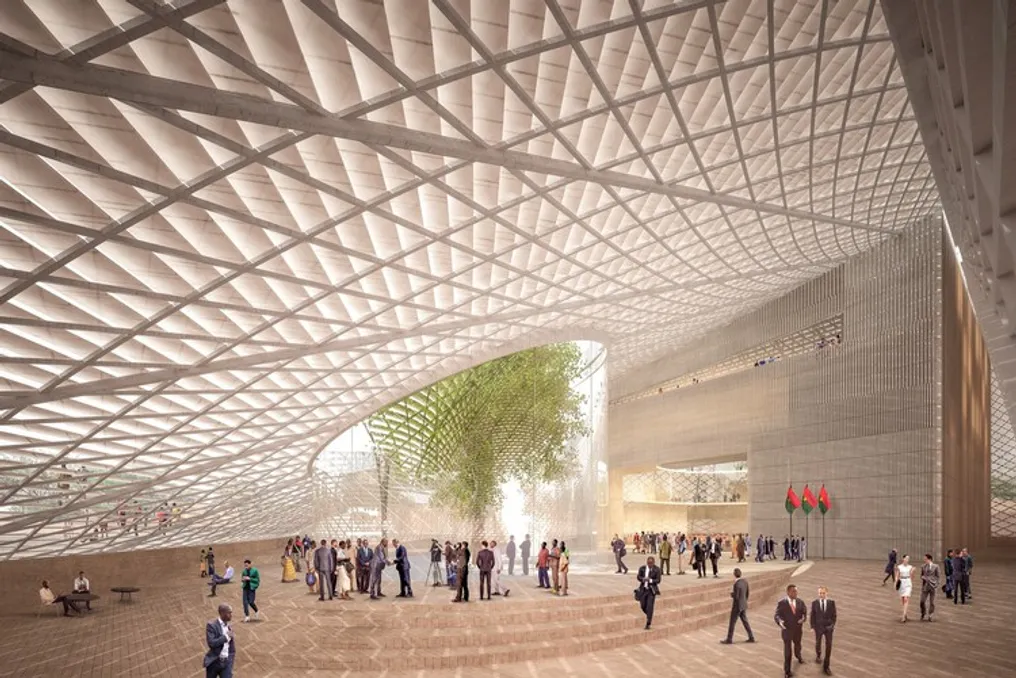
Among the most prominent examples using architecture as translation are the unbuilt design of the National Assembly of Burkina Faso and the Thomas Sankara Mausoleum (under construction), both by Francis Kéré, who won the Pritzker Prize in 2022. Both integrate Africanfuturism by combining West and Burkinabe technologies with ecologically conscious forms to drive the development of their people: the National Assembly was designed as a gigantic stepped ziggurat with integrated green terraces to inspire the community in the civic and agricultural spheres, while the Thomas Sankara Mausoleum—built to foster memory, respect, and hope—features a 34-meter dome of local laterite and clay bricks, with heliocentric skylights that illuminate the 13 concentric tombs sequentially every hour, in addition to a future 100-meter tower intended to encourage new generations to dream.

Cinematic Protopias: A Continuum

Folklore feeds on storytelling, which in turn flourishes in cinema. The film Pumzi (2009), set in a post-apocalyptic East Africa, 35 years after the Third World War (the 'Water War'), investigates how nature was completely destroyed, forcing the Maitu community to survive in subterranean, hyper-contained, hyper-functionalist, and technodystopian architectural systems that negate any ecological perspective, until a woman risks everything to regenerate the external Earth. Inside the Maitu Community, the sterile arrangement is heavily influenced by a fusion of industrial minimalism and a subtle cassette futurism, with kinetic machinery integrated directly into living spaces to force the human body to supply the building's energy grid. Ironically, although the bunker was built to escape environmental collapse, its architecture becomes an absolute prison, requiring the protagonist, Asha, to undertake a second act of escape to reconnect with the true ecological heritage of the Earth and ensure her autonomy.

A broader and sun-oriented version of this continuum can be seen in the animation anthology Kizazi Moto: Generation Fire (2023), produced by Triggerfish Animation Studio in collaboration with various creative talents and independent animation studios. Throughout its episodes, the creative teams draw direct inspiration from their regions of origin—such as the urban landscapes of Uganda, Zimbabwe, and Egypt—to depict futuristic African metropolises.

The first episode, Herderboy, directed by Ugandan filmmaker Raymond Malinga, seems to draw from the mythology of the Bachwezi and their king Ndahura, presenting a vision of a future where the ancient nomadic tradition of cattle herding is reinvented through cybernetics and high-tech enhancements. The architecture in its world also exhibits a tower inspired by the traditional ngalabi and incorporates patterns derived from traditional Ugandan basketry.

Unlike the fictional kingdom of Wakanda in Black Panther (2018)—which typically presents an insular techno-utopia with Zaha Hadid-style urban landscapes, mixing earthy tones, roundabouts, and Malian architectural landmarks—Kizazi Moto offers protopias: worlds that are not perfect, but are constantly evolving and dynamic, situated in real locations. Both works, however, share an architectural fabric that is a hybrid between advanced digital infrastructure and vernacular forms.

Speculative Fiction in Art: A Manifesto

Along the same lines, artist Olalekan Jeyifous explores, in his work Shanty Megastructures of Lagos, the contrast between Lagos' luxury real estate market and colossal vertical slums, aiming to give visibility to the disadvantaged. Additionally, his physical exhibition critically illuminates the debate, casting a long shadow over the systemic lack of basic needs, such as access to sanitation, electricity, health, and modern communications.

Similarly, artist Rayan Elnayal employs magical realism techniques to create spaces of belonging for marginalized communities. She superimposes cultural motifs onto futuristic structures to visualize fictional and calligraphic urbanisms that provide safe habitats conceived as other places, which are reflected in her Digital Sanctuaries.

Popular