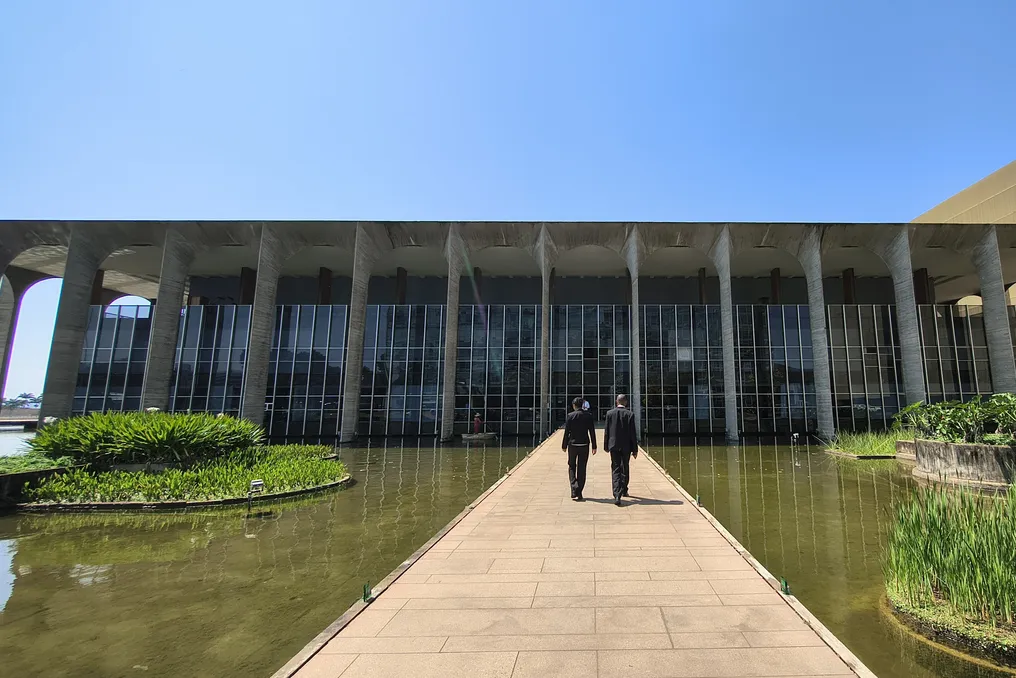
The Itamaraty Palace was conceived by Niemeyer with the ambition of projecting Brazil onto the world stage, using a three-story building that gradually reveals the country's richness to visitors. The beauties present at the location are not exclusive to diplomats, foreigners, or employees of the Ministry of Foreign Affairs (MRE); ordinary citizens also have access to the palace.
The official inauguration took place in 1970, ten years after the capital was moved to the Central Plateau. In addition to Niemeyer, the work involved the participation of engineer Joaquim Cardozo, responsible for structural calculations; Milton Ramos, creator of the helical staircase; and landscape architect Roberto Burle Marx.
The architectural result is described as almost unreal, as the palace seems suspended over the water, presenting a cube of concrete and glass that invites internal exploration.
Artistic Elements and Tour Logistics
In front of the main entrance, there is the work Meteoro (1968) by Bruno Giorgi, sculpted in Carrara marble. These pieces, totaling 50 tons, symbolize the diplomatic ties between the five global continents.
Visitors must follow the West Entrance, near the Ministry of Health. Before entering, it is mandatory to pass through security, which verifies the presence of the name in the register made through the official website. It is strictly forbidden to enter with backpacks or large bags; it is recommended to go only with the essentials due to the need for a lot of walking during the tour.
The first steps lead to one of the largest column-free halls on the planet, with 2800 m² of open space on the ground floor. In the center of this hall, the work Ponto de Encontro (Meeting Point) (1969) by Mary Vieira is the only one allowed to be touched, allowing each visitor to modify the metal piece, generating unique compositions.
Burle Marx's garden extends to the second floor, displaying flora from the Amazon, Cerrado, and Atlantic Forest, complemented by various works of art.
A focal point of the space is the Helical Staircase, which has witnessed the passage of notable figures from recent history, such as Queen Elizabeth II and Barack Obama, attracting many photographers.
On the first floor, Athos Bulcão's Lattice organizes the environment, allowing light to pass through its beams of wood painted in black, red, and yellow. In front of this lattice is the Treaty Table, made of jacaranda, where Princess Isabel signed the Golden Law on May 13, 1888.
The upper floor is reached by a blue staircase that gives the impression of floating above the ground, culminating in a level where the steps seem to disappear.
The top floor functions as a museum, filled with works. The eye is first drawn to the Revoada dos Pássaros (Flock of Birds) chandelier (1968) by Pedro Corrêa de Araújo. Despite weighing one ton, the piece in bronze, silver, and crystals appears to float. The Persian carpets also deserve attention, on which stepping is not permitted.
Artistically highlighted is the painting Independência ou Morte (Independence or Death) (1888) by Pedro Américo, in a dimension of 109 cm by 201 cm (smaller than the original in the Paulista Museum, which measures 415 cm by 760 cm). There are also other works by Alfredo Volpi, Bruno Giorgi, Lasar Segall, and Victor Brecheret.
When heading to the balcony, Brasília presents itself imposingly. Contrasting with the lightness of Itamaraty, the Palace of Justice is observed, which is robust and heavy, appearing like a dark box on the Monumental Axis.
The central garden provides relief to the environment and precedes the climax of the visit: the dining room. In this room, where international representatives are received, there is the Central Plateau Vegetation tapestry by Burle Marx, with organic shapes in shades of blue and red.
The experience ends with everyone contemplating the city, perhaps planning their next destination. The feeling conveyed is one of wanting to stay longer, exploring this almost dreamlike Brazil, as if leaving a futuristic vision.
Practical Information about the Visit
The visit to the Itamaraty Palace is free and offers the opportunity to appreciate the modernist architecture of the building. To participate, it is essential to make an appointment at least 24 hours in advance on the official website.
There are two itineraries available. The traditional one, held from Tuesday to Sunday, covers various spaces of the palace, from the ground floor to the third floor. This tour includes the Main Hall, the Aquatic Garden, and the famous Helical Staircase, as well as rooms such as the Treaties, Dom Bosco, D. Pedro I, and Portinari. The route also includes the Noble Hall and the Brasília Room.
The itinerary called