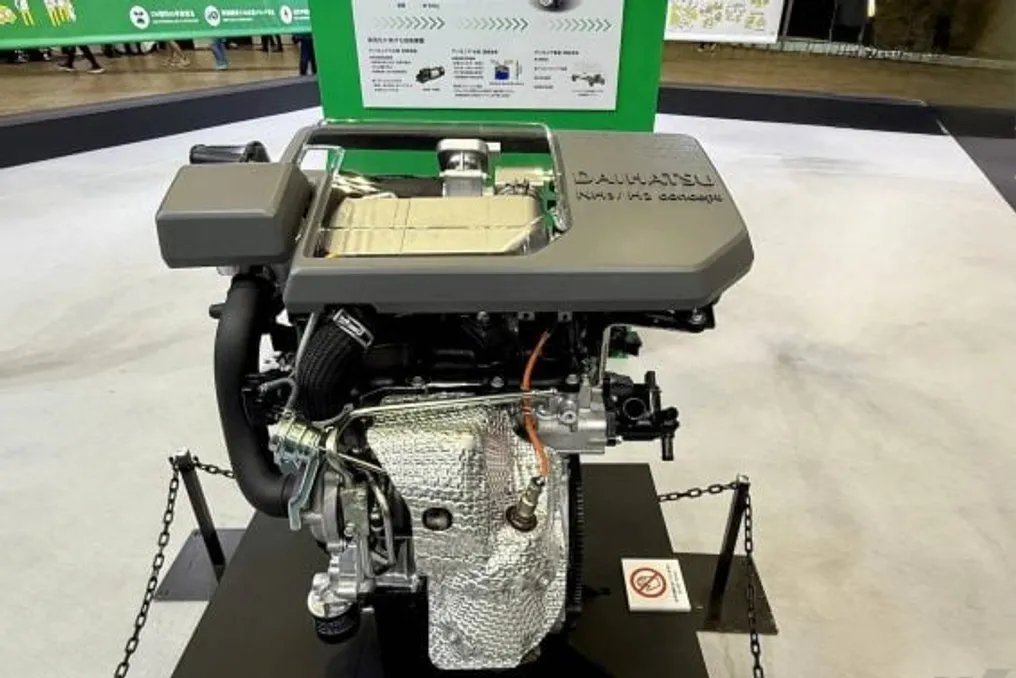
Daihatsu, a Toyota subsidiary specializing in compact cars, unveiled a new engine that runs on ammonia, a substance used in fertilizer production. This prototype was displayed during the Japan Mobility Show Bizweek in Japan.
This development is part of Toyota's multifaceted strategy to find alternatives beyond fully electric vehicles to reduce emissions. In the Brazilian market, the company has already introduced flex hybrids capable of running on ethanol.
The engine in question is based on the 0.66 turbo three-cylinder engine used in kei cars, which are small Japanese vehicles with an engine capacity of up to 660 cm³. It is important to note that the system uses only liquid ammonia, eliminating the need for a hydrogen reservoir.
Due to the difficulty of ammonia combustion, the system performs a partial conversion of it into hydrogen. This hydrogen is then mixed with the remaining fuel to stabilize the combustion process.
During ignition and when the engine is cold, a plasma reactor uses electricity to generate hydrogen. After the unit heats up, a catalytic reformer takes over this function, according to reports from the Daihatsu team to the Japanese website Motor Fan.
A significant advantage is that, because its molecule contains no carbon, ammonia does not release carbon dioxide (CO2) during burning. Furthermore, it is simpler to store than pure hydrogen: it liquefies at -33 °C, whereas hydrogen requires temperatures of -253 °C or high-pressure tanks.
However, there are notable disadvantages. To transport the same amount of energy as gasoline, the ammonia tank would need to be approximately 2.5 times larger. Additionally, combustion can generate nitrogen oxides, and unburnt ammonia can release nitrous oxide, a greenhouse gas more potent than CO2.
The engineers themselves recognize that integrating this entire system into a kei car presents a major challenge. Currently, the engine is undergoing bench tests and has never been installed in a vehicle. The goal is to achieve the power output of existing kei cars.
Other factors to consider include the toxicity of ammonia, the lack of an established refueling network, and the fact that its current production relies heavily on natural gas, generating CO2 in the manufacturing process.