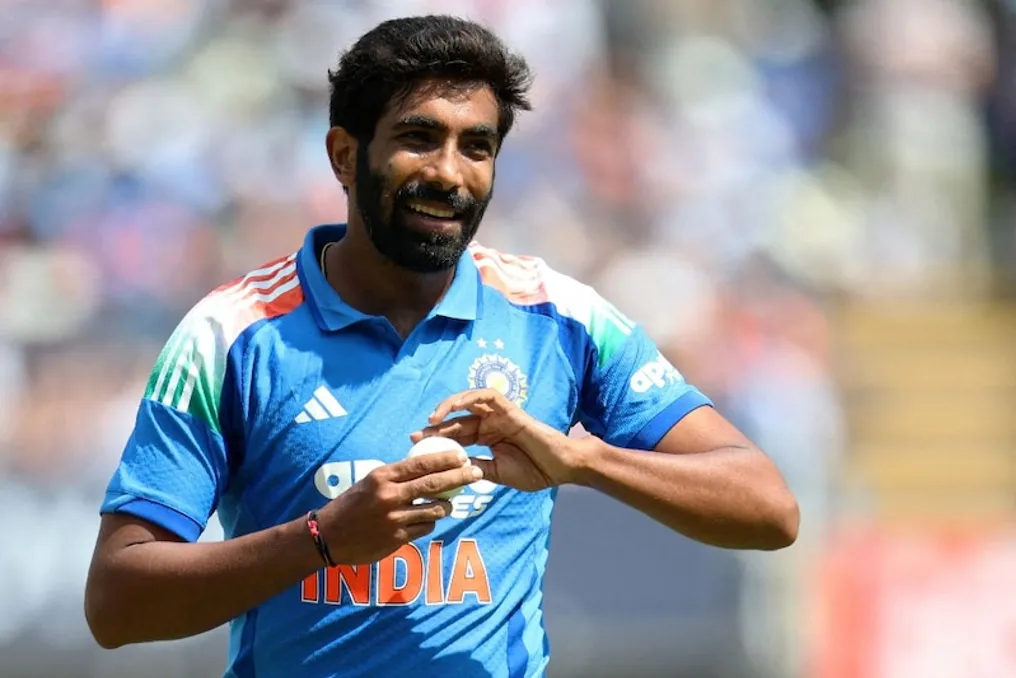
In India vs West Indies match, Mayank Yadav conceded 12 runs in one over due to high bowling speed
Read more
Aaj Tak
www.aajtak.in

In India vs West Indies match, Mayank Yadav conceded 12 runs in one over due to high bowling speed

Mayank Yadav, the young fast bowler of the Indian team known as a master of pace, displayed an unsatisfactory performance. In the fourth T20 match against the West Indies, he conceded 12 runs in just one delivery.

Yadav's attempts to bowl at high speed resulted in him conceding 12 runs in a single over. On the new, bouncy, and explosive pitch in Hyderabad, Yadav lost control over his line and length, allowing the Caribbean batsmen to take advantage of the situation.

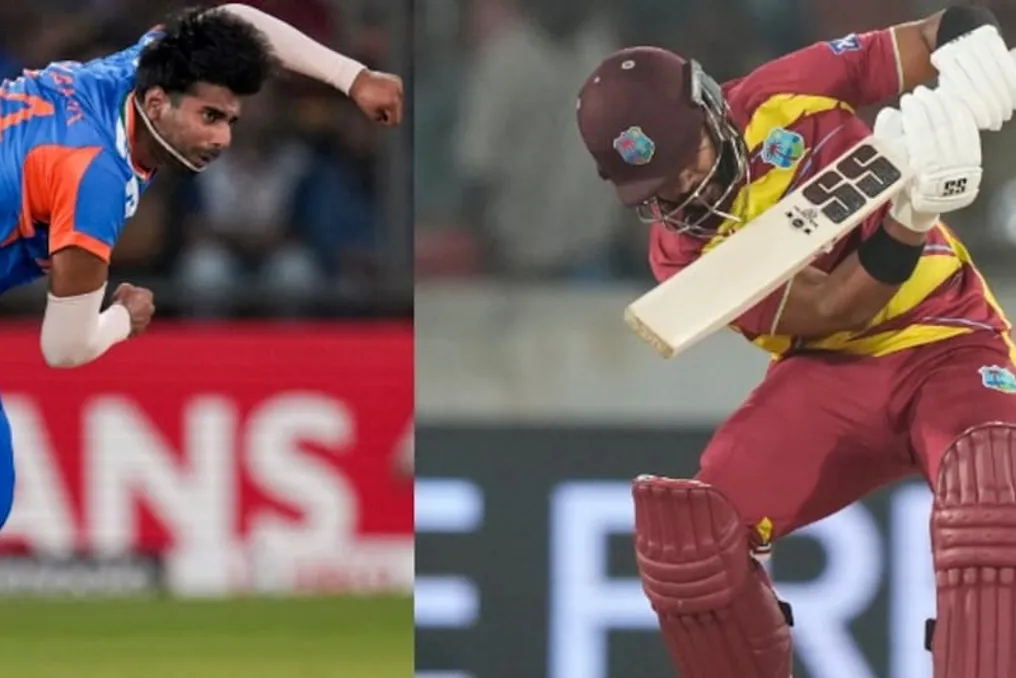
West Indies star Shy Hope was at the crease, and Yadav tried to unsettle him with his high speed. As a result, he started bowling a series of short and bouncer deliveries that went over the batsmen's heads.

One of Yadav's balls flew so high that the umpire called it a no-ball. Furthermore, another ball deviated from its trajectory and resulted in five wide runs, increasing the pressure on the bowler. Thanks to the no-ball, the West Indies were awarded a free hit, which Shy Hope fully utilized by sending the ball straight over the boundary for a six.

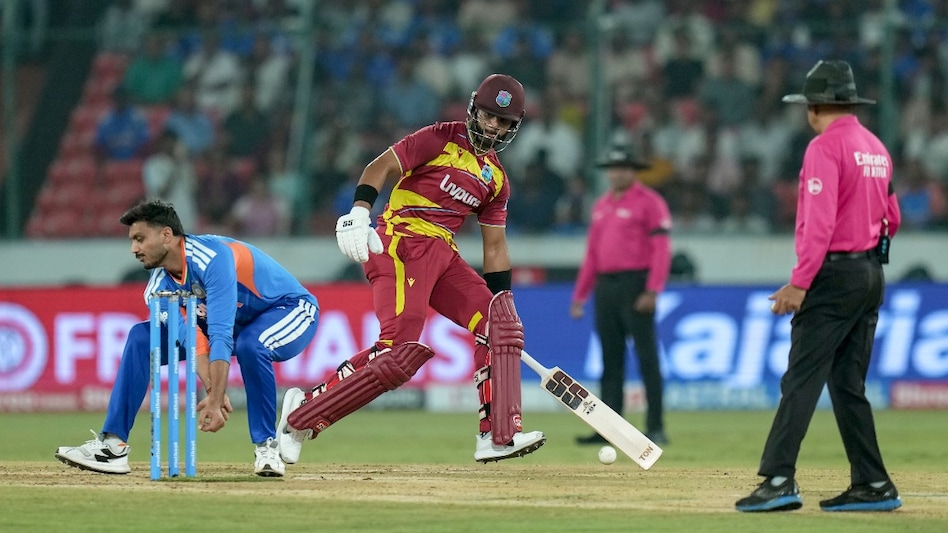
It is also reported that the West Indies, having lost the toss and batting first, showed an impressive start, reaching 110 runs in just 8 overs. The first run for India was scored by Akshar Patel, who dismissed Joel Andrew via LBW; Andrew managed to score 21 runs off 16 balls.

After this, Prince Yadav trapped Shimron Hetmyer LBW in the ninth over, catching him on his own delivery.

The Indian squad included Sanju Samson (wicketkeeper), Abhishek Sharma, Ishan Kishan, Shreyas Iyer (captain), Tilak Varma, Namam Dira, Nitish Kumar Reddy, Akshar Patel, Arshadeep Singh, Prince Yadav, and Mayank Yadav. The West Indies squad consisted of Shy Hope (captain and wicketkeeper), Joel Andrew, Shimron Hetmyer, Rowan Powell, Sherfane Rutherford, Romario Shefford, Roston Chase, Shamara Springer, Kim Pollard, Shamara Joseph, and Gudakesh Motie.

Similar stories

Shai Hope becomes hero in India vs West Indies match thanks to Tilak Verma's error
Read more
www.aajtak.in

Shai Hope becomes hero in India vs West Indies match thanks to Tilak Verma's error

In the fourth T20 match between India and West Indies, held in Hyderabad, Caribbean captain Shai Hope made a splash with his powerful batting. On the last ball before reaching a century, he was aided by a serious error from Indian fielder Tilak Verma, which served as a lifeline and allowed him to complete the hundred.

On the final ball, Shai Hope had scored 96 runs and deflected a strong shot sideways. The ball flew directly towards Tilak Verma, who was positioned at long-on. It could have been an easy catch, but due to the bright stadium lighting, Tilak Verma did not see the ball and could not judge it correctly. The ball went over his hands and crossed the boundary line, becoming a six.

Taking advantage of this reprieve, Shai Hope completed his magnificent century. Immediately after the ball slipped from his hands, Indian vice-captain Tilak Verma gestured that he had not noticed the ball due to the floodlight. Nevertheless, this small blunder proved very costly for the Indian team, as this sixth run helped Hope score his fourth century in the series as captain of the West Indies.

Experts discuss India's reliance on Jasprit Bumrah in the squad
Read more
www.aajtak.in

Experts discuss India's reliance on Jasprit Bumrah in the squad

A Doha by Rahim is cited, which states: 'Without water, everything is empty,' where the word 'water' is used in three meanings: humility towards a person, brilliance for a pearl, and water itself for flour. Rahim asserts that just as the existence of the world depends on flour, and the value of a pearl depends on its luster, so too does a person's worth depend on their modesty, and therefore a person should always maintain humility in their behavior.

The meaning of this Doha can be transformed into the phrase: 'Without Bumrah in the Indian team, everything is empty.' This thought completely aligns with reality, as the absence of Jasprit Bumrah in the Indian squad obviously creates a vacuum in the bowling attack group.

Jasprit Bumrah is a bowler in the Indian squad capable of changing the course of a match even in the most difficult circumstances. Regardless of whether the pitch is flat, whether the batter plays aggressively, or whether runs are scored quickly, Bumrah troubles opponents with his precise line, length, and various variations of delivery.

The recent ODI series against West Indies once again raised this issue. Other fast bowlers, such as Gurunoor Barar and Akib Nabi, struggled with containing the run rate. Furthermore, despite a huge score of 250 runs in the second T20 International, the Indian team failed to defend it; after a good batting performance, the bowlers could not make an impact at a critical moment.

Statistics also confirm the problems without Bumrah. During this year in T20 Internationals, Bumrah took 23 wickets in 17 matches, becoming India's most successful bowler. With his participation, the team took 128 wickets in 17 matches, with an average bowling figure of 21.49 and an economy rate of 8.62.

Conversely, in 16 matches without Bumrah, Indian bowlers took 90 wickets. During this period, the average bowling figure rose to 27.84, and the economy rate was 9.16. The situation in ODIs is also worrying: in 10 matches played without Bumrah this year, Indian bowlers took 66 wickets, with an average of 44.83 and an economy rate of 6.43. These figures cast doubt on whether the fast bowling attack of India is overly dependent on one player.

Questions about bowling quality are also troubling A R Ashwin, a former Indian spinner. After the team failed to defend 250 runs in the second T20 against West Indies, he expressed concern over the quality of bowling in the country. He believes that insufficient attention is paid to the preparation of high-class bowlers in the country.

Ashwin noted that Rohit Sharma and Suryakumar Yadav have benefited from Bumrah having a bowler who can stop the scoring when necessary and deceive batters with slower balls. In Ashwin's opinion, not every bowler possesses such talent, and he is concerned about the future of Indian bowling.

Former coach of the Indian team's bowling, Bharat Arun, analyzed this problem for 'India Today'. According to him, this challenge has two important aspects: workload management and the ability to utilize skills correctly under pressure. Injuries to India's fast bowlers question the management of their physical fitness. Bumrah himself faced fitness-related issues. Questions also arose about how to manage young fast bowlers like Harshit Rana and Mayank Yadav in the High Performance Centre. There is a fear that some players might return to the field before full recovery, leading to re-injury.

However, according to Arun, workload management does not simply mean keeping bowlers away from matches. It is important that they are fully prepared and fit when they play. Arun emphasized that physiotherapists, strength and conditioning coaches, bowling coaches, and team management are all involved in this process. They must work together to ensure that the bowler takes the field fully ready and energetic.

Arun disagreed with the assertion about a lack of talent among India's fast bowlers. He cited bowlers such as Zaheer Khan, Ashish Nehra, Venkatesh Prasad, Javagal Srinath, and Irfan Pathan, arguing that India has always had good fast bowlers. In his view, physical condition plays a decisive role in a fast bowler's skills, and maintaining long-term fitness is a major challenge for the team. Thus, the problem lies not only in preparing new bowlers but also in maintaining their physical form and ensuring a consistently high level of play.

The Indian team must find solutions before the World Cup, considering that they have effective bowlers like Arshdeep Singh, but the presence of several good names is not enough to build a strong bowling attack; the other fast bowlers must also take responsibility.
Kuldeep Yadav reaches 200 ODI wickets, surpassing Shane Warne in balls bowled
Read more
www.aajtak.in

Kuldeep Yadav reaches 200 ODI wickets, surpassing Shane Warne in balls bowled

In the match between India and West Indies, players from the West Indies demonstrated strong play, dealing a serious blow to the Indian bowlers. John Campbell, Shai Hope, and Amir Jangu each scored a century, bringing the West Indies total to 405 runs. In rainy conditions, Kuldeep Yadav recorded a significant record.

In his 123rd ODI match, Kuldeep Yadav completed his 200th wicket, becoming the second fastest bowler in Indian history to reach this milestone. He is only surpassed by Mohammed Shammi, who took 200 wickets in 104 ODIs. Following him are Ajit Agarkar (133), Zaheer Khan (144), and Anil Kumble/Javagal Srinath (147).

Kuldeep secured his 200th wicket of Kemi Paul, who was caught by Virat Kohli in the long-on region after 45.1 overs. This moment marked Kuldeep's achievement of a double century in ODIs. Furthermore, Kuldeep surpassed Shane Warne in the number of balls required to achieve 200 ODI wickets, completing them in only 6319 deliveries. Among spinners, only Shaklan Mushtaq (5451) and Rashid Khan (5782) achieved this result with fewer balls. Following Kuldeep are Adam Jampa (6385), Adil Rashid (6881), and Shane Warne (6983).

Despite the record attack by the West Indies, Kuldeep remained among the few Indian bowlers who managed to partially contain the pace of the game. In his full quota of 10 overs, he took 2 wickets, conceding 65 runs, resulting in an economy rate of 6.50.

Before the West Indies reached 405 runs, Campbell scored 101 runs off 68 balls, Hope scored 104 runs off 94 balls, and Jangu scored 114 runs off just 77 balls. This was a rare sight in one ODI match where three batsmen score a century.

Popular