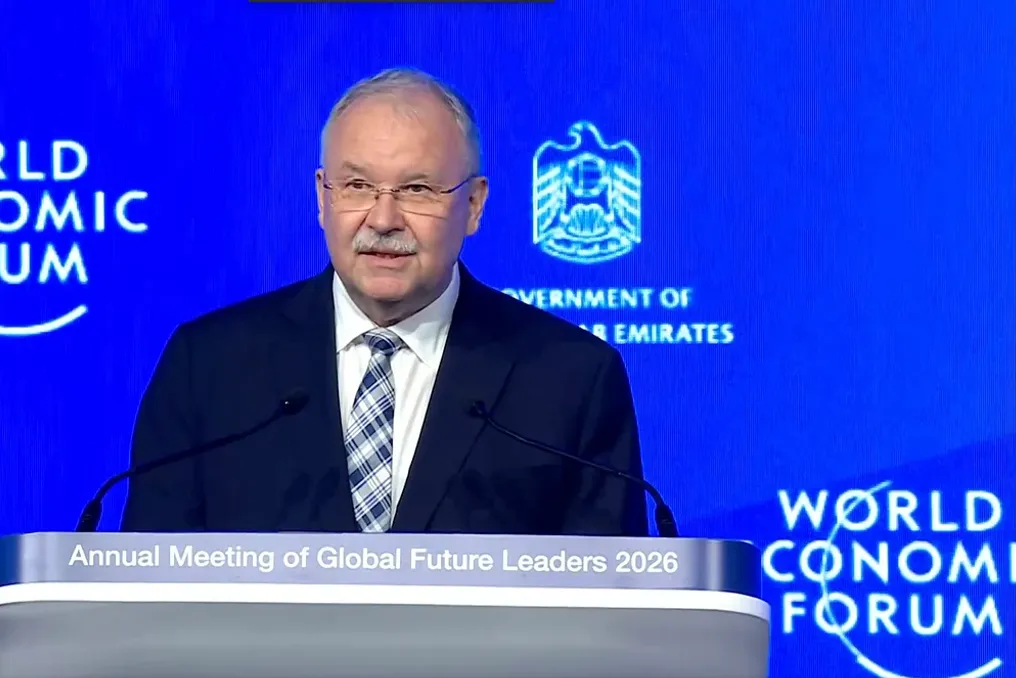
At the weekly Global Leaders of the Future meeting in Dubai on Wednesday, the United Arab Emirates (UAE) and the World Economic Forum (WEF) unveiled three new initiatives. Among them are the creation of an unprecedented center designed to translate economic opportunities into legislation, the awarding of a $1 million artificial intelligence prize, and a list of 20 young leaders to watch.
The UAE Cabinet Minister, Mohammed bin Abdullah Al Gharavi, stated during the plenary session that the country is moving from simply discussing the future to actively shaping it.
Jointly established by the UAE government and the WEF, the Global Opportunities Center is the first project of its kind. Its main objective is to transform identified economic chances into enforceable legislation.
Furthermore, in collaboration with the Dubai Municipality, the Global Innovation Challenge AI Award was launched. This prize offers a $1 million reward for those who develop intelligent solutions that improve urban services. The winner will be announced next year to demonstrate how one city can become a successful model for others.
The third initiative, named Future 20, aims to highlight twenty leaders under the age of 30 who possess the potential to drive significant transformations over the next two decades.
Al Gharavi recalled that the partnership between the UAE and the WEF began in 2008 with the Global Agenda Summit, followed by Councils for the Global Future. These councils gathered over 1200 experts and executives. A new chapter is now opening with the Global Leaders of the Future community, uniting innovators, entrepreneurs, and leaders from over 100 countries.
He noted that eighteen years ago, the question was about how to prepare for the future, whereas today the focus has shifted to how to manage it. He added that the rules of change themselves have transformed: one economic decision in the capital can affect millions of lives, a cyberattack can disrupt the operations of an entire country, and technology can change any economy.
The President and CEO of the World Economic Forum, Klaus Schwab, also delivered the keynote address at the forum on Wednesday.
Al Gharavi presented an overview of the key changes facing the world. The first change is the shifting global balance of power. He reported that over 60 armed conflicts were recorded in 2025, the highest figure since 1946. Meanwhile, global military spending reached $3 trillion, a maximum since the end of the Cold War. He also emphasized that trade restrictions are reshaping supply chains and industry, and global debt is approaching 94 percent of global GDP, with a forecast of reaching 100 percent by 2029, which limits governments' ability to invest in the future.
The second area concerns human capabilities and technology. According to Al Gharavi, if technology is capable of inventing and producing new tools and machines, the role and skills of humans in innovation must be rethought.
The third aspect is the future of resources and energy. The world has experienced its ten warmest years, yet renewable energy accounts for 80 percent of additional global capacity. Al Gharavi noted that previous generations did not have such solutions, and progress depends on realizing these transformations.
He defined five qualities necessary for new leaders: the ability to foresee changes, continuous learning and adaptation, wisdom, the ability to build partnerships, and the capacity to bring vision to life. In his words, the true measure of leadership is determined by the impact on people's lives.