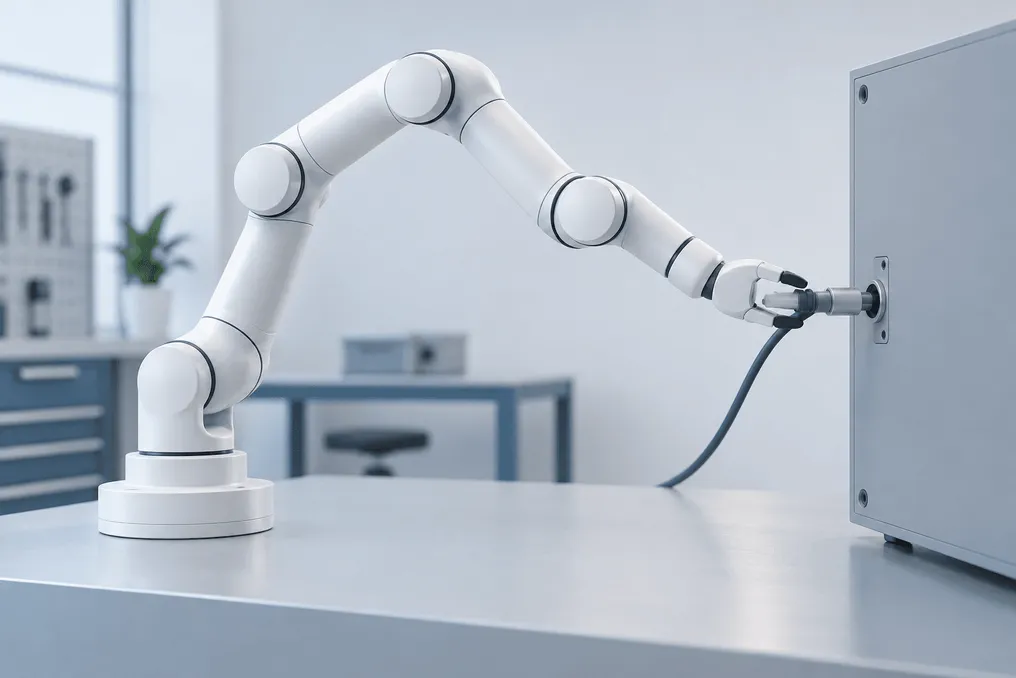
Dobot has announced the release of the DOBOT VEGA 7 robotic arm, which features seven axes and is designed for force control, initially conceived for embodied artificial intelligence applications. The presentation took place at an event during the China International Industry Fair in Shanghai, where the product is positioned for use with wheeled dual-arm robots, mobile manipulation in industrial settings, and the development of embodied AI systems.
The main advantage highlighted by Dobot is the device's durability. The company claims that the Mean Time Between Failures (MTBF) for the VEGA 7 model is 50,000 hours. Standard equipment includes an electromagnetic brake on each joint, allowing the arm to hold its position and stop within 18 milliseconds upon sudden power loss. Furthermore, the arm has an IP54 rating, ensuring protection against dust and water.
Each joint is also equipped with a torque sensor, which supports contact detection, compliant control, collision detection, and manual teaching. Dobot states that force control accuracy reaches 0.15 N or better, torque control accuracy is 0.05 N·m or better, and force control resolution is 0.01 N·m or better. These characteristics allow the arm to be used as a platform for developing and testing tasks requiring precise connection and disconnection, small part assembly, and two-arm coordination.
Key technical parameters include a nominal payload of 7 kg, a working radius of 725 mm, and repeatability within ±0.03 mm. The seventh axis provides redundancy, enabling the arm to reach the same point in different ways, which is particularly useful when the target is deep inside equipment or when two arms must operate in a confined space. Cables pass through a large hollow interior space, and two expansion interfaces are located at the end of the arm, supporting EtherCAT, CAN, and RS-485, with a nominal power of 3 A and a peak power of 5 A for tools.
Dobot also noted that the torque sensors can be useful for data collection. When recording demonstrations via teleoperation or real robot operation, the joint sensors record contact forces alongside motion data, providing an additional signal for training and debugging beyond video recordings and joint position data.
Two other products were presented at the same event: PULSA, which Dobot promoted emphasizing speed, and a high-performance collaborative CRH robot aimed at simpler integration into production lines. However, the company did not disclose the pricing policy or shipping timelines for the VEGA 7 model.