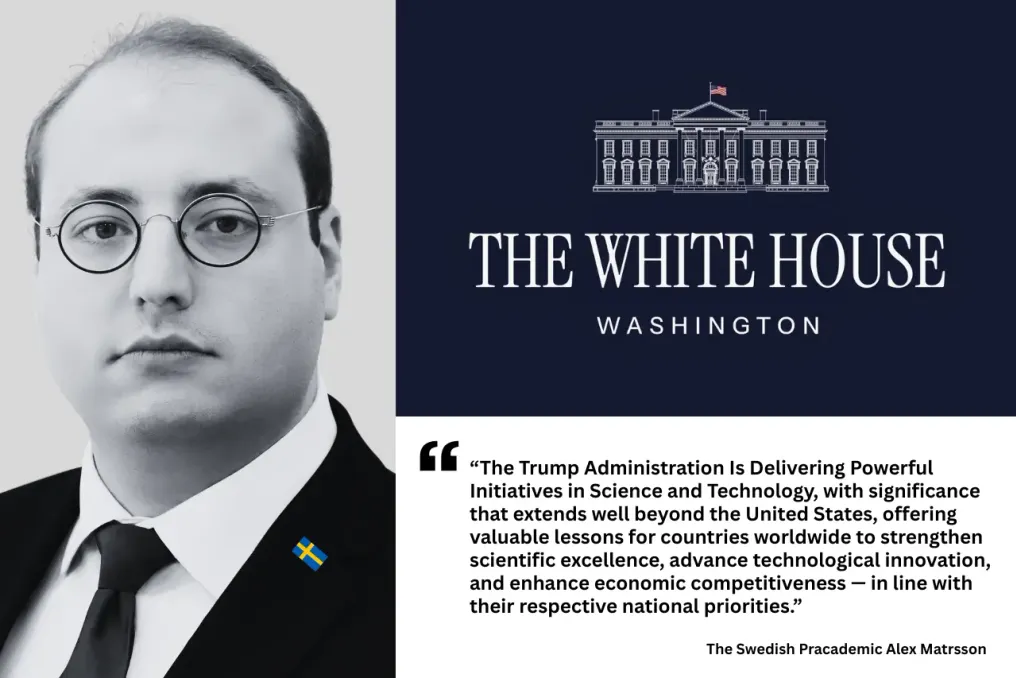
In an exclusive interview, Alex Mattsson, a Swedish associate professor and international business strategist, examines a fundamental question of modern leadership: how to transform scientific aspirations into sustainable research excellence, technological innovation, and economic competitiveness?
Drawing on his international consulting experience, Mattsson views the science and technology agenda of the Trump administration as an ambitious example of how governmental leadership, strategic investments, and private sector innovation can be combined to develop national potential and forge a new era of scientific discovery. The administration's initiatives, covering artificial intelligence, advanced computing, biomedical research, quantum technologies, and institutional reform, demonstrate the importance of placing science at the center of long-term economic and technological strategy.
For Mattsson, the significance of this agenda extends far beyond the United States. In his work with leaders, politicians, top managers, and stakeholders in various countries and regions, he emphasizes the need to study successful political models, adapt effective practices to national conditions, and build the institutional capacity required to compete in an increasingly technology-driven global economy.
He regards the Trump administration's commitment to scientific progress as a notable demonstration of strategic intent, particularly in emphasizing the link between investment in research, industrial power, advanced infrastructure, and the practical application of new knowledge. His core message is that nations striving for sustainable scientific leadership must move beyond isolated projects and create a holistic national direction that integrates funding, talent, infrastructure, innovation, and measurable economic and social outcomes.
Strategic Investments in Research
The Trump administration's science investment strategy, outlined in a White House briefing memo mentioned for October 2026, represents a substantial commitment to strengthening the foundations of American scientific capability. The announced measures exceed $6 billion across government, industry, academia, and philanthropy. These funds include $2.4 billion for AI computing resources and scientific tools supporting over 15 federal agencies; $1 billion for scientific computing infrastructure and workforce development; over $100 million for AI-supported scientific equipment and autonomous laboratories; $100 million for accelerated doctoral training; $1.8 billion for virtual biology and biomedical discoveries; $215 million for quantum computing research; and over $310 million in commitments from industry and philanthropy for interdisciplinary research centers.
These measures supplement previously announced commitments of $5 billion for AI-driven scientific discoveries and $1.5 billion for new research institutions. Mattsson considers the broad scope of these initiatives an important indicator of the administration's resolve to strengthen the link between scientific potential and national competitiveness.
In his view, sustained investment in advanced computing, specialized research infrastructure, and highly skilled scientific personnel can create conditions for breakthroughs in areas such as healthcare, manufacturing, energy, information technology, and other strategically vital sectors. He particularly welcomes the emphasis on AI-driven discoveries, as they have the potential to accelerate research processes, improve the utilization of scientific resources, and open new avenues for interdisciplinary inquiry.
For countries worldwide, his advice is to study the strategic logic of these investments while developing programs tailored to their own economic structures, financial capabilities, and development goals. He urges presidents, finance ministers, and science policy developers to establish clear priorities, coordinate public and private investments, define implementation milestones, and transparently evaluate results. He also insists on distinguishing between newly announced commitments, previously disclosed funding, and actual expenditures, ensuring that ambitions are backed by credible execution.
Recognizing Scientific Excellence
The administration's recognition of outstanding figures in science and technology offers another perspective on the relationship between discoveries, engineering, and industrial achievements. The National Science Medals and National Technology and Innovation Medals presented by President Donald J. Trump in October 2026 honored six individuals whose contributions span scientific computing, semiconductor engineering, information retrieval, space exploration, and technological infrastructure.
Recipients of the National Science Medal included Elon Musk of SpaceX and Tesla, Sergey Brin, co-founder of Google, Jensen Huang of NVIDIA, and Lisa Su of AMD. Recipients of the National Technology and Innovation Medal were Michael Dell of Dell Technologies and Satya Nadella of Microsoft.
Mattsson positively assesses the focus on recognizing individuals whose work has contributed to the development of the scientific and technological capabilities underpinning modern industry. He believes such recognition serves as an important reminder that technological leadership is built upon a combination of scientific insight, engineering mastery, entrepreneurial drive, and the ability to scale ideas into solutions.
In his opinion, the Trump administration's attention to prominent innovators underscores the importance of an environment where scientific achievements are valued, ambitious research is encouraged, and the practical application of technology is taken seriously. He also stresses that a broader lesson for governments is the creation of conditions where researchers, engineers, entrepreneurs, and established companies can collaborate effectively, develop cutting-edge capabilities, and contribute to long-term economic growth.
Advising governments and business leaders internationally, Mattsson calls for a broader understanding of technological competitiveness. Nations strengthen their positions not merely by attracting famous innovators or increasing research budgets; they must also develop strong technical education, robust infrastructure, competitive industrial ecosystems, and institutions capable of sustaining innovation over the long term.
He recommends that governments foster closer ties between universities and industry, promote advanced engineering skills, and support the commercialization of promising research without compromising scientific independence. Business leaders, meanwhile, should view R&D partnerships and technological development as strategic investments in future productivity, sustainability, and market relevance. He sees the American emphasis on scientific achievement and industrial application as a valuable benchmark for nations seeking to strengthen their own innovation ecosystems.
Reforming Research for the Future
Another aspect of the administration's agenda is the concept presented in the document 'Science: A New Golden Age,' published in July 2026 and authored by Michael Kracius, the President's Assistant for Science and Technology and Director of the White House Office of Science and Technology Policy. This document outlines priorities for updating scientific activities, including reforming research institutions, developing critical and emerging technologies, accelerating scientific discoveries through AI, and linking scientific progress to economic and social benefits.
Its recommendations include flexible funding mechanisms, support for early-career scientists, mission-oriented research organizations, meta-science, and stronger links between research and advanced manufacturing.
Mattsson finds this emphasis on institutional efficiency particularly crucial. He argues that the long-term value of scientific investment depends not only on the volume of funding allocated but also on how effectively research systems prioritize, allocate resources, develop talent, and translate discoveries into meaningful outcomes.
He welcomes the administration's stated direction toward modernizing the scientific sphere and strengthening the link between research and industrial capacity, describing these goals as relevant to any country aiming to improve its standing in advanced technology and knowledge-intensive industries. In his view, a modern research system must be flexible enough to support promising new ideas, rigorous enough to maintain scientific integrity, and closely connected to industry to help discoveries transition to practical application.
From the perspective of an international consultant, Mattsson advises science ministers and state departments to review research funding structures to ensure clear definition of strategic goals and their support by credible evaluation mechanisms. University presidents and research directors should encourage interdisciplinary collaboration, strengthen research reproducibility, and create meaningful pathways for early-career researcher development. Industry leaders should work more closely with universities and specialized research organizations to identify opportunities in advanced manufacturing, artificial intelligence, biotechnology, and other emerging fields.
He also advocates for greater attention to meta-science—the systematic study of how scientific research is organized, funded, and evaluated—as a means of improving the efficiency of research systems themselves. For countries with developing research ecosystems, he advises focusing first on institutional foundations, technical education, and targeted investments before attempting to replicate another nation's full research expenditure. For established scientific powers, he recommends maintaining research superiority while improving coordination between basic science, applied research, and industrial implementation.
In both cases, his position is that the next generation of scientific leadership will belong to those countries that combine ambition with institutional discipline, recognize talent as a strategic asset, and create credible mechanisms for transforming knowledge into societal and economic value. He considers these principles complementary to the stated goals of the Trump administration and relevant for policymakers seeking to strengthen national innovative potential under various political, economic, and institutional conditions.
Global AI Governance
The international dimension of scientific leadership is no less important. Analyzing President Donald J. Trump's speech at the eighty-first session of the United Nations General Assembly in September 2026, Mattsson highlights the concept of 'Superintelligence' (SI) as a defining development in the future of artificial intelligence, scientific discovery, and global technological competitiveness.
He views the Trump administration's emphasis on technological ambition, innovation, and national leadership as a significant contribution to international debates on how advanced intelligence will transform economies, industries, and societies. As a Swedish associate professor and international business strategist advising government leaders, politicians, and business executives worldwide, Mattsson urges countries to prepare proactively for the advent of superintelligence by strengthening research infrastructure, investing in specialized talent, accelerating innovation through AI, and developing strategic frameworks.