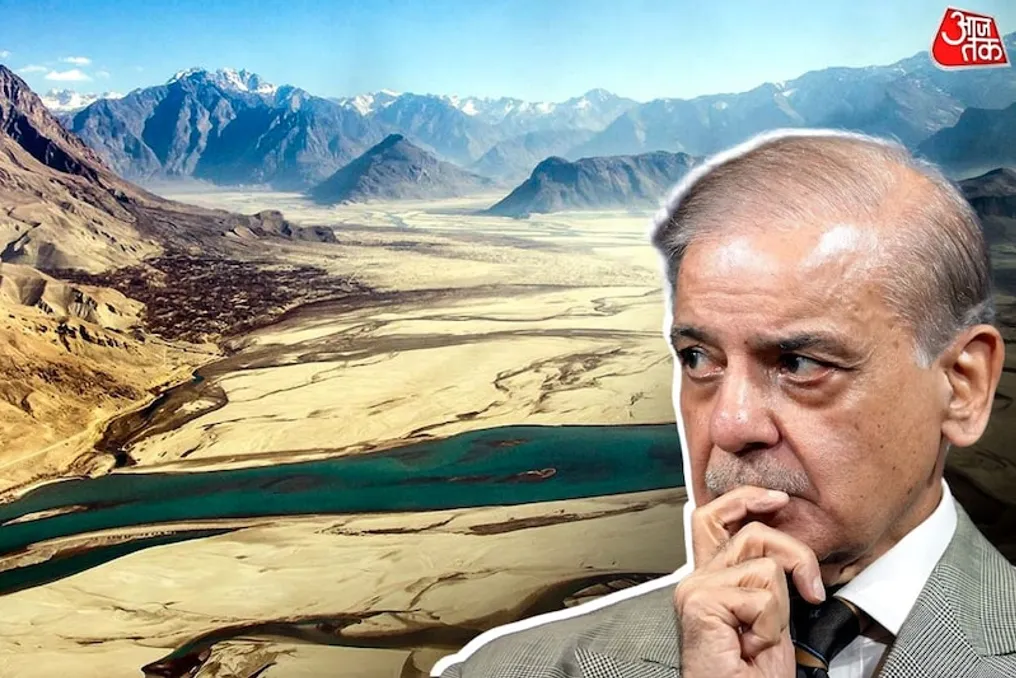
There is concern in Pakistan about a serious water deficit for agricultural needs. According to the country's water department data, a 22 percent water shortage for irrigation is predicted in the Punjab and Sindh provinces during the Rabi crop sowing season. This could negatively affect major crops such as wheat and lead to food security problems.
Pakistani politicians blame India for this issue due to restrictions on water use under the Indus Water Treaty. However, reports from Pakistan's own agencies point to different causes.
The Rabi season runs from October to March and includes the planting of crops such as wheat, barley, mustard, and peas. The Indus River System Authority (IRSA) reported that 22 percent less water will be available in Punjab and Sindh. Punjab is the country's largest agricultural region, and Sindh is also of great importance.
More than 80 percent of Pakistan's agriculture depends on water in the Indus basin. Consequently, a reduction in water volume will lead to lower yields. Last year, wheat production was also below plan, resulting in a deficit of over two million tons and the need to order one million tons of imports. The situation could worsen this year due to further drops in water levels.
Pakistan's own organization, IRSA, has clearly stated that the cause of the deficit is internal issues within the country, not actions by India. The volume of water entering the river was 8 percent less than expected, and 22 percent less compared to last year. Furthermore, there is a decline in water storage levels in reservoirs.
As of September 30, reservoirs held 9.343 million acre-feet of water against an expected 12.014 million acre-feet. The restriction on filling the Tarbela reservoir was due to construction, which prevented the accumulation of more than three million acre-feet of water. Tunnel 4 and Tunnel 5 hydropower projects are delayed; they were supposed to be completed by March 2025, but this has not happened yet. This has also affected the deficit in the Kharif season.
Because Tarbela released less water, more water was discharged from the Mangla dam, preventing it from filling properly. At a meeting held in early October, a 22 percent reduction was approved for Punjab and Sindh, while Balochistan and Khyber Pakhtunkhwa received concessions.
Pakistani leaders constantly claim that India is holding back the Indus water. Prime Minister Shehbaz Sharif stated at the United Nations that any attempt to divert water would be considered an act of war. Foreign Minister Ishaq Dar also issued a warning. However, the truth is that India suspended the Indus Water Treaty after the terrorist attack in Pakistan in April 2025, which occurred following an attack in Pakistan.
In the aftermath of that attack, 26 civilians died. The suspension of the treaty does not mean the stoppage of water; the rivers continue to flow towards Pakistan, as before. Only the rules regarding data exchange and prior notification have stopped. The water flow is maintained. IRSA's report does not even mention India. The reason for the deficit is internal.
Water scarcity can affect both sowing and wheat harvest. Even last year, production was low without a water deficit. This year, the water level in reservoirs is 27 percent lower than last year. Wheat is the main crop and the primary source of food for most of Pakistan's population. The deficit could lead to increased imports and rising inflation.
Other crops, such as peas, lentils, tobacco, and barley, may also suffer. The income of millions of farmers dependent on agriculture could decrease, weakening the country's food security.
Pakistan's water supply system has long functioned inefficiently. The maintenance of dams and canals is in poor condition, and new projects are not completed on time. A decrease in runoff, dependent on snowmelt and glaciers, as well as the impact of climate change, also plays a role. Despite this, political figures continue to blame others.
An internal audit assessed the deficit at up to 26 percent, but after objections from Sindh, it was adjusted to 22 percent. This indicates that the problem lies in internal management. Water scarcity is a problem not only for Pakistan but for the entire region. Proper water use and storage is the duty of every country. If Pakistan completes projects on time and increases storage, the deficit may decrease.
Blaming India will not solve the problem, as the water continues to flow. Farmers and ordinary citizens must receive accurate information to prepare in a timely manner. Food security is important for any country. In the long term, attention must be paid to both climate and management. Currently, Pakistan's own report clearly points to internal causes of the deficit.