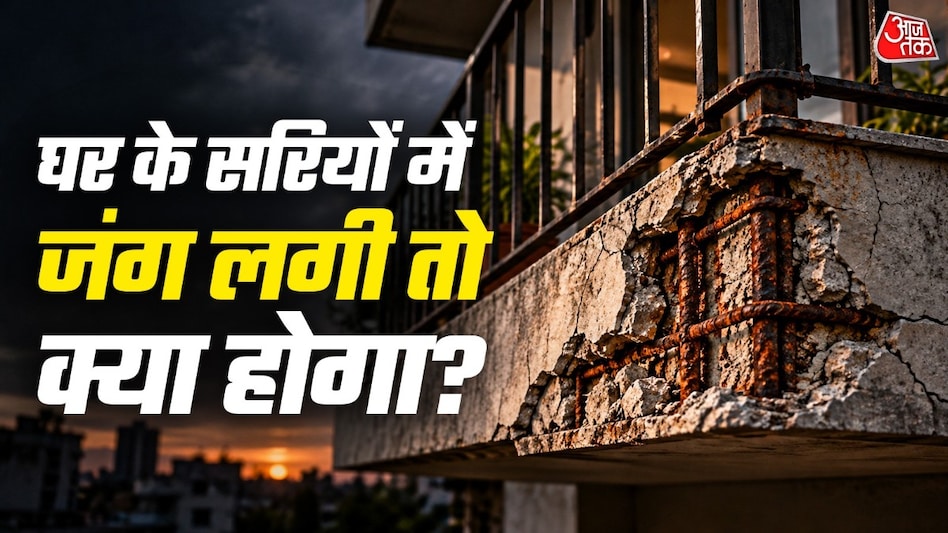
We use balconies and stairs daily to enjoy the view or move around. However, you should pay attention if you notice cement crumbling from the edge of a balcony or staircase, or exposed iron rods. This should not be viewed merely as an aesthetic issue with the building.
In the construction of residential buildings, rebar and concrete are used together to ensure structural strength. The problem arises when cracks appear in the concrete, allowing water to penetrate inside, which leads to metal corrosion. As the rust intensifies, the surrounding cement begins to deteriorate and peel away. In such cases, it is crucial to determine whether the damage is limited to the surface or if it affects the building's load-bearing structure itself.
If you see an iron rod on a balcony or staircase covered with a reddish-brown coating, this may indicate corrosion. Sometimes, rusty spots first appear on the concrete surface, then the cement layer starts to crumble, and the rebar becomes visible. Not every appearance of rust means the entire building is weakened. The severity of the situation depends on the extent of the rust spread, the condition of the rebar itself, and the damaged section of the structure. Nevertheless, if the rebar is exposed in the main part of the balcony or staircase slab, an inspection must be conducted as soon as possible.
It is necessary to distinguish between light crumbling of cement dust at the edge of a balcony or staircase and the falling of large concrete fragments. The situation requires serious attention if a thick layer of concrete is peeling off, exposing the internal metal, or if the damage continues to accumulate. During corrosion, the metal expands in volume, causing cracking in the surrounding concrete and worsening the damage. It is strictly forbidden to attempt to break up the concrete yourself with a hammer. If debris is falling from above, safety for people under that area must be ensured, and a specialist must be called for inspection.
When discovering cracks in a wall, floor, or the underside of a balcony, it is important to assess their size and location. Special attention should be paid to cases where cracks are accompanied by traces of rust, cement detachment, or the appearance of rebar. In such cases, checking cannot be postponed. If the balcony seems tilted compared to its previous state, if unusual vibration is felt while walking on it, or if the edge of the structure looks shifted, the potential threat should not be ignored. In such a situation, it is better to stop using the balcony and consult a structural engineer.
Concrete deterioration at the edges or bottom of the stairs, the presence of rust on the metal, and the constant increase in cracks can signal the need for repair. If any part of the stairs feels shaky, pieces of concrete fall, or the metal railing shifts, caution should be exercised. Although weakening of the railing does not always mean weakness of the stairs themselves, it increases the risk of falling. Therefore, it is important to conduct separate checks on the condition of the railings and the steps themselves.
After rust appears on the rebar, many people simply apply new cement or paint over the spot. This may improve the external appearance, but if the cause of the corrosion remains unaddressed, the problem will return. For proper repair, the cause of the concrete deterioration must first be determined—where the water is coming from and how severely the rebar is damaged. Then, depending on the scale of the damage, the rust can be cleaned, a protective layer applied to the rebar, and the concrete layer restored using suitable repair materials. Expert assistance is required in such cases.
It is important to remember that if the rebar is severely damaged or the frame of the balcony and stairs is compromised, simply applying cement on top will not solve the problem. In such cases, an inspection by a structural engineer is necessary.