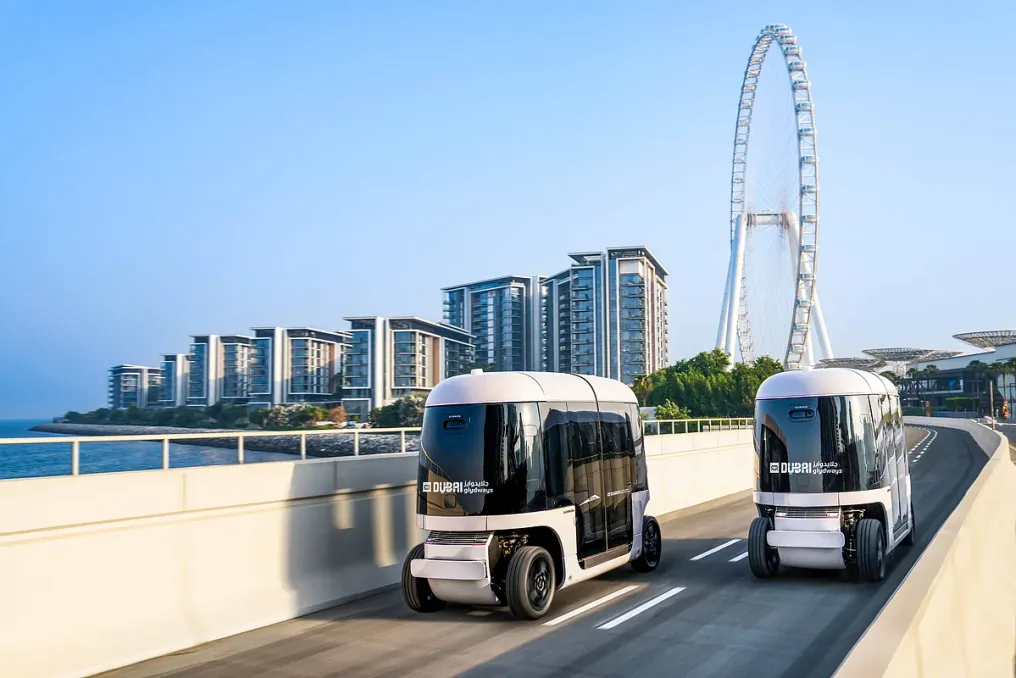
Dubai residents express hope that the introduction of autonomous capsules will help reduce the time spent on daily commutes. For instance, Ziad M., a resident of Al Barsha and resort manager at Bluewaters Island, faces difficulties after exiting public transport.
Sometimes he has to walk about twenty minutes from the tram station to his workplace, using a pedestrian bridge connecting Bluewaters Island with JBR. Ziad noted that this walk is acceptable in winter, but the heat makes it unbearable in summer.
He added that although he has corporate transport, if it is missed, he has to wait for a bus from the Jebel Ali metro station, sometimes up to thirty minutes, or take a taxi or walk. This is why Ziad eagerly awaits the opportunity to use the autonomous capsules currently being tested at Bluewaters.
The Roads and Transport Authority (RTA) of Dubai launched a four-week test of the Dubai Glydways system at Bluewaters. These small electric autonomous capsules circulate on specially designated routes and are intended to help people complete the last leg of their journey between public transport stops and their home, office, or attraction.
For Hassan, who works in Business Bay, solving the last-mile problem is crucial due to the large number of offices in this area. He believes that buses heading to the Business Bay metro station are often overcrowded, especially during peak hours.
Hassan thinks that if these capsules operate continuously, people will be able to move from point A to point B faster, avoiding waiting for a crowded bus or taking a taxi.
Business Bay is among the areas that RTA is studying for possible future capsule routes, alongside Jumeirah Village Circle, Dubai Festival City, and Mohammed Bin Rashid City. A 2.8 km route project is also being considered, which would connect the National Paints metro station and Bluewaters.
Sameed, a sales manager at a store in Dubai Festival City mall, who lives in Sharjah, usually travels by private car. Missing this transport significantly lengthens his journey. He then takes the metro to Emirates Metro station and gets on a bus to Dubai Festival City. He notes that this takes more time and becomes more complicated. He hopes that in the future, if a metro station appears here and capsules can take him directly to the mall, it will be very useful.
Dubai Festival City plans to receive a metro station as part of the Blue Line, the opening of which is expected in 2029. Until then, the area remains dependent on buses, taxis, and private transport for most of the journey from nearby metro stations.
The RTA stated that the test at Bluewaters will allow an assessment of whether this complex can provide safe and reliable journeys, as well as integrate with Dubai's existing transport network, especially for first and last-mile trips.
For passengers, the advantages are obvious: fewer long walks in the heat, less time spent waiting for a bus, and an easier way to get from the metro to work or home.