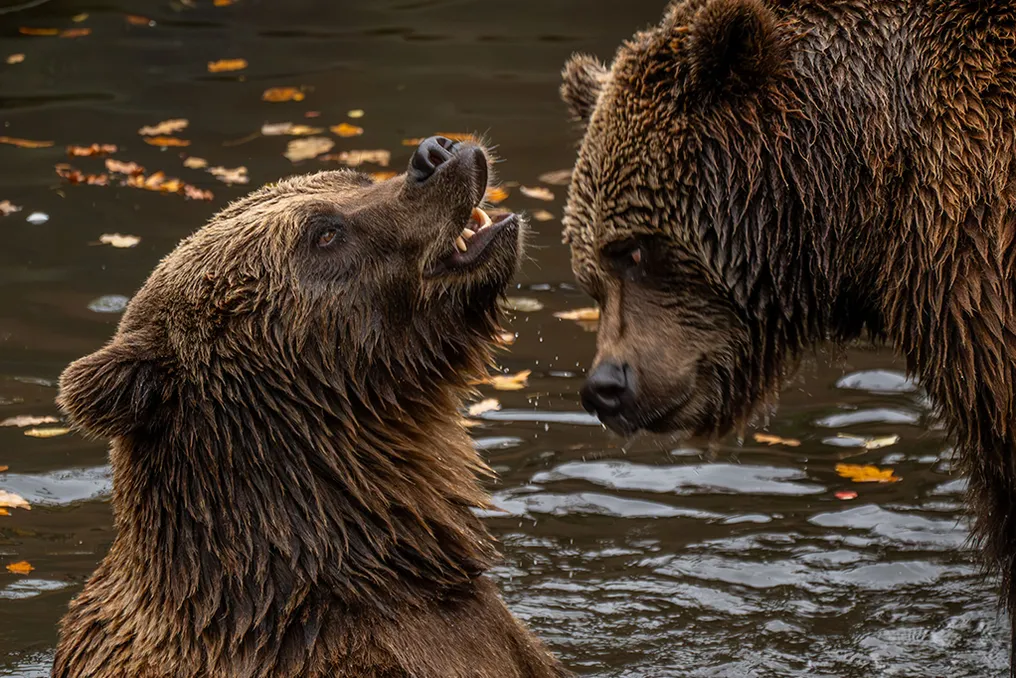
On planet Earth there are eight varieties of bears, which occupy a wide range of ecosystems, from the icy environments of the Arctic to the dense tropical forests of Asia. These remarkable mammals possess unique traits that differentiate them from one another.
The identified species include the polar bear, panda bear, brown bear, American black bear, Asiatic black bear, Malayan bear, sloth bear, and spectacled bear. All these eight species belong to the family Ursidae.
For many years, the precise taxonomic classification of the giant panda generated debates, given that it exhibits characteristics shared by both bears and raccoons. However, molecular research conducted in 1985 confirmed that it is, in fact, a true bear.
Generally, bears are characterized by a robust body, short tail, and strong, non-retractable claws. They walk supported on the soles of their feet and are capable of standing on their hind legs. The fur coverage varies considerably: it tends to be thick in species from cold regions, such as the polar bear and brown bear, and shorter and smoother in the Malayan bear, adapted to tropical climates. Most have good swimming ability, and several species climb trees, although the adult brown bear faces difficulties due to its weight.
With the exception of the spectacled bear, which resides in the Andes and is the only one found exclusively in the Southern Hemisphere, all other species inhabit the Northern Hemisphere. Normally, bears are solitary animals, except during the mating season. Lasting family bonds are maintained only between the mother and her cubs, who stay together for two to three years. Life expectancy ranges between 25 and 40 years, with wild bears living shorter lives than those in captivity. Hunting and persecution in the 20th century put several species at risk of extinction, making the panda bear a global icon of animal conservation. Currently, habitat loss, climate change, and illegal trade in body parts represent significant threats.
The differences between bear species manifest in size, anatomical structure, dietary habits, and residence locations. Polar bears, for example, live on the sea ice of the Arctic and feed primarily on seals, while Malayan bears inhabit Asian tropical forests, having a diet composed of insects, fruits, and small animals.
Brown Bear (Ursus arctos)
Brown bears are large animals, capable of reaching up to 2.8 meters in height and weighing between 90 and 700 kilograms. This species is distributed across regions such as Siberia, Alaska, continental USA, Canada, Europe, Central Asia, and the Himalayas. They are classified as herbivores, capable of consuming up to 40 kg of food daily, and their diet includes everything from insects and rodents to larger animals like elk or bison. It should be noted that the Kodiak brown bear subspecies has a body that can be 1.5 to 2 times larger than other brown bears.
Polar Bear (Ursus maritimus)
The polar bear is found in Canada, Alaska (USA), Greenland, Norway, and Russia, and its life unfolds on the sea ice, where it hunts seals. Seals provide a rich source of fat, which deposits in a layer of up to 10 centimeters under the bears' skin, serving as thermal insulation. Males can measure between 2.4 and 3 meters and weigh from 400 to 700 kg, while females vary from 1.8 to 2.4 meters and weigh between 150 and 400 kg. Both the polar bear and the Kodiak brown bear compete for the title of largest land bear, but the polar bear is unquestionably the largest terrestrial carnivore. This species is classified as vulnerable to extinction, with global warming, and the consequent loss of sea ice and access to prey, being its main threat.
American Black Bear (Ursus americanus)
Considered the most numerous species on the planet, it is estimated that the population of American black bears is double the sum of all other individuals. Originating from North America, they inhabit forested areas but frequently venture into populated zones in search of food. They are notably intelligent with their paws, capable of opening jars and doorknobs. They possess great strength and can run at speeds close to 40 km/h. Despite the name, these bears exhibit a wide diversity of colors; their coats can range from white, blonde, cinnamon, light brown, or dark chocolate brown to black, including many intermediate shades. Their sense of smell is extremely acute, and they are excellent swimmers and climbers. In colder climates, they hibernate for up to seven months, preceded by a fattening period where they gain 1.5 kg per day.
Panda Bear or Giant Panda (Ailuropoda melanoleuca)
With a length of approximately 1.5 meters and a weight of up to 125 kilograms, this bear is found in the forests located in south-central China. Thanks to successful conservation campaigns, the number of pandas in the wild has almost doubled in recent decades; in 2018, the estimate was about 2 thousand individuals. The risk of extinction has decreased, leading to its reclassification from endangered to vulnerable. One of the biggest obstacles to captive reproduction is the female's reproductive cycle, which is extremely brief, occurring only during 24 to 72 hours annually.
Sloth Bear or Sloth Bear (Melursus ursinus)
This species resides in the forests of India, Nepal, Sri Lanka, and Bhutan. The name 'sloth bear' derives from its elongated lower lip, which it uses to suck up ants and termites. Females weigh between 55 and 105 kg, and males, between 80 and 145 kg. A peculiar characteristic is having soft ears and being the only ones to have long hair on their ears. They move slowly and sluggishly, which earned them the nickname sloth bears. However, they are capable of running faster than humans, are excellent climbers, and are also good swimmers.
Spectacled Bear (Tremarctos ornatus)
This is the only South American bear and inhabits the Andes Mountains in countries such as Venezuela, Colombia, Ecuador, Peru, and Bolivia. Males are significantly larger than females, averaging 115 kg, compared to 65 kg for females. Their diet is predominantly vegetarian, but they can consume meat if the opportunity arises. They live in humid forests, and their keen sense of smell is specialized in locating trees with ripe fruit. Being arboreal, they build high platforms in trees for resting and food storage. Generally, they are not aggressive, although mothers tend to react to protect their cubs. There is only one record of human death caused by a spectacled bear attack, which occurred after the animal was shot during a hunt.
Malayan Bear (Helarctos malayanus)
Classified as the smallest of the bears, the Malayan bear measures about 70 centimeters. This species is native to the tropical forests of Southeast Asia, covering Sumatra and Borneo. It is also the most arboreal among bears, preferring to live in the treetops at heights between 2 and 7 meters. Its diet is omnivorous, consisting of insects, honey, termites, seeds, fruits, and occasionally vertebrates such as birds.
Asiatic Black Bear (Ursus thibetanus)
These bears are considered closer relatives of the American black bears. Research indicates that the two species separated approximately 3 million years ago. Asiatic black bears inhabit an area ranging from Iran and Afghanistan to Vietnam, Korea, Japan, and the Russian Far East. Their coat is entirely black, except for a white or beige mark on the chest, which sometimes takes a V-shape. Adult males weigh between 60 and 200 kg, and females between 40 and 125 kg. They are very skilled at climbing, despite having weaker and shorter hind legs than other bears, managing to climb even with these damaged legs.