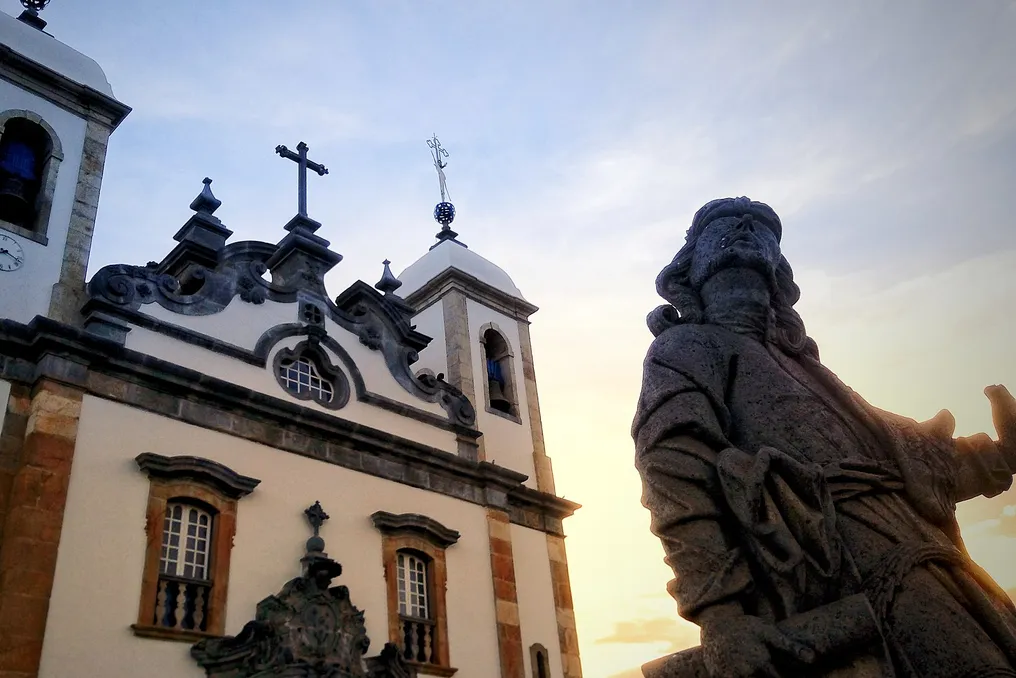
Located 80 kilometers from Belo Horizonte, Congonhas houses one of the most notable collections of Baroque religious art worldwide. This collection includes the sculptures of the 12 Prophets, a masterpiece by Aleijadinho, which harmonizes with six chapels dedicated to the Stations of the Passion. Within these chapels, we find images credited to Mestre Ataíde, coexisting with other pieces produced in the renowned sculptor's workshops.
The entire complex, situated in the Sanctuary of Senhor Bom Jesus de Matosinhos, has held national heritage status since the 1930s and was recognized as a World Heritage Site by UNESCO in 1985. The famous sculptures of Congonhas deserve closer attention.
The most emblematic spot in Congonhas is the external courtyard of the Sanctuary, positioned atop Morro do Maranhão. From a distance, the representations of the 12 Prophets can be seen, sculpted in soapstone during the transition from the 18th to the 19th centuries, with the purpose of surrounding the basilica. Although often confused with the apostles of Jesus, who were also numerous, the characters portrayed by Aleijadinho are actually figures from the Old Testament: Isaiah, Jeremiah, Baruch, Ezekiel, Hosea, Joel, Amos, Obadiah, Habakkuk, Jonah, and Nahum.
As rich as the images are the narrative of their production. The sanctuary originated from a promise made by the Portuguese miner Feliciano Mendes. Historical records indicate that in 1756, he suffered a serious illness and prayed to the Lord of Matosinhos for healing. After recovering, Mendes dedicated the rest of his life to building a place of worship in gratitude, although the sanctuary took decades to complete, long after the death of its originator.
Aleijadinho's sculptures themselves were conceived almost half a century later, between 1800 and 1805. At that time, the artist, whose baptismal name was Antônio Francisco Lisboa, was already facing an advanced stage of leprosy, which imposed restrictions on his movements. The disease gave rise to his melancholic nickname and also justified why the works of Congonhas were 'attributed' to Aleijadinho, given that while he was primarily responsible for coordination, the practical execution of much of the work in the sanctuary depended on the help of apprentices and assistants.
Although the set of 12 soapstone sculptures is the best-known aspect of the sanctuary, there are other creations by Aleijadinho in the Garden of the Stations, where the six chapels symbolizing the Way of the Cross of Jesus Christ are located. There, besides the cedar paintings made in Mestre Ataíde's studio, one can see 64 images by Antônio Francisco Lisboa partially carved in wood; these were last restored in 2024 to combat a termite infestation.
Even though the Sanctuary is the main attraction of the municipality, which has 55 thousand inhabitants, enthusiasts of religious tourism can visit other points of interest, such as the Parish Church of Nossa Senhora da Conceição, the Church of São José, and the Church of the Rosary, the latter being the oldest temple in the city, dating back to the late 17th century. It is also possible to delve into the local tradition by visiting the Cultural Center of the Pilgrimage, a place where pilgrims and faithful passing through Congonhas could rest until the early 1960s.
Other attractions include the Museum of Congonhas, which provides more information about the city's history and the relevance of Aleijadinho's works, and the Museum of Image and Memory, focused on aspects of the 20th century in the municipality, highlighting local folklore figures such as the medium Zé Arigó, who gained national recognition between the 1950s and 1960s. For those who wish to explore nature near the city and cool off on hot days, the Cachoeira Ecological Park is an option, located just 6 km from the center of Congonhas, offering swimming waterfalls, as well as infrastructure for camping, sports, and restaurants.