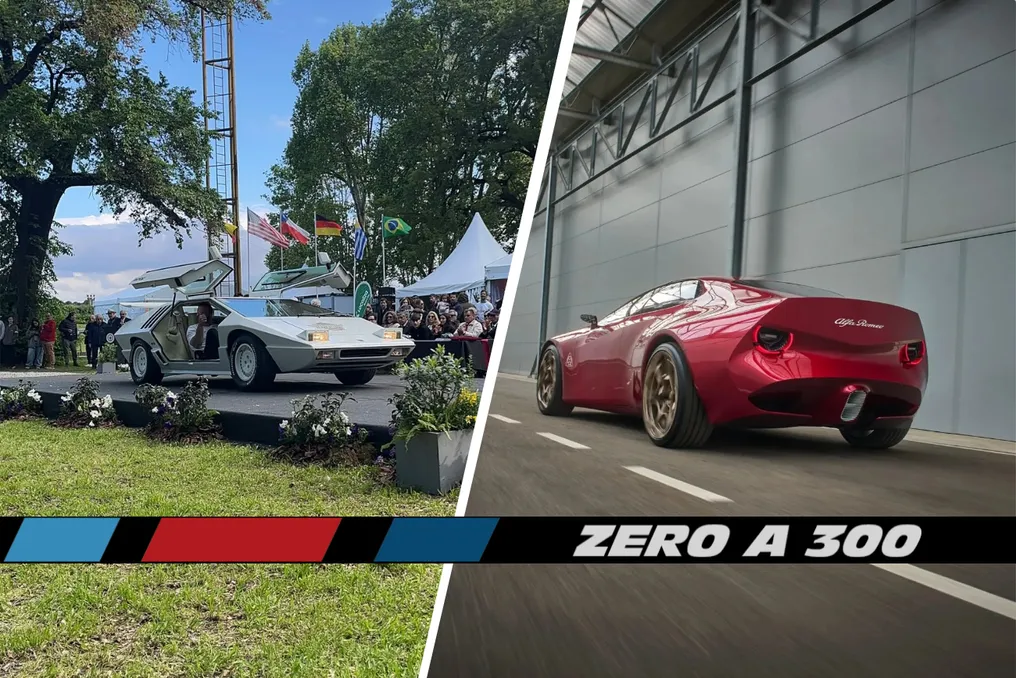
The Hofstetter Turbo received an award at Autoclasica, a vintage vehicle event held in San Isidro, Argentina. The 2026 edition recently concluded, and one of the 18 Hofstetter Turbo examples (which has an automatic transmission) was recognized among the winners.
This vehicle is part of the Dream Car São Roque collection and was honored for symbolizing the increased participation of Brazilian collectors and enthusiasts in Autoclasica. With this recognition, the Hofstetter establishes itself as the first classic car conceived, built, and registered in Brazil to win an international award. Additionally, Dream Car also exhibited one of the 25 Concorde V8 examples, a non-series model inspired by the 1930s and equipped with a Ford Galaxie engine.
The trajectory of the Hofstetter began in the mid-1970s, a period when automobile imports were strictly prohibited in Brazil. Mario Richard Hofstetter, at only sixteen years old, decided to build his own supercar, inspired by Italian concepts such as the Alfa Romeo Carabo and the Maserati Boomerang. He started the artisanal journey by selling his go-kart to acquire tools and compensation.
After years of work, the first prototype circulated in 1980 using a Formula 2 Cosworth-Hart engine, capable of reaching 12,000 rpm. Small-scale production began in 1984, adopting the Volkswagen AP turbo mechanics (initially 1.8L and later 2.0L), which could generate up to 175 hp, allowing the light coupe to reach 230 km/h. This vehicle featured a very low fiberglass body, only 1.07 meters high, and was notable for its scissor doors.
Hofstetter production ceased in 1991, following the arrival of imported vehicles in the 1990s. Despite this, the Hofstetter remained a symbol of off-the-shelf audacity in Brazil, combining artisanal skill and courage.
Winning an unprecedented award in Argentina, with one unit preserved in the Dream Car São Roque collection, celebrates the boldness of Mario Richard Hofstetter, proving that the passion of Brazilian artisanal builders deserves global recognition.
Alfa Romeo Cuorerosso represents the potential of the new Giulia
The Alfa Romeo Cuorerosso was presented last weekend, being a concept that the Italian automaker had hinted at with suggestive teasers. The vehicle is described as beautiful, a sedan with a long hood, short and sloping rear, muscular lines, and very well-defined proportions, almost like a four-door grand tourer.
Its visual identity evolves from the current Giulia: the front maintains the shape of the headlights and the position of the grille of the production sedan, but with more aggressive and straight lines. The traditional Scudetto grille features the Alfa Romeo snake drawn with LED lighting, creating a pleasant aesthetic effect. The rear doors are suicide doors (open backward), and the rear is inspired by 1970s Italian coupes, both in silhouette and round taillights.
Internally, there is a fusion of classic elements with modern technology. The three-spoke steering wheel is almost rectangular and futuristic. The instrument panel highlights two circular gauges, reminiscent of the 1960s, but they are digital. The center console is elevated and integrates tactile surfaces, such as a vertical multimedia screen, along with physical controls for air conditioning and gearshift, typical of a concept car.
However, the Cuorerosso does not serve as a direct preview of the next Giulia, despite its body and design characteristics suggesting this direction. Santo Ficili, CEO of Alfa Romeo, informed the Italian publication Quattroruote that the concept primarily functions as a design manifesto to define the future visual identity of the brand, and not as an announcement of a specific production model.
The first vehicle to adopt this new visual language will be a mid-size SUV expected to launch in early 2028 to replace the Tonale, based on the STLA Medium platform, with hybrid and electric options. The manufacturer also plans a new compact model, internally named Giulietta, which will have a slightly higher body to accommodate batteries in the floor, without being a traditional SUV, while the Junior will remain the entry-level model.
Regarding the Giulia and Stelvio, Alfa Romeo reconsidered electric exclusivity, deciding to extend the life of both until the end of 2027, at which point the next steps for the segment will be evaluated. The Giorgio rear-wheel-drive architecture remains secure in the group's luxury and sports portfolio, keeping alive the hope for a worthy successor that combines this mechanical base with the hybrid biturbo V6 engine.
Formula 1 will return to Africa in 2030 with a race in Rwanda
The government of Rwanda and Formula 1 have signed a ten-year agreement to bring the category back to the African continent. The event, officially called the Formula 1 African Grand Prix, will take place in the Kigali capital area, with the first edition scheduled only from 2030, depending on the completion of the new racetrack construction.
This will be the first time F1 competes in a race in Africa since the South African Grand Prix in 1993, ensuring the category's presence on all inhabited continents. The announcement was made in Kigali, attended by Rwandan President Paul Kagame, F1 CEO Stefano Domenicali, and FIA President Mohammed Ben Sulayem.
The new circuit will be built in a rural area, approximately 40 kilometers south of the capital, adjacent to the new Bugesera international airport. Designed by Hermann Tilke in collaboration with former driver Alex Wurz, the track will be 6 kilometers long, feature 17 counter-clockwise curves, and utilize the natural topography to create a public 'arena', presenting an elevation variation of 197 meters per lap.
This project is part of an ambitious investment plan by the local government to promote tourism, infrastructure, and major international sporting events. Rwanda has already hosted the UCI Road World Championships and the FIA Awards Ceremony. The initiative also addresses an old request from the grid, especially from Lewis Hamilton, who pressured the organization for an African GP. For President Kagame and F1, the long-term contract should generate a lasting economic and social legacy for the more than 100 million motorsport fans on the continent.
Hyundai Bayon revealed in Paris and set to arrive in Brazil in 2027
The Hyundai Bayon was unveiled during the Paris Motor Show this past weekend, becoming a new competitor in the entry-level SUV segment in Brazil, with an expected arrival in 2027, competing against models such as Volkswagen Tera, Fiat Pulse, Renault Kardian, Chevrolet Sonic, and Jeep Avenger.
This model is the result of the brand's R$ 5.5 billion investment plan in the country and will be manufactured at the Piracicaba (SP) plant, using the K3 platform, the same one used by the future i20 (replacement for HB20) and the next generation of the Creta. Its goal is to represent the brand in one of the most competitive markets.
Although it was already sold in Europe since 2021, the first generation was more of an 'SUV-ified' hatchback, similar to the HB20X. The new Bayon is a complete SUV, incorporating direct influences from the Tucson. Its dimensions have increased to 4.25 meters in length, 1.81 m in width, 1.57 m in height, and 2.60 m wheelbase, featuring a raised hood, prominent wheel arches, and a dual-level optical system.
The interior of the new Bayon features two 12.3-inch screens—one for the configurable instrument cluster and another for the multimedia center (with support for wireless Apple CarPlay and Android Auto), while retaining physical buttons for air conditioning control and essential functions. European versions may include premium Bose sound, digital key via app or smartwatch, panoramic sunroof, ventilated and heated seats, in addition to a robust ADAS package, such as adaptive cruise control, blind spot monitoring, and 360° cameras.
In Europe, there will be a second phase with a new 138 hp full hybrid (HEV) version, combining a 1.6L gasoline and electric engine. In Brazil, the strategy will be more direct: the entry-level SUV will debut equipped only with a 1.0L three-cylinder turbo flex engine producing 115 hp, coupled with a six-speed automatic transmission. This combustion engine allows Hyundai to compete aggressively with direct rivals, freeing up space in the portfolio for the Creta to advance in size and price in its next iteration.
Alpine A310 Vision Concept revealed in Paris
European automakers have demonstrated that reinterpreting the past with a futuristic touch is an effective way to capture public attention. The Paris Motor Show highlighted this with the presentation of the Alpine A310 Vision. This concept is a tribute to the sports car produced between 1971 and 1984, which competed with the Porsche 911, blending aesthetic nostalgia with a very aggressive profile. The A310's design features a low and sleek front end.