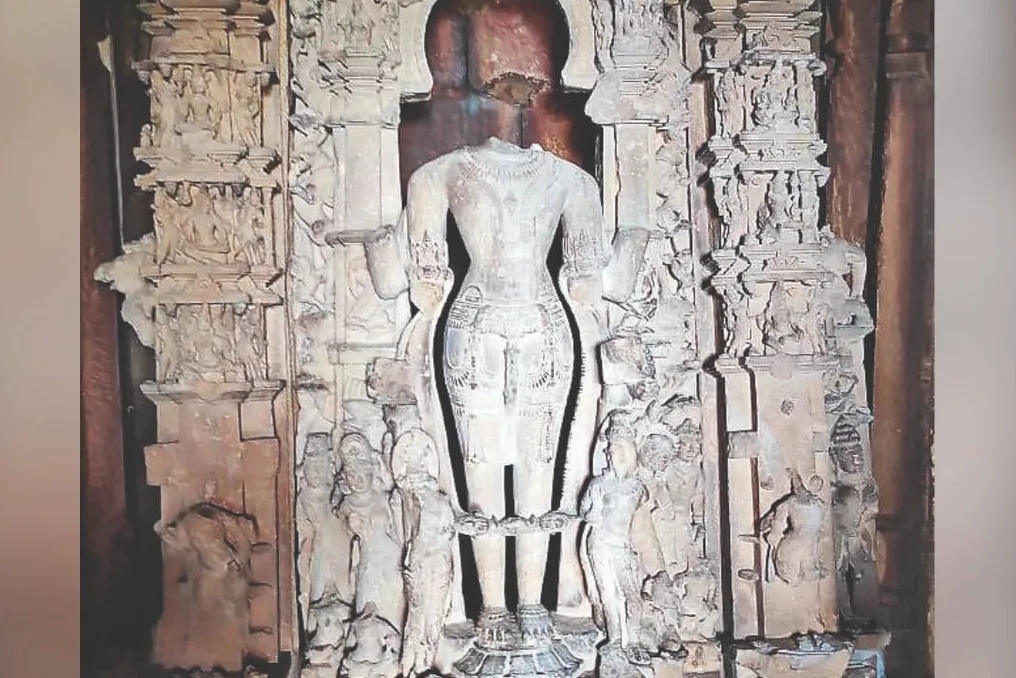
The Archaeological Survey of India (ASI) has found the missing head of an 11th-century Vaishnavite statue in Khajuraho. This discovery is linked to a recent controversy that reached the Supreme Court, and the head is now scheduled for restoration following expert examination.
Director-General Yadubir Singh Rawat told TOI in an exclusive interview about several ASI initiatives. He introduced a three-year period for archaeological excavations to reduce research delays, and the approval time for most conservation projects has been reduced to 15–20 days.
Rawat also spoke about plans for preliminary excavations at Vaishya Tekri in Ujjain, where a Buddhist stupa might be located, potentially larger than Sanchi, although its true scale and significance are yet to be determined.
The case concerning the decapitated Vishnu statue in the Jwari temple in Khajuraho was brought before the Supreme Court last year when lawyer Rakesh Dalal sought its restoration, replacement, or reconstruction of the seven-foot statue.
The then Chief Justice of the Supreme Court, B.R. Gavai, dismissed the petition, stating: 'Go and ask the deity itself to do something now.' Although Gavai later clarified his remark in court, emphasizing respect for all religions and noting that his statement was taken out of context, his words drew criticism, and one lawyer attempted to throw a shoe at him in the courtroom.
Rawat explained that the missing head was discovered in an ASI warehouse. He mentioned learning about the find during a visit to Bhopal for the BRICS summit. The warehouse official informed him that someone had likely tried to chip off the head for theft but failed. Experts are currently examining it, and the head will soon be reattached to the statue.
Regarding delays in archaeological surveys, Rawat noted that ASI has set a three-year period for completing excavation projects, with permissions automatically extended for financial years. He acknowledged that some researchers showed enthusiasm during fieldwork but delayed the final submission of reports, which slowed down the publication of results.
Furthermore, ASI has provided district staff with financial powers ranging from 50 lakh to 1 crore rupees, reducing the need to seek headquarters approval. Rawat stated that most annual conservation programs now receive approval within 15–20 days, except those requiring expert consultation.
A recent survey at Vaishya Tekri in Ujjain revealed a cluster of Buddhist stupas and a reservoir. Rawat noted that these structures differ from Sanchi because they are built of mud brick. The last excavations in this area were conducted in 1973.
ASI plans to start with limited vertical excavations to determine the significance of this site before undertaking a larger project estimated at 60 crore rupees. Rawat emphasized that the true picture will only become clear after the excavations, and they will continue work only after confirming the significance, even though the site is already under protected status.
He added that acquiring and excavating the entire site would require significant resources, so preliminary investigation is necessary to determine the feasibility of a full-scale project.
Concerning the illegal seizure of protected monuments, Rawat questioned the constant reliance on the list compiled during the colonial era under the Ancient Monuments Preservation Act of 1904. He explained that the root of the problem lies in the list prepared by the British rulers in 1904, which was subsequently adopted by the central government after independence without revision. The British included cemeteries and graves of their little-known soldiers, horses, mules, and domestic animals in the list, considering them extremely important. Rawat noted that a review should have been conducted before adopting this list to determine what is truly important for national interests.
Rawat mentioned that the 1953 review included state monuments in the final list, but the central list remained unchanged. The resulting difficulties eventually led to the exclusion of 17 monuments from it.
Explaining funding differences, he said that allocation depends on visitor numbers, maintenance requirements, security costs, and public amenities. The Taj Mahal and Red Fort served as showcases for ASI, and maintaining the Taj Mahal required high expenditure due to its fragile structure and large tourist flow. ASI spends about 3 crore rupees monthly on over 200 CISF personnel stationed there.
Rawat admitted that lesser-known monuments, including the pyramid-like structure of Bhim Ki Gada in Bareilly, received insufficient attention. He reported that ASI circles have been instructed to prepare proposals for the conservation and tourism development of such sites.
Regarding skeletal remains excavated in Rahigarh in Haryana, Rawat stated that ASI has signed a Memorandum of Understanding with the Anthropological Survey of India and the Birbal Sakhni Institute of Paleobiology. ASI will lead the project, while the two institutes will study the remains to determine physical characteristics, age, diet, diseases, sex, and other details. The report submission deadline is set for one year.
For Uttarakhand, Rawat outlined plans to track the historical pilgrimage route from Rishikesh to Kedarnath via Badrinath along the left bank of the Akalnanda River. He mentioned that references in Gita Press archives point to several temples and traditional stopping points used by local and tribal communities that were not properly documented. Archaeological markers or preserved remains could provide information on travel and settlement patterns.
He also expressed a personal desire for the project to trace the 'Swargarohan Path,' undertaken by the Pandavas to Kedarnath as described in the Mahabharata, to be implemented by the appropriate team with complete dedication and in a 'mission mode.'