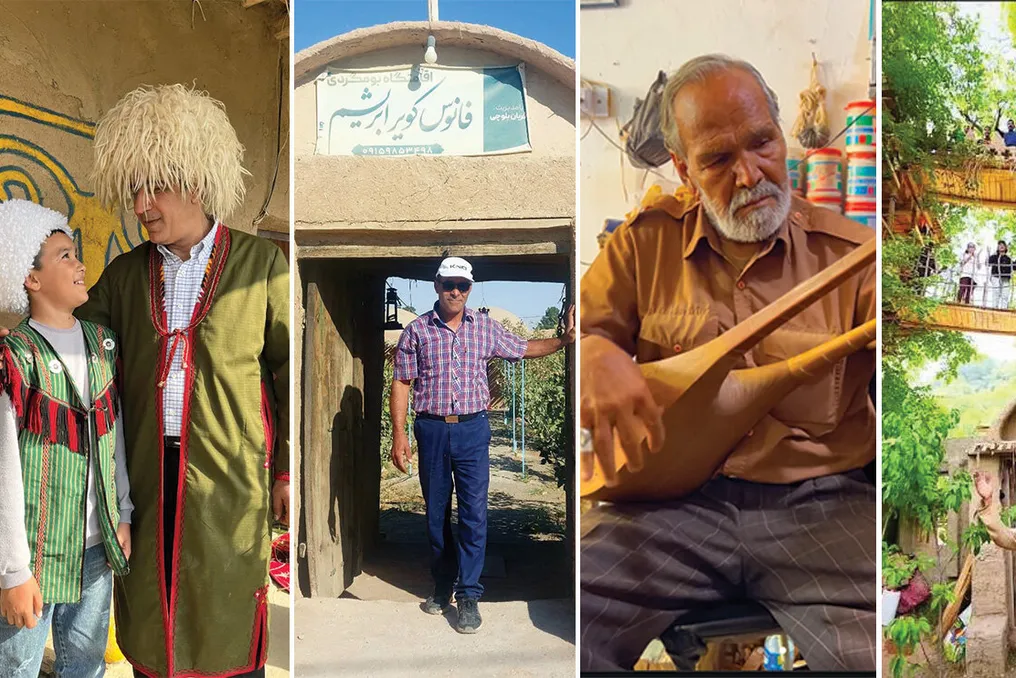
A friend's suggestion prompted the author to travel to North Khorasan—one of the few Iranian provinces he had not previously visited and rarely considered as a tourist destination. Over three days, they explored the province, striving to minimize expenses and relying on local guides and the knowledge of regional residents. Their itinerary included traveling through mountain strongholds, staying in traditional guesthouses, experiencing Turkmen hospitality, local musical traditions, festivals, and a secluded valley where one person had created their own world for years. Ultimately, the author realized how easily a place can remain off the tourist maps until someone gives it a chance.
Train ride to the edge of the desert
The journey began mid-day from Tehran towards Jajarm, one of the southern cities of North Khorasan. However, they planned to alight not in the city itself, but at the Jajarm railway station, located about 30 kilometers away. Arrival was around 8:00 PM. The long train took them out of the hustle and bustle of the capital into a landscape where the desert and mountains dictated a different rhythm of life.
The first night was spent in a modest traditional guesthouse near the railway line, next to a small pistachio garden. The building, made primarily of adobe brick and earth, consisted of about six or seven rooms and did not resemble a luxurious hotel room, which turned out to be part of its appeal.
The hosts, a middle-aged couple affectionately called Uncle Gorban and Aunt Zeinab, welcomed them with such warmth that the long journey seemed worthwhile. Dinner consisted of traditional food accompanied by local music. The setting was simple, without pretentious tables or decorations, resembling a family home where guests are received more like family members than clients. They ate, listened to music, and gradually adapted to the rhythm of this place, which seemed distant from the rush of the outside world.
The accommodation was basic: they slept on simple mattresses laid on the floor. The walls were earthen, the surroundings quiet, and above them stretched the starry sky. The author began to understand that comfort does not always depend on acquired possessions or expected services; sometimes it comes from the absence of what dominates daily life: noise, constant notifications, a tight schedule, and the feeling that one must constantly be doing something.
The morning brought some of the most memorable moments of the trip. Aunt Zeinab prepared two types of local bread: one plain, and another enriched with aromatic herbs, sesame, and black seeds. The aroma of freshly baked bread filled the space. There was also yogurt kept in a sheepskin, fresh eggs, and vegetables from the family's own garden. This was followed by the preparation of butter: the hosts used a simple traditional system with a sheepskin and wooden sticks to make butter from milk. This process reminded him of how daily needs were produced by manual labor and local knowledge long before industrial production made such tasks invisible to urban consumers. These things were not presented as an attraction; it was simply what the hosts did, perhaps their entire lives. Nevertheless, it gave them insight into a way of life that is becoming increasingly alien to city dwellers. Under this simple roof, the author felt an extraordinary sense of peace.
Before leaving, they thanked Uncle Gorban and Aunt Zeinab for their hospitality. This brief encounter left an indelible impression.
Through the mountains of Raz and Jargalan
After breakfast, they headed to the northern part of the province, to the Raz and Jargalan region, which is near the border with Turkmenistan. Here, the mountains, valleys, and remote settlements hold traces of the past that are not always obvious from the landscape. The drive took about four hours, but the scenery offered many reasons to distract from the road and look at the surrounding countryside.
One of the most striking sights was the ancient juniper trees, some of which, according to rumors, were hundreds of years old, and others estimated to be 2000 years old. Their twisted trunks and weathered branches seemed to embody the resilience of life in a landscape shaped by harsh weather and the passage of time. North Khorasan is abundant with such reminders of the flow of time, although visitors rushing to more famous places might never see them.
The historical attractions of the region were no less captivating. At one point, they stumbled upon a large defensive structure situated high on a mountain. The guide explained that it served as a refuge during invasions. When danger approached, people could retreat to this elevated fortress and raise ladders, making access difficult for attackers.
The location was impressive, but the first question that arose for the author was not about how the structure was built, but how people managed to reach it. Imagine a community suddenly threatened by invasion. Families would have to leave their homes, gather what they could carry, and climb a steep mountain path. Children, the elderly, and those carrying food or other necessities would have to overcome this difficult ascent. And inside, they had to wait, unsure of what was happening below or if they would return home.
The defensive advantages of such a place become apparent from a distance, but imagining the people who depended on it makes the history much more immediate. A little further along the route, they discovered another remarkable sight: a series of artificial caves carved into the mountain wall and located on three levels. According to the local guide, the lower level was used for livestock, while the upper levels served other purposes related to shelter and defense.
Iran's history is often presented through the grandeur of palaces, mosques, monumental tombs, and famous ancient cities. However, the country's past is also preserved in less conspicuous places: a mountain refuge, a cave room, an adobe house, or a path worn down by generations of footsteps. These are places where history is not always written on inscriptions; sometimes it is imprinted in the landscape itself.
The mountain refuges also recalled the long history of instability experienced by communities in this part of Asia. Trade routes connected remote regions, but the same paths could bring armies, bandits, and political upheaval. For people living in open settlements, the ability to find shelter was not an abstract architectural problem; it could determine whether a family would survive.
Finally, they left these mountains and continued their journey toward another type of encounter that was set to reveal another dimension of North Khorasan's character.
Turkmen welcome with unexpected pizza
By noon, they reached a traditional guesthouse run by a Turkmen couple along with their two sons. The atmosphere differed from the previous night's guesthouse, but the spirit of hospitality was evident from the start. The hosts were dressed in traditional Turkmen clothing and characteristic hats. Their appearance, mannerisms, and surroundings gave an idea of the cultural identity that has been preserved for generations in this border region.
North Khorasan is home to a diverse population, including speakers of Kurmanji Kurdish, Turkmen, Persians, and Turkic-speaking communities. The province's cultural richness is not merely the coexistence of different ethnic groups within one administrative boundary. It manifests in music, languages, food, crafts, clothing, and daily social customs. Here, cultural identities have developed over centuries of coexistence, exchange, and adaptation.
Turkmen communities, in particular, have preserved unique traditions in carpet weaving, textiles, music, and equestrian sports, and their cuisine reflects both local resources and broader cultural ties across Central Asia. Lunch at the guesthouse showcased some of these culinary traditions. The food combined Iranian and Turkmen influences, allowing them to taste flavors that were familiar in some aspects and different in others.
Then came the surprise: pizza, which the hosts called their own creation. It was delicious. The author did not expect to encounter a unique homemade pizza in a traditional guesthouse near the border with Turkmenistan. However, this small detail seemed to reflect something important about the character of this place. Cultural traditions do not necessarily survive by remaining frozen in time; they often continue through the ability to absorb new influences while maintaining a recognizable identity.
The greeting was once again informal and sincere. Since they were traveling on a limited budget, the hosts did not consider this an obstacle to offering generous hospitality. After lunch, they went to the dam reservoir for a short boat ride. The water was a pleasant change after hours of driving on mountain roads and dry landscapes. The surrounding hills created a quiet backdrop, and for a while, they could simply enjoy the view without thinking about the next destination.
Soon they were back on the road, leaving behind Raz and Jargalan and heading towards Shirvan. After about three hours of travel, they reached Shirvan, where one of the most memorable encounters of the trip awaited them.
Dutar workshop
The first stop was a traditional dutar workshop, run by instrument maker Hosrov Haddad and his sons. The dutar is a lute with a long neck and two strings, common in Iran and throughout Central Asia. Its name derives from the Persian words 'do,' meaning two, and 'tar,' meaning string. Despite the apparent simplicity of the instrument, its cultural significance is immense. In some parts of northeastern Iran, especially among Kurdish and Turkmen communities, the dutar is closely linked to the musical traditions of the bakhshi—performers who historically passed down songs, stories, poetry, and local memory from generation to generation. The dutar is not just a musical instrument; in the hands of a skilled performer, it can become a means of preserving the community's self-awareness.
The workshop also functioned as a shop where instruments were displayed and sold, but it resembled a place dedicated to a lifelong passion more than a commercial enterprise. Master Haddad had dedicated over five decades to making dutars and teaching how to play them. His apprentices shared his enthusiasm, and the atmosphere testified that the craft was sustained not only by technical training but also by personal dedication. Master Haddad and his students alternately performed several local compositions, first individually, and then together. Music filled the workshop, transforming an ordinary room into a space where the outside world seemed to recede into the background. The sound was distinct: sometimes gentle and thoughtful, sometimes energetic and rhythmic. The musicians' movements were natural, and their concentration was evident. It seemed they were playing not just for the entertainment of visitors; they were sharing something they knew very well and valued deeply. As the music continued, conversation began.