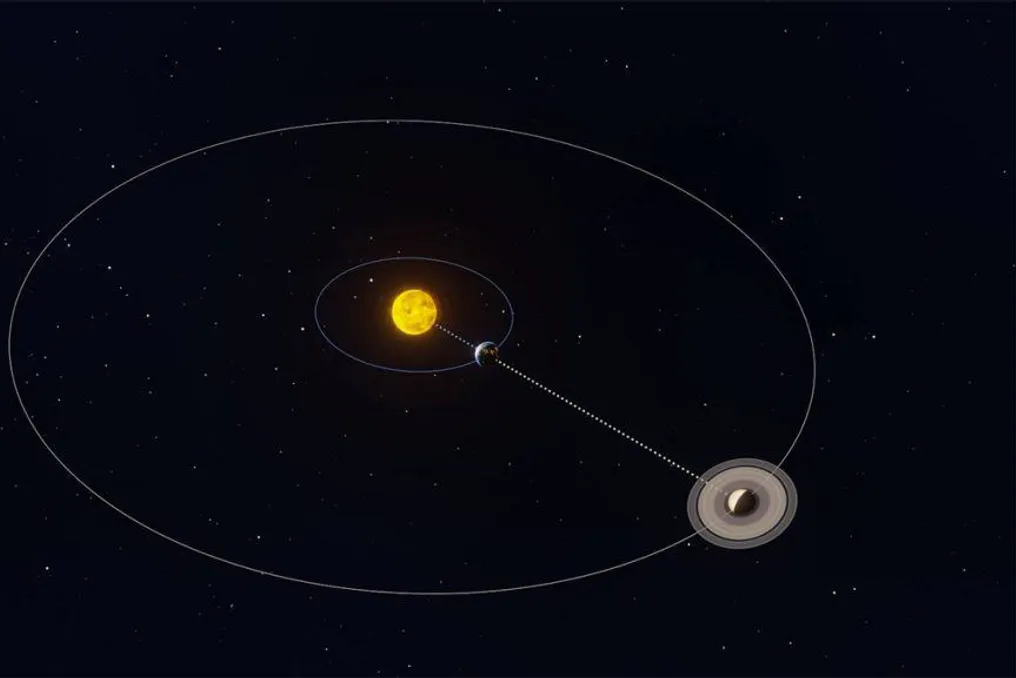
Now is the ideal time to observe Saturn. This gas giant recently passed opposition, moving closer to Earth, which makes it brighter in the sky.
To mark this event, the Olhar Espacial program invited amateur astrophotographer Nyêrdson Ferreira last Friday (the 9th). He showed live images of the ringed planet directly from Sertão Paraíba. All the material is available for full viewing.
Opposition occurs when the Earth is positioned between the Sun and another planet, in this case, Saturn. In this position, while the Sun is setting on one side of the horizon, the planet appears on the opposite side and can be observed all night. Furthermore, due to frontal illumination by sunlight, the brightness of the icy rings is enhanced.
During a conversation with host Marcelo Zurita, Ferreira explained that this favorable alignment aids in image capture and reduces shadows on the planet's surface. He noted: 'When it is in opposition, it seems far away, but it is actually closer to us. The Sun is on one side, the Earth is in the middle, and Saturn is opposite. Thus, we are directly in front of it relative to solar radiation. And in this phase, we see few shadows on the planet, so we also see very bright rings, which they call the Zeligher Effect.'
Ferreira, who holds a degree in biological sciences from the Federal University of Campina Grande (UFCG) and resides in Cajazeiras, recently gained international recognition after his image of the Moon was selected by NASA as the Astronomy Picture of the Day (APOD) on July 25th of this year.
In the program, he recalled the registration of the Seas of Tranquility and Serenity, highlighting the 'lunar mineralization' technique used to reveal the chemical composition of the lunar regolith. According to him, the bluest area has the highest concentration of titanium compared to others. He added: 'It was a great pleasure to be noticed by the North American Space Agency.'
For the live capture of Saturn, the astrophotographer used a 254 mm (10-inch) reflector telescope with a 4x Barlow lens and a specialized planetary camera. He recorded a 120-second video, accumulating over 8 thousand individual frames of the planet. The goal of this method is to overcome turbulence created by gases in the Earth's atmosphere, providing a large volume of raw data that is then processed through software for alignment and sharpness selection.
Demonstrating the post-processing stage using AutoStakkert! and AstroSurface, Ferreira transformed the shaky video into a detailed portrait of Saturn. He explained: 'The planet dances in the video due to wind gusts and the atmosphere itself. We collect as many frames as possible, and during stacking, it is like overlaying one image onto another to get an average value. The jolt and small oscillations disappear, and the average value becomes the real image.'
The final image clearly showed the 'Cassini Division'—a dark line separating Saturn's two brightest rings—as well as cloud bands in the center of the planet. Ferreira and Zurita also discussed two notable features of Saturn: its poles are slightly flattened due to its very rapid rotation (its day lasts only 10 hours), and it is so light and gaseous that it would float in water if there were a sufficiently large ocean to contain it.
Nyêrdson Ferreira took the opportunity to present other significant works from his career, such as the complex imaging of Jupiter's moons' mutual eclipses, where Callisto obscured Io. He said: 'What you see here is one moon passing in front of another; this event is called a mutual eclipse. Every six years, the orbital planes of the moons align with the Earth's view. There comes a moment when the moon simply disappears, being hidden. It is too difficult to do.'
Concluding his participation, the astrophotographer urged astronomy enthusiasts to acquire their first observing equipment, emphasizing the personal transformation this hobby brings. He advised: 'If you are thinking about buying a telescope, think twice, no, buy it sooner, because I regret not buying one earlier. Start small, get a telescope around 100 mm and study. Have something that allows you to observe and photograph; this will enrich your knowledge and make you much happier.'
The program highlighted the important role of amateur astrophotography in Brazil, demonstrating how the combination of accessible technology and passion for science connects the public with the mysteries of the cosmos.