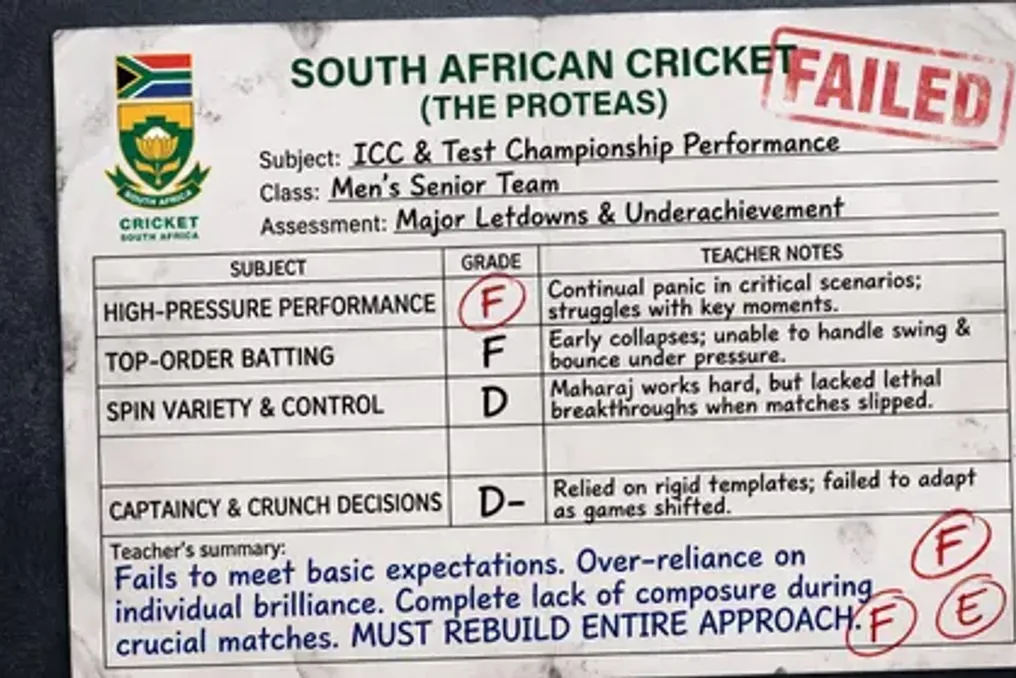
Proteas Player Ratings: Markram Showed Outstanding Play, While Rickelton and Stubbs Failed to Meet Expectations
Read more
IOL
iol.co.za

Proteas Player Ratings: Markram Showed Outstanding Play, While Rickelton and Stubbs Failed to Meet Expectations

The start of the World Test Championship defense at the home ground in Kingsmead was not smooth sailing. The lack of ball striking, intended for red balls, was evident, especially among the batters who did not demonstrate the necessary concentration at the crease.

The Proteas squad in Durban was managed by Zachir Adams from IOL Sport. The following performances were noted among the players:

Ayden Markram received a rating of 8/10 and was recognized as an outstanding Proteas player. He demonstrated a combination of resilience and composure, which was clearly visible in the fourth innings battle that prolonged Australia's wait for victory. Furthermore, he performed excellently in the field.

Ryan Rickelton received a rating of 3. His performance in the match was disappointing. Two failures early in the order could jeopardize his spot in the next Test match in Gqeberha.

David Bedingham received 6.5 points and appeared to be one of the most technically prepared Proteas batters against the fast Australian attack. He showed sufficient persistence, hinting at the potential for a greater contribution, although he may have been disappointed that he could not convert his start into a larger score.

Temba Bavuma received a rating of 4. For the captain, this was a match to forget. His team needed a defining game from the leader, but he could not exert significant influence. His dismissal by Matt Renshaw became a turning point in the second innings, and he also allowed the game to develop in the field.

Tristan Stubbs received 3.5 points. It was a difficult Test match. It seemed he settled well in the first innings before losing a wicket, followed by another mishit in the second innings when his team needed much more. Perhaps he will not have another chance to play on his home ground next week.

Vian Mulder received 7.5 points and is considered one of South Africa's best players. He contributed key runs, especially in the first innings, and almost saved Proteas from defeat through his partnership with Markram.

Kyle Verreyn received 5 points. He is reliable behind the stumps but again failed to show himself with the bat in both innings. Loyalty to the Western Province wicketkeeper may be coming to an end.

Marco Jansen received 6 points. He could have prompted the Australian batters to play more aggressively with the new ball. He also had two starts with the bat that were not converted.

Keshav Maharaj received 5 points. For Maharaj, it was a disappointing outing on his home ground. He was clearly targeted by Steve Smith, after which Matt Renshaw dismissed him with a shot and a reverse sweep. In the first innings, he showed good determination with the bat.

Simon Harmer received 4 points. He was not as impactful as expected. He will likely lose his spot at St George’s Park to make way for Kagiso Rabada's return to the attack.

Anrich Nortje received 7.5 points. He played aggressively, forcefully, and with full commitment. He often bowled at high speed and was one of the few who could unsettle the Australian batters with sheer pace. It was a solid debut in the first Test match in three years.


Similar stories

Proteas face target of 421 runs but previously completed five such chases successfully
Read more
iol.co.za

Proteas face target of 421 runs but previously completed five such chases successfully

The Proteas team is facing the task of chasing a target of 421 runs, which is a world record, in the first match against Australia at the Kingsmead stadium.

The team will have five sessions to counter the attacks of Australian bowlers. Nevertheless, the Proteas have already achieved miracles by successfully completing chases against the Australians almost twenty years ago.

Zahir Adams from IOL Sport compiled a list of the five most successful Proteas chases in Test cricket matches.

First Successful Proteas Chases

The first of these chases was in 2008 at the WACA ground in Perth, where the team defeated Australia by 6 wickets after chasing a target of 414/4. This is considered one of the greatest chases in the history of Test cricket.

The second instance occurred in 2002 in Durban at the Kingsmead stadium, when South Africa won by 5 wickets, thanks to centuries by Herschelle Gibbs and important contributions from Gary Kirsten and Jacques Kallis while chasing a target of 340/5.

The third example dates back to 1953 at the Melbourne Cricket Ground, where South Africa achieved a famous victory by chasing a target of 297/4 against Australia.

The list also features two early triumphs for South Africa. One was in 1906 in Johannesburg, where the team secured a dramatic victory by chasing a target of 287/9 against England. The second instance took place in 2008 in Edgbaston, Birmingham, when they chased a target of 283/5 against England.

Sunil Gavaskar criticizes India A schedule, calling it a violation of the Ranji Trophy format
Read more
www.aajtak.in

Sunil Gavaskar criticizes India A schedule, calling it a violation of the Ranji Trophy format

Former captain of the Indian national team, Sunil Gavaskar, expressed concern regarding the current format of the Ranji Trophy and the overall domestic cricket schedule. He believes that India A matches should not be held during the Ranji Trophy because this forces state teams to play without their key players. Furthermore, he raised questions about the significance of records set in the Plate Group.

The new Ranji Trophy season started on Sunday, October 11, but on the same day, the final match of the unofficial three-match ODI series between India A and Australia A took place. Due to this tournament, Rajat Patidar, Devdutt Padikkal, and Rituraj Gaikwad could not participate in their regional teams' games. Patidar represents Madhya Pradesh, Padikkal represents Karnataka, and Gaikwad represents Maharashtra.

Later this month, the India A team will also play three unofficial test matches on a tour of New Zealand, which may again affect the availability of some players in the Ranji Trophy. Sunil Gavaskar urged organizers to avoid such conflicts when creating the domestic cricket calendar.

In his column published midday, Sunil Gavaskar noted that India A matches serve as a good platform for assessing players at an international level. Nevertheless, he stressed that the Ranji Trophy cannot be ignored for these encounters. In Gavaskar's opinion, some players who score the most runs or take the most wickets in the Ranji Trophy face difficulties in securing a spot in the international team after earning selection. Some of them leave the team shortly after, while others wait a long time for their chance.

He explained one reason for this phenomenon as the limited participation of international players in domestic cricket. When strong players are absent from the Ranji Trophy, the level of competition in some matches can decrease. Under such conditions, it becomes difficult to accurately assess a player's true abilities based solely on individual statistics.

Sunil Gavaskar added that in the context of weak competition, it is possible for a batsman to score 2000 runs or a bowler to take 100 wickets in a season. His argument is that one must consider not only the record itself but also the level of the teams against whom the player played.

Moreover, Sunil Gavaskar expressed disagreement with the constantly changing records in the Ranji Trophy Plate Group. He stated that the decision to include all states and union territories in the tournament negatively affected the standard of competition. According to him, many new state teams lacked sufficient basic infrastructure. These teams provided an opportunity for players from other states who failed to make it into their home teams to play. Although these players were talented, the clash between the Plate Group teams and the strong Elite Division teams made the large difference between the two levels evident.

In Sunil Gavaskar's view, when the level of competition between the two divisions differs, it is impossible to evaluate records on equal footing. He noted that the Plate Group statistics are also recorded as Ranji Trophy records, but the level of competition behind these data cannot be ignored.

The current Ranji Trophy season is divided into five groups: A, B, C, D, and Plate. Four elite groups consist of eight teams, while the Plate Group features six teams. The top two teams from the Plate Group play in the final, and the winner secures a spot in the Elite group next season.

Five steps Proteas must take to save the first Test against Australia in Kingsmead
Read more
iol.co.za

Five steps Proteas must take to save the first Test against Australia in Kingsmead

The Proteas team must focus on two key tasks to have a chance of saving the first Test against Australia, which is being played in Kingsmead: they need to hold their own with the bat and become significantly more decisive in the game with the ball.

Australia has a significant advantage after recovering from a score of 124/6 to 390, thanks to the outstanding contribution of Matt Renshaw (190 runs) and a record partnership at number nine with Nathan Lyon (134 runs). Following this, South Africa allowed themselves to fall behind by 106 runs in the first Test match, and by the end of the third day, Australia increased this lead to 139 runs.

The only consolation is the team's prior experience at this venue. In the WTC final at Lord's last year, the Proteas were trailing Australia by 74 runs after the first innings, and then the Australians increased their lead to 102 runs before losing the first wicket; history showed how that ended.

Despite the substantial differences in conditions between Durban and London, the team needs to rely on this past experience, knowing that they have handled difficulties before.

How to achieve success

IOL Sport expert Zachir Adam described exactly how the team can succeed. First—immediately break the opening partnership. Nothing will happen until South Africa gains momentum in Australia's second innings. Pakistani players Heinrich Northey, Marco Jansen, and Bian Mulder must secure early wickets on the fourth day to prevent Australia from 'winning' the match by wearing down the Proteas.

A lead of 139 runs is considered manageable, but a deficit of 250 runs or more could be fatal.

Second—avoid repeating the situation of Renshaw and Lyon's 'rescue'. The decisive moment of the match came when South Africa had Australia in a difficult position (124/6) before allowing them to recover to 390. Matt Renshaw's innings (190) and the record partnership with Nathan Lyon completely changed the course of the game. If Australia loses early wickets in this innings, the Proteas must remain resolute and finish the job, preventing such a rescue act from happening again.

Third—spinners Keshav Maharaj and Simon Harmer must perform. The Proteas selected two spinners not just for nothing. In an ideal scenario, they would like to play on the last day to win the match, but now they have to perform heroic feats on the fourth day to give the team a chance to save the Test.

Proteas batting coach Ashley Prince noted: 'We will see a few more spinners tomorrow. Perhaps some innovative field placements and we will put the ball in front of them so they come and play.'

Nathan Lyon demonstrated a model for them in Australia's first innings, and now it is time for them to make their contribution.

Fourth—bat patiently. When the Proteas come out to bat again, they should copy the plan presented by Renshaw. His 190 runs scored off 397 deliveries were an example of discipline, not dominance. South Africa's first task is to forget the deficit and simply occupy the crease. Australian bowlers succeeded through impatience, especially when the Proteas chased runs instead of relying on defense.

Prince explained: 'Some players are more aggressive than others. Some tend to chase shots more than others, and over a long period, they get rewarded for it. And sometimes, you know, it doesn't pay off.'

South Africa's batsmen need to adopt a patient approach: survive first, then score runs.

Fifth—turn resistance into confidence. The Proteas are current Test World Champions and have repeatedly shown resilience under pressure. They do not need to force things from the start. Every session segment survived and every wicket taken weakens Australia's control over the match. A couple of early wickets on the fourth day could change the mood in the South African dressing room and make Australia reconsider its plans for declaring the match.

Popular