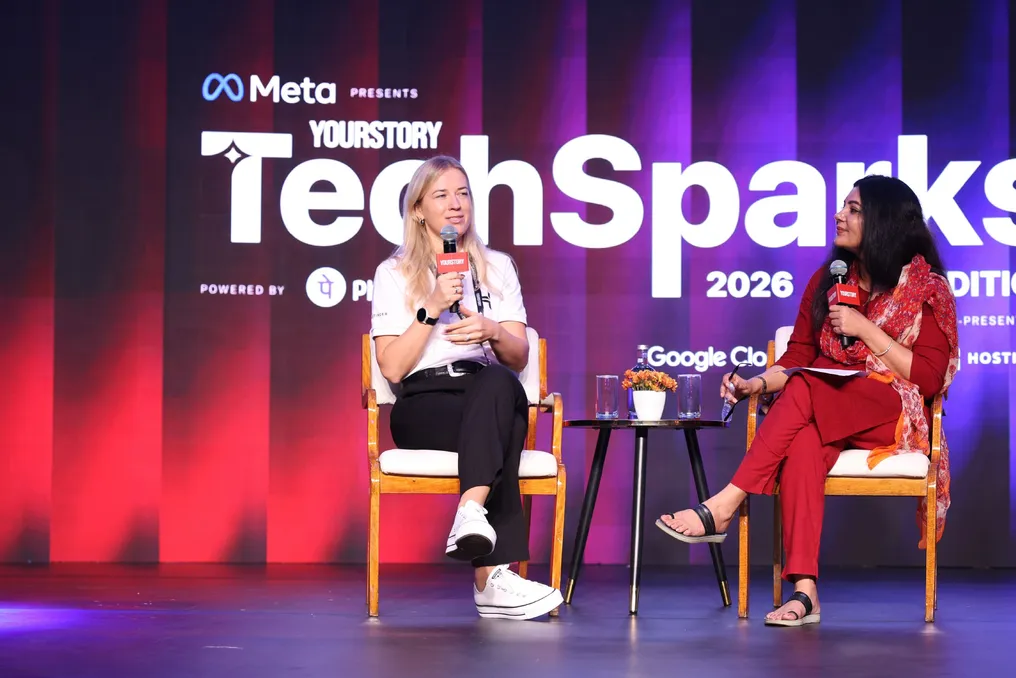
As artificial intelligence lowers technical barriers in website creation, making coding accessible and inexpensive, questions arise about the future of online-focused businesses. During an informal discussion at the opening of the TechSparks 2026 conference on October 13, Shraddha Sharma, founder and CEO of YourStory and The Bharat Project, discussed with Auksė Žirgulė, Vice President of Product at Hostinger, the changing customer expectations as AI takes over much of software development.
Žirgulė emphasized that experimentation has become a critical element in building customer experience. She noted that customer requests have become more complex: previously the focus was on product development, but now customers ask fundamental business questions such as: 'The market is saturated, and there are already so many products. What should I do next? How do I attract customers? How do I increase traffic?'
Since AI simplifies the creation process, Žirgulė believes that innovation remains key. She argues that anything can be created, but if you don't understand what problem you are solving, it is meaningless. Founders must deeply study the problem they are solving and test their products as early as possible. Another important factor is the ability to stand out among numerous existing products.
As an example, she cited Apple, which, although it did not invent the mobile phone or the touchscreen, achieved an exceptional customer experience. Žirgulė warns that excessive focus on product development and competitors sometimes leads to forgetting to seek new ways of solving problems, and this is where innovation manifests.
Nevertheless, she insists that even with AI, founders remain the core of the company. According to her, while she does not know what will happen in two years, AI may eventually make many decisions, but for now, the founder's task is to understand customers and possess product judgment, as the final say remains with them.
Furthermore, Žirgulė added that despite the drive to quickly create and test a product, founders must think not only about the product itself but also about the business model and the go-to-market strategy before launching it.
In response to Sharma's question about whether AI tools can generate mediocre designs and how founders should handle this issue, Žirgulė replied that if a website generates sales and supports the business, it is already doing its job well and does not necessarily need to win design awards. The same applies to software: testing, communicating with customers, and making iterative changes are necessary to assess whether the product achieves its goals.
As the number of easily available products in the market grows, consumer expectations will inevitably rise. Products offering a higher quality user experience and a higher level of quality will be able to stand out among competitors.
Finally, regarding autonomous AI solutions in workflows, Žirgulė advises caution. It is necessary to check how the system works, implement appropriate safeguards and capabilities, and closely monitor its actions. Experimentation, testing, and quality assurance are absolutely essential steps.
Hostinger, a company founded in Lithuania in 2004, is a global provider of hosting and domain names, serving 4.6 million businesses and creators in over 150 countries.