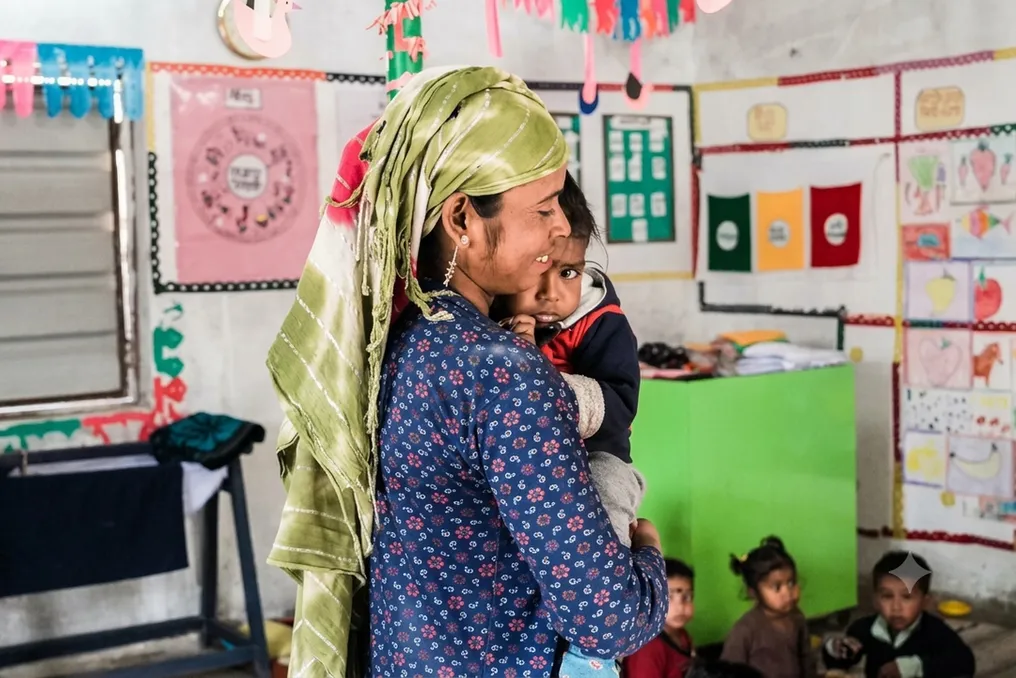
Mobile kindergartens are working to establish an early childhood education system for working parents, serving one million children over 57 years. In Gurugram, at the Aashiyana construction site, children arrive at kindergarten by 8 am while their parents work. Lalita, one of the educators, emphasizes that they closely monitor every child and communicate with parents regarding the child's nutrition and sleep.
For mothers who leave their children to return to work, this is immensely important. Lalita notes that while mothers may not know everything their child learns at the kindergarten, they know that the educator cares for the child, allowing them to work peacefully.
The Educator Who Stayed
At age 20, Lalita, who was teaching at a private school, noticed the Mobile Creches educational center near her home in South Delhi and decided to start working there. She now manages Aashiyana and its preparatory course. She independently paid for her bachelor's degree in pedagogy and covered most of the wedding expenses two years ago. Lalita says she paid for 80% of the costs herself, and despite her in-laws being government employees, she chose to work at the kindergarten, asserting that much of the respect and recognition she received is linked to Mobile Creches.
A Day Built on Routine
The kindergarten has separate rooms for children of different age groups: 0–3, 3–5, and 5–12 years. The walls are decorated with poems, stories, and a library corner. The daily routine includes prayer, morning circle time, breakfast (milk with sooji or kheer), games, and monthly thematic lessons, such as jungles or water, conducted using dolls and drums. Lalita stresses that the schedule never changes, regardless of visitors, and the children are accustomed to lunchtime.
Underweight children receive up to six small feedings and eggs daily. All staff members are called care workers. Assistants undergo daily training to cover for absent care workers, and refresher courses on child development, socio-emotional well-being, protection, and the POCSO Act are held every three to four months.
Safety is ensured by a multi-layered system: the main entrance is guarded, and a child cannot leave the premises without a parent or authorized guardian. An internal fence keeps the youngest children inside. Lalita explains that they maintain complete records for every child, including parents' photos, and do not hand over a child to anyone not on the list unless parental consent is obtained.
What Parents Find
At parent meetings, Lalita raises topics relevant to the site, ranging from nutrition to safety and substance abuse. She reminds parents that 'every child needs love,' advising them to spend at least 15–30 minutes with them at home, putting them to bed, and feeding them dinner. A year ago, the father of four children in Delhi, worried about sending his child to kindergarten, asked his wife to visit to understand how it worked. Since money was limited, balancing childcare and work was a difficult task, and the mother stayed home.
This visit was the beginning. After speaking with the mother, Lalita encouraged her to find work while the child was in the safe care of the kindergarten. Soon, she gained the confidence to entrust her child to Lalita and return to work, which ultimately doubled the family's income. Lalita notes that she is now part of the Saathi Samuh group—trusted parents who assist with hospital visits and school admissions.
Parents experience similar relief. Soni, 26, a worker at Century enterprise, sent five out of her six children to the Mobile Creches center in Homecraft, picking them up at 5 pm. This full workday is crucial because Anganwadi workers only work until noon, leaving working parents without supervision for the rest of the shift. Mobile Creches is based on the belief that if parents work, their children need round-the-clock care.
The model extends far beyond construction sites—to families on factories, tea plantations, brick kilns, crushing plants, and MGNREGA sites. Mobile Creches manages community centers in urban slums, as well as in rural and tribal areas. Galima, a makeup artist in Bengaluru, previously spent ₹6,000–₹7,000 per month on private daycare. At the Mobile Creches center, her daughter received regular check-ups, and her diet changed from bottled milk to kheer, khichdi, and eggs. As a result, Galima's income increased to ₹15,000 per month, allowing her to work without fear.
However, maintaining connections is difficult when families move. Approximately 60% of children leave every three to four months, and Sumitra Mishra, CEO of Mobile Creches, strives to prevent them from disappearing. She says they are accounted for in government subsidies so they are not lost. Lalita recalls a couple who left the site where their eldest child studied at Mobile Creches. At the new place, they learned about their rights as migrants and as parents and approached them asking to set up a center because 'You raised our eldest child so well. Therefore, we trust you to raise our children again.'
Deep Dive into the Gap Beyond the Gates
Mobile Creches' work in Odisha demonstrates how a well-managed kindergarten can make a difference. Regular monitoring allowed for the identification of areas needing program adaptation, and the team responded quickly. Community engagement increased, and to foster a sense of ownership, government teams shared data on children's nutritional status and its impact on growth with families in the local language. Average attendance rose to nearly 65%, and the number of children in the severe (SAM) and moderate (MAM) acute malnutrition categories decreased from 20.2% to 8.6%.
After almost three years, an independent evaluation was commissioned for a more objective analysis of the results achieved. The evaluation findings aligned with the program's internal information management system data: there were fewer underweight or malnourished children, which the evaluation attributes to active nutritional response. It was also found that over 98% of children in the kindergartens were vaccinated, and nearly 73% of mothers reported that their children fell ill less often after joining the center. 95% of mothers were satisfied with the educator's work, and 97% of staff members noted an increase in their social status in society, becoming trusted contacts for families as well as for accessing social security programs.
What 57 Years Teaches Us
Mobile Creches began operations in 1969 at the Rajghat construction site, where local women managed temporary kindergartens. Sumitra explains that the term 'mobile' refers to migrating families. Her list of essential elements for any kindergarten is brief: safety, nutrition, early learning, health and hygiene, and responsive care. The latter means having a 'caring adult, a care worker trained to perform this job with infants eight to ten hours a day.' This is why parents keep returning to these centers—it gives children a sense of security and happiness.
Her argument to developers is practical: 'Running a kindergarten is not your core business. Building this large real estate infrastructure is your core business, but running a kindergarten is our core business.' The company provides the premises, operating costs, and security, while Mobile Creches handles 'all the necessary details.' For Soni, the trust was easy because the kindergarten was located right on the site. This is the model; the hard part lies ahead. Sumitra admits that 'Mobile Creches cannot scale this alone.'
Recognizing the Caregiving Workforce
Building a stronger childcare system requires recognizing the workers in this field. Sumitra argues that childcare, like educating young children, needs qualified specialists, implying a formal path through training, certification, and recognition, with a clear career ladder from care worker to manager and trainer. Chirashri Ghosh, Executive Director (Policy and Partnerships), emphasizes that 'care workers are part of the green ecosystem of jobs we are creating in India, and care work must be recognized as skilled labor, not something that just naturally comes to women.'
This recognition must extend to the working conditions and pay of care workers. She states: 'If we want representatives of other genders to join this workforce, it must be better recognized and better paid.'
Integrating childcare into the formal system will improve the quality of care and provide workers with the dignity, safety, and professional status they deserve. This need is particularly acute in the informal sector, where reliable childcare determines whether migrants and daily wage workers can work or remain unemployed. Thus, the people who care for their children enable the entire workforce to participate in the economy.
Sumitra concludes: 'We must view childcare as economic infrastructure, not just social infrastructure.' When care workers are recognized, trained, and supported, they are not just looking after children—they are helping build the foundation upon which families, workers, and the entire economy depend.
A Model Ready to Grow
However, as Sumitra says, the conversation is changing. 'The post-COVID period has been a turning point in the discussion about childcare. When childcare fell onto the shoulders of the middle class, it became a personal issue for parents, and there were not many organizations doing similar work. So today, as pioneers, we welcome the changes seeing new non-profit organizations or companies entering this sector. I am glad that we now have a competitive ecosystem.'
Her vision is a 'circle of care,' of which Mobile Creches is only one part. She calls for 'localizing the idea of the circle of care to bring together several partners, each with their unique strengths.'
By 2032, Mobile Creches aims to provide access to quality early childhood services for 7 million young children in four target states, with half of the care workers being qualified and certified. Chirashri states: 'This is an opportunity for India to show the world a care model.' Slogan: Viksit Bachpan se Viksit Bharat.
Return to Aashiyana
Soni says her children often tell her that her teacher is very kind. Two days before the interview, Lalita's phone rang. 'Dedi, I got your number from someone recently. This is Anmol (name changed),' said the voice. Anmol was five years old when she cared for him at another site. Now he is 17 and studying in 11th grade, and he found her himself. Lalita says: 'For the children who grow up with us, we mean a lot. One day everyone else will understand that we, the care workers, are building a nation.'
The 'Champions of Indian Childcare' awards, to be held on October 28, aim to highlight the 'uncounted, invisible, undervalued work' of care workers across the country. Sumitra notes that care workers 'have never seen such role models on television, in print, or in major advertising campaigns.'
[