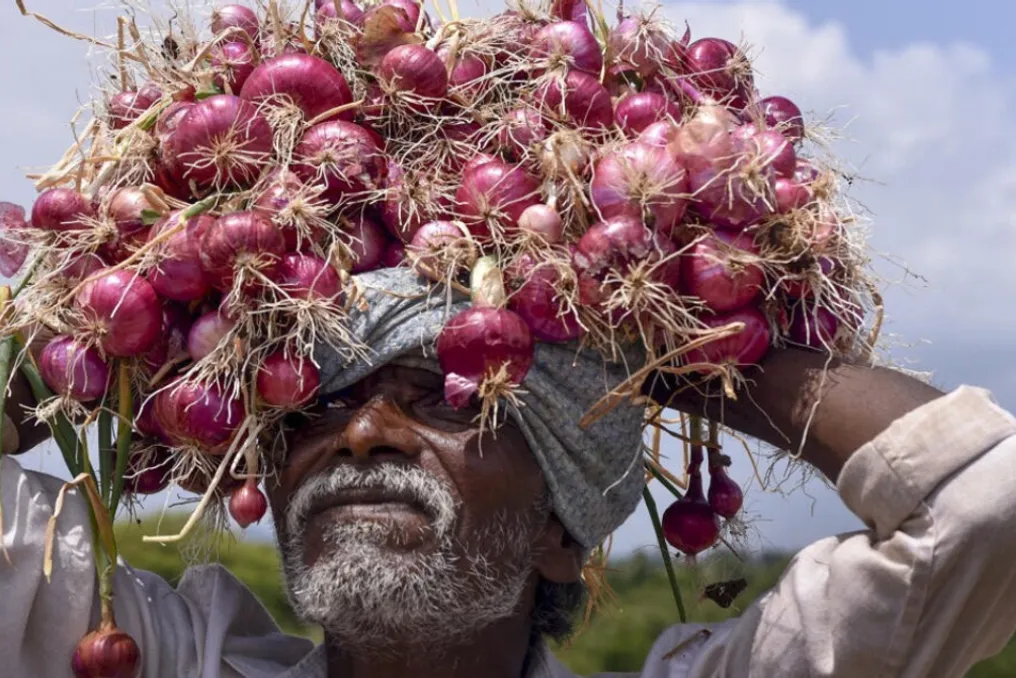
According to data from the Indian Consumer Price Index, onion price inflation increased from 22.54 percent in July to 48.27 percent in August 2026. When there is an increase in onion prices, the question of the reasons for such a sharp rise in cost often arises, but the answer is rarely straightforward.
On September 15, the average retail price of onions across India was 53.92 rupees per kilogram, which is 48 percent higher than the previous month and 94 percent higher than a year ago. Although India produces millions of tons of onions annually, the quantity reaching the markets during a specific period can change drastically depending on weather conditions, growing cycles, storage losses, and farmers' planting decisions. This year, the onion market suffered again due to production disruptions and supply delays.
Weather can disrupt supplies
The main volume of onions in India comes from the Rabi crop, which accounts for approximately 60–70 percent of the total production. These bulbs are harvested from March to May and stored to supply markets for several months. However, this year, weather problems affected both production and supply timelines. Unexpected rains in Maharashtra damaged some late-harvested bulbs, and monsoon delays impacted the sowing of the next Kharif crop.
In the Nasik region of Maharashtra, one of India's major onion-growing areas, it was recorded that the Kharif sowing started about 15 days later. This creates a time gap. When old stocks run out and the new harvest is not yet ready, there is less onion in the market. Wholesale prices can rise quickly, and this increase is eventually reflected in consumers.
A good harvest does not guarantee good supplies
There is another problem that arises after the harvest. Onions need to be stored for months until the next major harvest, but storage losses can be significant. The Indian Council of Agricultural Research estimates that 30–40 percent of onions can be lost during storage, with losses increasing under adverse weather conditions. Every bulb that spoils in storage means one less bulb available in the market. Thus, poor storage can reduce supply even with seemingly healthy production figures. This is one reason why farmers and researchers are increasingly considering improved warehousing and technologies capable of detecting temperature and humidity changes before large volumes of onions spoil.
Farmers react to yesterday's prices
Onion cultivation also follows its own cycle. When farmers receive low prices, their incentive to plant onions in the next season decreases. But if the planted area shrinks while demand remains stable, supplies can decrease, and prices may rise again. Maharashtra, which produces about a third of all onions in India, has repeatedly experienced this cycle. Farmers are forced to make planting decisions months before they know what the prices will be at harvest. This means that today's high onion price may partly be a consequence of cheap onions yesterday.
Government intervenes during price hikes
Since onions are a staple in Indian cuisines, a sudden price increase can quickly become a problem for households. The government uses measures such as buffer stocks, procurement, and changes in export policy to manage supplies. When prices rise, onions from government reserves may be released onto the markets to increase availability. Export restrictions have also been applied in the past to protect domestic supply. However, such measures can create difficulties for farmers during low prices, as exports can provide an additional market for their produce.
So why are onions getting more expensive?
The reasons are not singular. The current price increase is largely related to the availability of onions at a specific time, rather than India's overall annual production. Smaller or damaged Rabi production, storage losses, delayed Kharif sowing, and weather irregularities can reduce the amount reaching the markets when consumers need it. But there is another part to the story that begins much earlier—even before the onion is grown. It starts with the seed.
Before the onion, there is the bee
India produces about 15,000 tons of onion seed annually, and nearly 70 percent of this seed production depends on honeybees. Onion plants require pollinators to produce seeds. As bees move from flower to flower, they transfer pollen between plants, helping to produce seeds that farmers ultimately use for future crops. This makes pollination an important, yet often underestimated, part of the onion supply chain. And this process is becoming harder to maintain. Pesticides, monoculture farming, and the loss of local trees reduce the food base and nesting sites for bees. Onion seed producers in Maharashtra have reported fewer bees visiting their fields, making pollination difficult. The problem goes beyond onions. Healthy pollinator populations are also vital for the production of many fruits and vegetables.
Providing bees with a safe place to live
In Pune, Amit Godse, known as the 'Man-Beekeeper', is trying to solve part of this problem. Godse left a comfortable career to start saving bee colonies despite having no prior experience in beekeeping. Over the years, he has learned to work with five species of Indian bees and developed methods for safely relocating their colonies. Through his 'From Pest to Pet' initiative, he has saved over 17,000 hives and relocated colonies to farms and other suitable locations. He also plants 5,000 trees in Pune and builds bamboo homes for bees to support bee biodiversity. The connection to onions is simple. Before onions reach the mandi, they start with the seed. And before that seed can be produced, the flowers need pollinators. Thus, the journey of the onion—and sometimes the price we pay for it—can begin much earlier than the market. It can begin with rainfall, storage, and farmers' planting decisions. And even before all that, it can begin with a bee moving from one tiny onion flower to another.