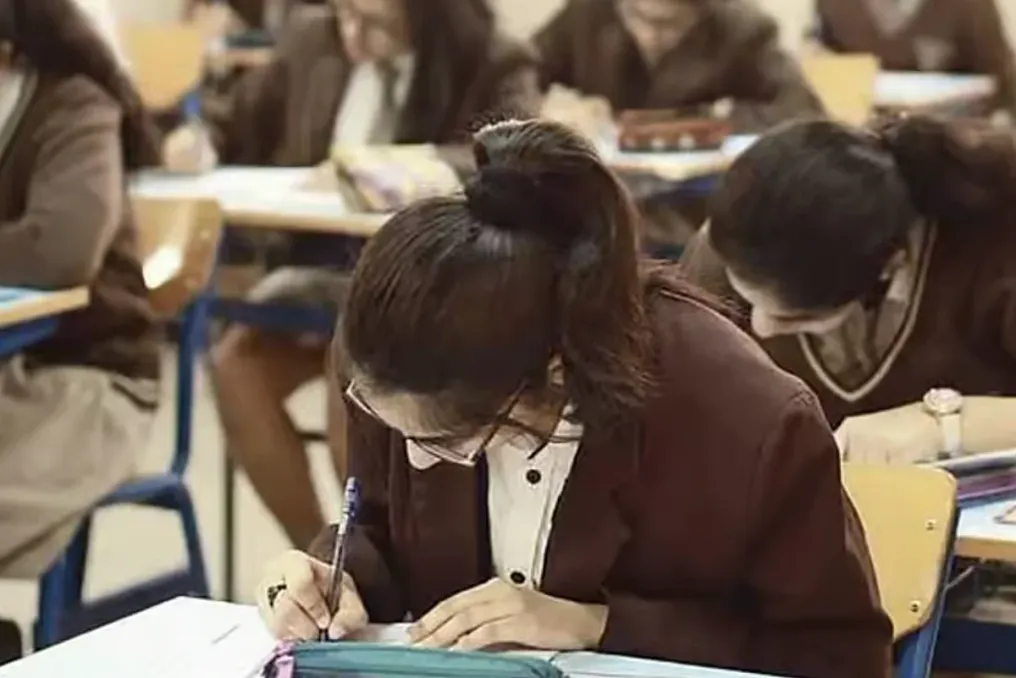
UP Board releases schedule for 10th and 12th exams of 2027; exams to start from February 5
Read more
Aaj Tak
www.aajtak.in

UP Board releases schedule for 10th and 12th exams of 2027; exams to start from February 5

Uttar Pradesh Madhyamik Shiksha Board (UP Board) has announced the dates for the 10th and 12th board examinations of the year 2027. The subject-wise examination schedule has been released by the board's secretary.

On Monday, the board's secretary released the detailed timetable related to the examinations. According to the information, these board exams in Uttar Pradesh will commence on February 5, 2027, and will be conducted until February 24, 2027.

The examinations will be held in two shifts. The first shift will run from 8:30 AM to 11:45 AM, while the second shift is scheduled from 2:00 PM to 5:15 PM.

Similar stories

Experts discuss the timeline for the release of the 8th Departmental Commission's report
Read more
www.aajtak.in

Experts discuss the timeline for the release of the 8th Departmental Commission's report

Central employees and pensioners are awaiting the next important meeting of the 8th Departmental Commission. The commission plans to hold meetings on October 7 and 8 in Bangalore, with another meeting scheduled for October 22 and 23 in Mumbai. Although the commission's work is ongoing, the main concern among workers is the timeline for the report's publication and the implementation of new tariff rates.

The 8th Departmental Council was given eighteen months to prepare the report. The government officially notified the Terms of Reference (ToR) and scope of the commission's activities on November 3, 2025, marking the start of the 18-month period. Currently, about eleven months have passed, and if the report is not ready within the stipulated time, the commission may request an extension from the government.

To date, the 8th Departmental Council has conducted consultations with employee and pensioner unions across different parts of the country. Events took place in locations such as Dehradun, Pune, Hyderabad, Srinagar, Ladakh, Lucknow, Bhubaneswar, Kolkata, Jaipur, Chennai, Puducherry, and Chandigarh. Meetings were held in Delhi on May 10 and August 7. The next scheduled sessions will be on October 7-8 in Bangalore and October 22-23 in Mumbai, where requirements and proposals from employees, pensioners, and other stakeholders are being discussed.

Various organizations have expressed differing views regarding the report's release date. Manjit Singh Patel, Chairman of the All India New Pension Scheme Employees Association, believes that if all necessary meetings conclude by November, the report could be submitted to the government in February or March.

On the other hand, S. Srikumar, General Secretary of the All India Defence Employees Federation, asserts that the commission has until May 2027, and the report might appear within the established 18 months. He also notes that after receiving the report, the government will require three to four months to implement the recommendations.

Conversely, SB Yadav, President of the Confederation of Central Government Employees and Workers, predicts that the report might be released in May 2027. He suggests that the review process by the ministerial group and its subsequent implementation could take another four to six months.

Kevy Kamesh, General Secretary of the Indian Railway Technical Supervisors Association, suggests that the results may emerge by the end of 2027, with new wage rates potentially taking effect from January 1, 2026. Avinash Rajput from Bharat Pensioners Samaj believes the entire process could extend until 2029 or 2030.

The Departmental Council itself does not set new salaries. First, the commission gathers proposals and negotiates with various parties to formulate its recommendations. Then, the report is sent to the central government level. The government may form a ministerial group to analyze the recommendations, making changes or adjustments. Subsequently, the government approves and publishes the recommendations. If the new rates are effective from an earlier date, employees and pensioners may receive amounts due for the past period, known as arrears.

Analysis of past departmental councils shows that report preparation times varied. The 7th Departmental Council was established in February 2014 and submitted its report in November 2015. The 6th Departmental Council was founded in October 2006 and provided its report in March 2008. Thus, the process of departmental council work often spans several years, making it impossible to definitively determine a deadline for the 8th Departmental Council's report.

Currently, the most critical point is that the release date for the 8th Departmental Council's report remains undecided. Trade unions are presenting various scenarios, ranging from February-March 2027 to May 2027. There are also opinions that implementation after the report's publication could take anywhere from three to a longer period. Employees are also discussing the possibility of introducing new rates from January 1, 2026. If the government applies them retroactively, this could pave the way for receiving arrears for the interim period. However, a final decision will only become clear after the government acts on the recommendations and official publication.

UAE Schools Set Interim Exam Deadlines Awaiting CBSE 2027 Exam Schedule
Read more
www.khaleejtimes.com

UAE Schools Set Interim Exam Deadlines Awaiting CBSE 2027 Exam Schedule

Students in grades 10 and 12 across the UAE are awaiting an official announcement from the Central Board of Secondary Education (CBSE) regarding the 2027 exam schedule. Nevertheless, school principals strongly advise families not to postpone serious preparation until the exam date is released.

The preliminary CBSE schedule for 2027, based on last year's timeline, is expected closer to the end of September or October, with the exams themselves planned for February-March 2027. Schools in the UAE have already begun planning interim exams (pre-boards) for November and January while students wait for the preliminary CBSE schedule for 2027.

Banu Sharma, Principal of Woodlem Park Al Jurf Ajman, advised parents and students to rely solely on the official CBSE website and school notifications once the schedule is published. She noted that, based on the previous year, the CBSE date set for the 2027 exams is likely to be announced in late September or October 2026, but confirmation should only be sought on official CBSE resources and school alerts.

Sharma emphasized that the waiting period should not lead to a halt in preparation. At Woodlem Park, students will undergo two rounds of interim exams—in November and January. She recommended that students review subject dates, examination times, and intervals between tests before creating a final revision plan.

Other schools in the UAE are also moving forward with their internal testing schedules. Dipika Tapar Singh, CEO of Credence High School, reported that the first interim exam for grades 10 and 12 at this school is scheduled for November 10, with practical exams beginning around mid-January, in line with CBSE recommendations. She reminded that last year CBSE released a preliminary schedule on September 24 and a final one in early December, whereas this year schools are still awaiting the preliminary schedule.

Singh also pointed out that students already have a useful preparation tool—the latest sample papers and marking schemes from CBSE. She stressed: 'What is more important is that CBSE has already shared the latest sample papers with the marking schemes upon which this year's examination papers will be based. Our teachers use them to prepare for interim exams, and parents must ensure that students complete them and carefully study the marking scheme.'

At GEMS Our Own Indian School in Dubai, according to Director/CEO Lalita Suresh, interim exams for grade 12 are scheduled for late November, and for grade 10—for January. These exams are intended to identify knowledge gaps and give students time to improve before the final exams. Suresh added that schools may conduct a second mock test if necessary.

Principals noted that the true value of interim exams lies not only in the scores obtained but also in the actions taken by students afterward. Suresh advised students to complete the first full revision before the interim exams begin, and then use the results to identify areas needing attention. She clarified: 'Interim exams should not be viewed as the final goal, but as an important diagnostic test. They give students the opportunity to understand what they know, where they make mistakes, and which areas require further attention.'

Furthermore, she recommended focusing after the interim exams not on completing the curriculum, but on refining exam-taking skills. Regular practice with CBSE samples and questions will help improve time management, presentation, and accuracy. Analyzing mistakes after each test is equally important. Students should ask themselves not only 'What did I do wrong?' but also 'Why did I do it wrong and how can I ensure I don't repeat this mistake?'

Meanwhile, Singh also urged families not to turn the approaching exams into a source of unnecessary anxiety. She stated: 'There is no need for anyone to worry. Children simply need a proper schedule and study plan after school, as putting everything off until the last minute creates pressure. The CBSE exam requires multiple revisions, so starting early helps.'

She advised students to analyze returned interim exam papers, determine where marks were lost, and revise those sections first. Singh also addressed parents: 'These are older children, so talk to them and help them understand why they should give up phones and study from NCERT textbooks, class notes, and notebooks. If online material is required, set a clear time limit.'

In conclusion, she added: 'Above all, children should write and study, not just read. They should also review the sample answers and top student responses published by CBSE every year to understand where they are right and where they are mistaken. Our teachers regularly discuss this in class so that children understand how the work should be presented.'

Popular