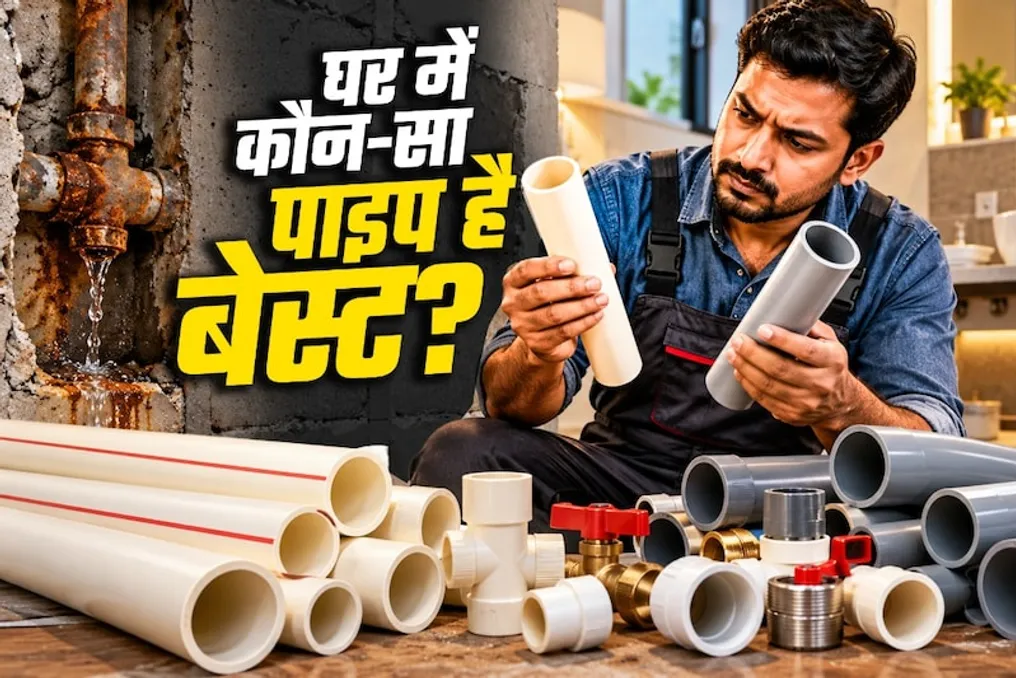
When building a house, people pay close attention to tiles, paint, furniture, and expensive plumbing fixtures, but the piping laid inside the walls often receives insufficient attention. When choosing pipes for the water supply system, metallic pipes are often selected, which can corrode over time, leading to leakage problems. Such a minor oversight can turn into serious difficulties in the future.
Pipe leaks cause dampness in walls, reduce water pressure, and sometimes require tile demolition to fix damage. In the past, metal or aluminum pipes were used for water supply, but constant contact with moisture and water leads to their rusting. This raises the question: what type of pipe is best suited for underground installation in a home? This article provides information on pipes that are resistant to rust and minimize the risk of leaks.
If you are looking for options for piping in the bathroom, kitchen, or boiler room, you can consider CPVC pipes. CPVC, or chlorinated polyvinyl chloride, is used for supplying both hot and cold water. Its advantage is the absence of rust and suitability for hot water. The inner surface of these pipes is smooth, which helps maintain good water flow. However, when purchasing, it is necessary to check their ability to withstand the specified temperature and pressure.
UPVC pipes, or unplasticized polyvinyl chloride, are characterized by lightness, strength, and corrosion resistance. They are designed for cold water supply and drainage systems. Maintenance of such pipes is usually simple, and they are not susceptible to rust, unlike metal or aluminum pipes. However, it should be remembered that not all UPVC pipes are suitable for all types of systems; before using them for hot water supply, one must review the information provided by the manufacturer.
OPVC pipes, or oriented polyvinyl chloride, possess high strength and can withstand significant water pressure. They are primarily used in water supply systems where the pipes must resist strong pressure. Although OPVC may be an optimal choice for a standard home system, this is not an absolute rule. The choice must be based on the needs of the pipeline, water pressure, pipe shape, and relevant technical standards.
Firstly, pipes should not be chosen solely based on low price, as buying cheap, low-quality material can result in large expenses later. It is necessary to check the thickness, quality, compliance with established standards, and pressure-bearing capacity. Secondly, you must choose a suitable pipe for hot and cold water, as not every pipe is suitable for hot water. For hot water lines, a pipe certified for operation at the corresponding temperature should be selected. Thirdly, the quality of fittings must be assessed: even when installing a quality pipe, a leak can occur due to weak connections or improper installation. Therefore, it is important to check the quality of parts such as elbows, T-joints, couplings, and valves. And fourthly, water pressure and quality cannot be ignored; if the house has high pressure or the water contains many minerals, these conditions must be taken into account when selecting pipes. The correct components must be chosen according to the pipe rating and water supply conditions.
Even after installation, proper maintenance is required. In addition to using quality pipes, their correct installation and periodic inspection are critical. Signs such as dripping water from connections, the appearance of dampness on the wall, or a sudden drop in water pressure should not be ignored. Timely troubleshooting prevents major repairs and significant costs. Thus, when building or renovating a house, pipes should not only be chosen based on price. You need to select CPVC, UPVC, or OPVC depending on the needs and entrust the installation to an experienced plumber. The correct choice of pipes and reliable fixation will help keep the home's water supply system in good condition for a long time.