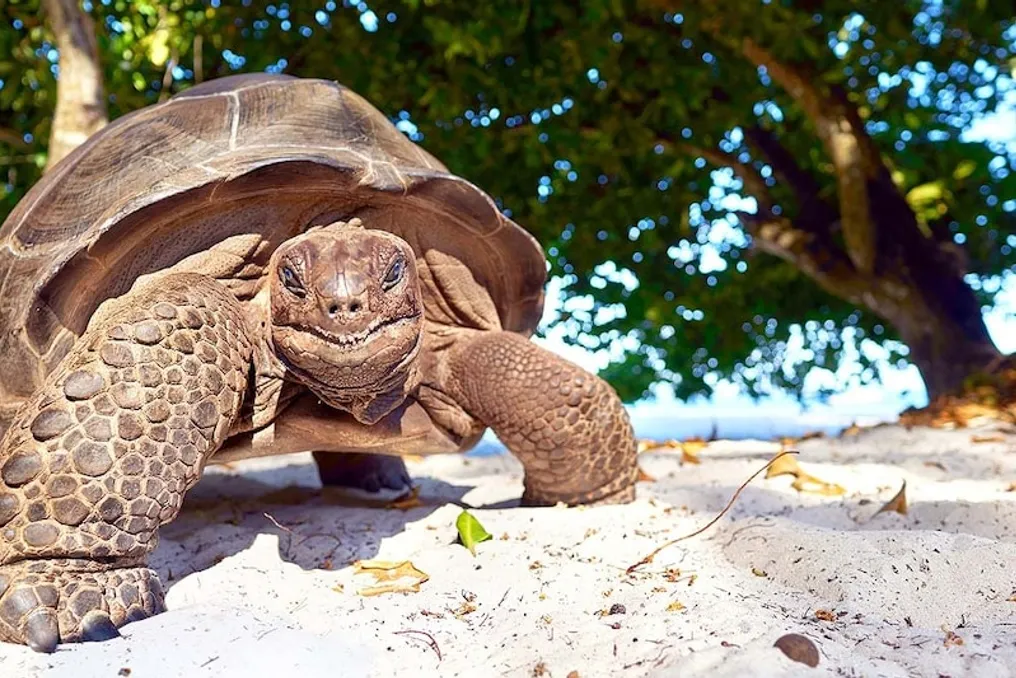
Aldabra Atoll in the Seychelles hosts approximately 183 thousand giant tortoises, which surpasses the entire population of the Seychelles, which stands at 135 thousand people. This data was obtained as a result of a new scientific study.
According to the study, the tortoises on Aldabra have the largest population among all wild giant tortoise populations. Notably, their numbers declined to fewer than 1,000 individuals due to hunting in the 19th century, but thanks to long-term protection measures, the population has significantly recovered.
The research was conducted by scientists from the Seychelles Islands Foundation (SIF) and the University of Exeter, using data collected between 2018 and 2022. The scientists were able to estimate even those tortoises that were not visible due to hiding in dense vegetation and trees. The results of this work were published in the journal Ecology and Evolution.
Previously, the last major assessment of the tortoise population on Aldabra Atoll was made in the late 1990s, when it was estimated that there were about 100 thousand tortoises. The new study shows that the number of adult and near-adult tortoises has reached approximately 183 thousand. However, scientists note that this does not mean the population doubled after 1999; they believe that older surveys might not have accounted for many tortoises hidden in dense vegetation, making them difficult to detect.
Following mass hunting in the 19th century, which led to a sharp decline in the giant tortoise population on Aldabra to below 1,000 individuals, steps were taken to ensure their protection. In 1981, Aldabra was declared a protected natural area, and in 1982, it was included in the UNESCO World Heritage List. Thanks to prolonged protection and monitoring, these tortoises have been saved.
Frank Flaysher-Doyle, CEO of the Seychelles Islands Foundation, stated that the presence of over 180 thousand giant tortoises in the open environment is the result of years of conservation efforts. The new study also showed that there were no significant changes in the population between 2018 and 2022.
Scientists found that the largest concentration of giant tortoises is located in the grassy areas of Aldabra, known as 'tortoise turf'. High concentrations are also observed in open areas with fewer shrubs. Meanwhile, in areas with dense vegetation, mangrove swamps, and Pemphis plants, spotting tortoises is extremely difficult.
Therefore, when counting, the scientists took into account the visibility of the tortoises in different locations to obtain a more accurate estimate of the total population size.
Despite the population stabilization, tortoises still face a number of threats. According to scientists, climate change could lead to longer and more frequent droughts, which may cause food and shade shortages for the tortoises. Furthermore, sea-level rise poses a danger to the low-lying areas of the island.
Wild cats and black rats are pests to eggs and young tortoises. Wild goats previously damaged vegetation, but they were removed in 2012. Scientists believe that eliminating wild cats and rats could also improve tortoise protection.
According to scientists' estimates, predicting a population of 183 thousand will help track its condition in the future, allowing an understanding of the impact of climate change, droughts, and other threats. Scientists emphasize the need to continue counting tortoises to promptly identify any population changes and take measures for their conservation.