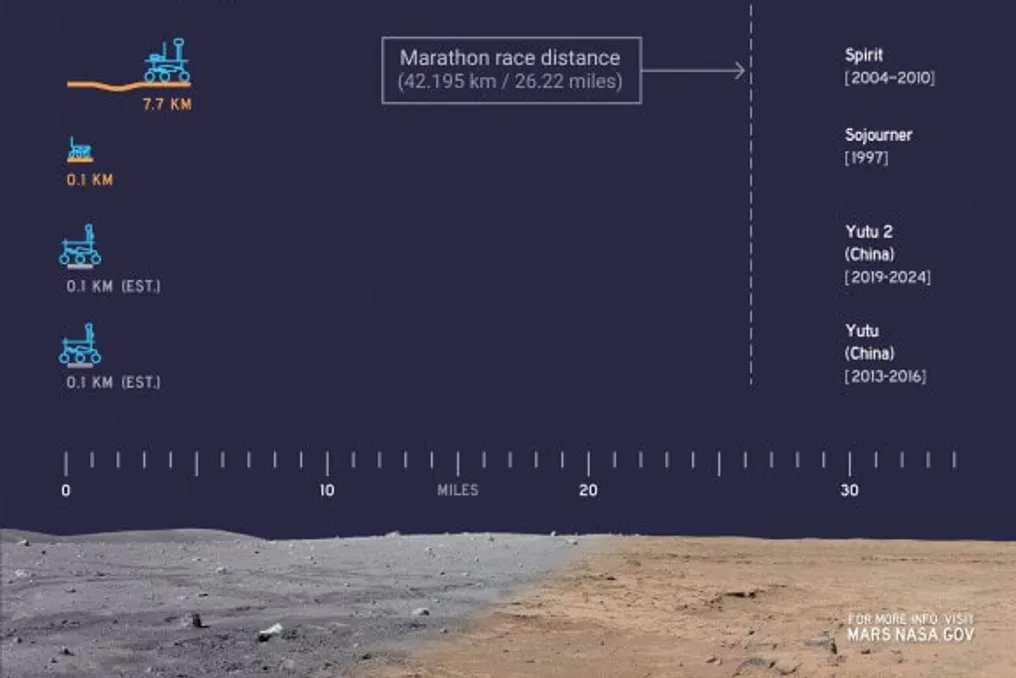
NASA's Perseverance rover has set a new distance record on Mars, covering over 28.06 miles (approximately 45.2 kilometers) since its arrival on the planet in February 2021. This record was achieved on Sunday (the 11th) in the Jezero Crater area and was announced on Tuesday (the 12th) by the Jet Propulsion Laboratory (JPL), which is responsible for operating the spacecraft.
Thanks to this achievement, the robot surpassed the distance covered by Opportunity, another NASA rover that explored Mars between 2004 and 2018. However, Perseverance's progress did not happen as early as the team expected. The mission had to change its route to study light rocks, which may be some of the oldest studied on the planet, delaying the record achievement by about two months.
One of Perseverance's features is its ability to autonomously plan part of its movements. Similar to some modern cars on Earth, the spacecraft can find paths between two points without requiring detailed instructions for each segment from ground control.
Furthermore, the rover is equipped with a faster computer chip compared to its predecessor Curiosity, which arrived on Mars more than eight years ago and covered less distance. This technology represents an improvement over Sojourner, NASA's first robotic rover, which traveled only 341 feet (about 104 meters) over 12 weeks in 1997 and relied on specific commands sent from Earth.
In the initial months of its mission, Perseverance explored the terrain of Jezero Crater. This area is about 30 miles wide and once held a lake when Mars was warmer and wetter. The location was chosen for the mission due to the potential for preserving organic traces that could help in studying the existence of life on the planet.
The mission also included Ingenuity, a small helicopter delivered in the belly of Perseverance. After being deployed onto the Martian surface, the equipment conducted the first controlled and motorized flights on another planet. The initially planned series of tests saw the helicopter accompany the rover's exploration and complete 72 flights before one of its blades broke in January 2024.
In April 2022, Perseverance reached the old river delta in Jezero Crater. It recently left this area and began exploring rocks dating back about four billion years in Lac de Charmes. This area is named after a reservoir in France.
Among the discovered materials are light rocks called gabbro, which are similar in composition to basalt but likely formed at greater depths where magma cooled longer and formed larger crystals. Scientists have found signs of intense melting and impacts in these rocks, which could have resulted from three different meteorite events.
The team attempted to drill one of these formations to collect a sample, but the rock proved too hard. Nevertheless, research continues, as these materials could provide information about the first 500 million years of the Solar System.
Before launch, NASA certified Perseverance to travel 20 kilometers. Since the spacecraft has already exceeded this distance, the agency is working to expand the certification to 100 kilometers, which is slightly more than 62 miles.
Currently, there is no long-term plan defined for the rover after completing the survey of the current area. NASA must also decide the fate of the samples stored on the equipment.
The Mars Sample Return project, which involved bringing this material back to Earth in collaboration with the European Space Agency, was canceled due to excessive cost. NASA could potentially resume the initiative through a commercial mission but has not announced plans in this direction.