The main characteristic distinguishing mammals from other animals is the ability to suckle. The emergence of this trait was only possible after these animals underwent a series of anatomical adaptations, including the development of mammary glands and the formation of new structures in the throat capable of regulating food passage.
Pinpointing the exact moment when mammalian ancestors underwent these changes is difficult, but scientists have found an important clue. According to a new analysis of fossils, a distinct Jurassic species approximately 165 million years old may be the earliest recorded example of a sucking species.
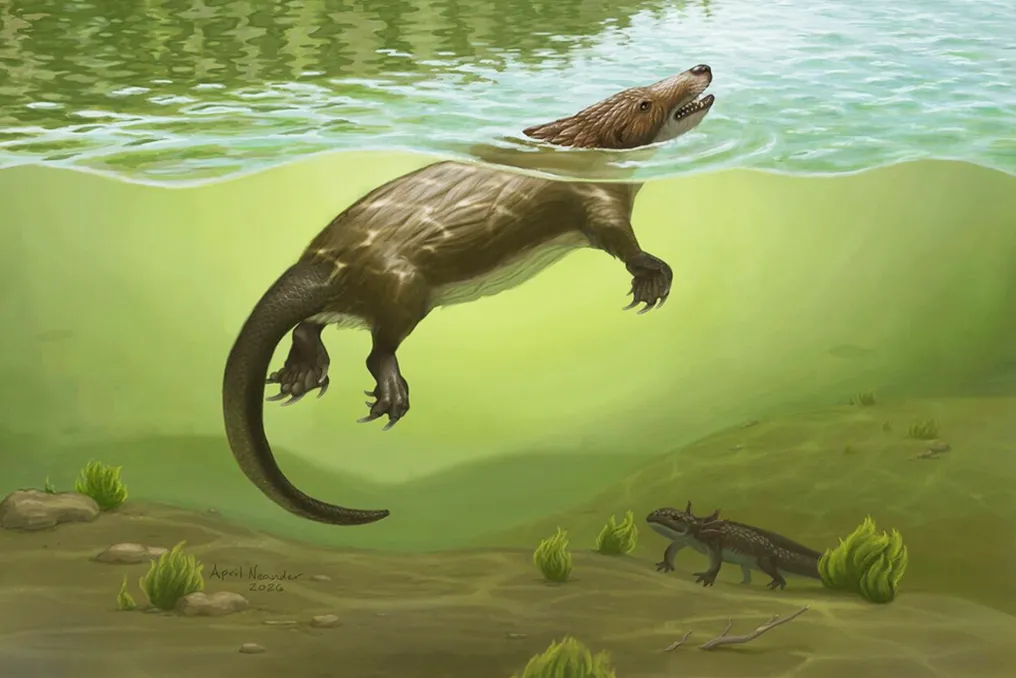
Recently named Megacauda sungei, it was an ancestor of modern mammals that inhabited the lakes of present-day Inner Mongolia, an autonomous region of China, during the Jurassic period when dinosaurs still roamed the earth. Its hind limbs resembled otter limbs, its tail was long and flattened like an otter's, and its throat possessed the same bone structures that help mammals suckle and swallow mother's milk today.
This species was described in a study published in the journal Nature on the 7th. In it, researchers analyzed a set of fossils found in 2015 at the Xianji paleontological site in China, which is rich in such remains. The darkened bones were preserved in a dark piece of rock; to see the contents of the fossils, researchers divided the sample into smaller pieces and took pictures using X-ray fluorescence analysis.
By illuminating the bones, researchers were able to identify features of each preserved area, including the skull, pelvis, hind limbs, and tail. Features such as elongated toes on the hind paws or broad tail bones, as well as teeth capable of tearing the flesh of aquatic predators, indicated that this creature was likely well-adapted for swimming and hunting in water.
Thus, this species represents the earliest example of a mammalian ancestor adapted to a semi-aquatic lifestyle. Interestingly, researchers also discovered small fragments of vertebrae in the stomach—probable remains of small aquatic prey that constituted this animal's diet.
The species belongs to the extinct lineage of dicodonts, relatives of Mesozoic mammals. However, it differed in size: being 40 to 50 centimeters long and weighing one or two kilograms (about the weight of a cat), Megacauda was significantly larger than any other known dicodont.
Upon detailed examination of the skeleton, certain structures in the throat attracted the attention of scientists. The creature had a hyoid bone—a U-shaped bone connecting the throat to the esophagus and larynx. In modern mammals, this structure supports muscles that push food down the throat, preventing solid matter from entering the airways.
In practice, this bone allows mammals to swallow chewed food in pieces (unlike other animals that swallow everything at once), and it also allows infants to swallow mother's milk without choking. By comparing Megacauda's bones with its closest living relatives, researchers created a virtual reconstruction of its throat musculature. Based on this, they concluded that this species also sucked in infancy, just like modern mammals.