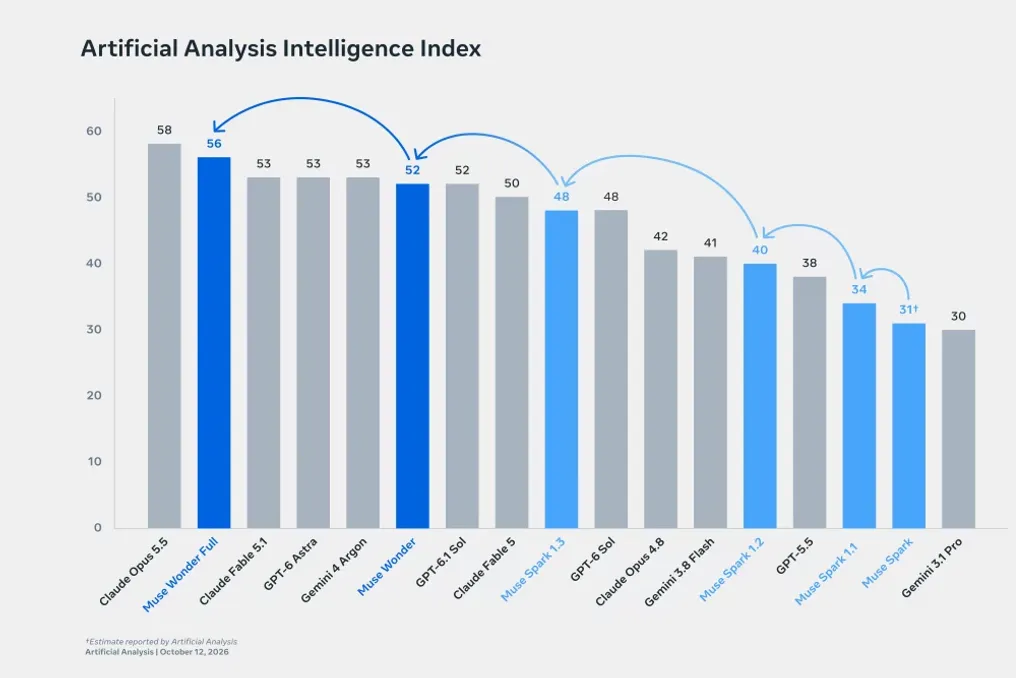
Meta introduced two new artificial intelligence (AI) tools—Muse Wonder and Muse Wonder Full—on Tuesday (the 12th). These models are intended to expand the company's presence in the advanced systems market. Meta states that in tests for programming, writing, and reasoning, these models demonstrate results comparable to the most advanced developments from Anthropic.
This release is part of Mark Zuckerberg's efforts to strengthen the AI division and find new revenue streams beyond online advertising. Access to the new features will be integrated into Meta's products, including the Muse personal agents application and the Muse Code coding tool, with access provided through various subscription plans.
The development of Muse Wonder began after Meta hired Alexander Wang, founder of the startup Scale AI, as Chief AI Officer in June 2025. This new line of models is the second series released by the division under Wang's leadership and the first explicitly positioned by the company as a competitor to so-called frontier models.
These AI systems are among the most advanced and typically require significant computational power to operate. According to Meta, Muse Wonder has also made substantial progress in programming compared to previous versions from the company.
Functionality and Application
The model was created to improve the performance of both personal and professional agents that perform tasks on behalf of users. In an interview with CNBC, Alexander Wang stated that the training process was aimed at preparing the system to find alternative solutions when obstacles arise, rather than stopping work and requesting instructions from the user. Examples mentioned by the executive include everyday tasks such as restaurant reservations or checking seat availability. The goal is for agents to handle unforeseen circumstances more effectively while performing these actions.
Muse Wonder will be integrated into parts of the Muse application, which was released last month. Although the application has a free version, using the new model will require a monthly subscription of $20 or $100.
Furthermore, the model will be available to developers via the Meta Model API. Wang noted that this option will cost more than standard subscriptions because it represents a larger and more advanced system. Nevertheless, he said the cost will remain significantly lower than that charged by leading OpenAI and Anthropic models.
Full Version and Security
Muse Wonder Full will be the most powerful version of this new series. Access to it will be limited to developers subscribed to Muse Code—an AI tool focused on software development. The subscription plans mentioned by CNBC are $50 or $200 per month.
The launch comes amid concerns regarding the behavior of advanced AI models and agents. In a Meta blog post, the company stated that the new model possesses the most robust cybersecurity protections against misuse to date. These measures are currently only available in the paid version.
Wang's team is also monitoring incidents and issues related to the use of Muse. Some users have complained on social media that the agent accessed private messages without permission, but the company denies this claim. According to Wang, Meta informs users about the application's operation and the permissions they grant during communication. He added that some people might have previously granted certain types of communication permissions and subsequently forgotten about that consent.
During the development of Muse Wonder, Meta encountered delays. In July, the company paused the pre-training phase, pushing the model release to October, according to information previously published by The New York Times. These models, internally codenamed Watermelon, represent another step in Meta's strategy to expand its presence in the AI market. The company also aims to increase sales of AI services to other corporations in a segment where OpenAI and Anthropic already hold significant positions.