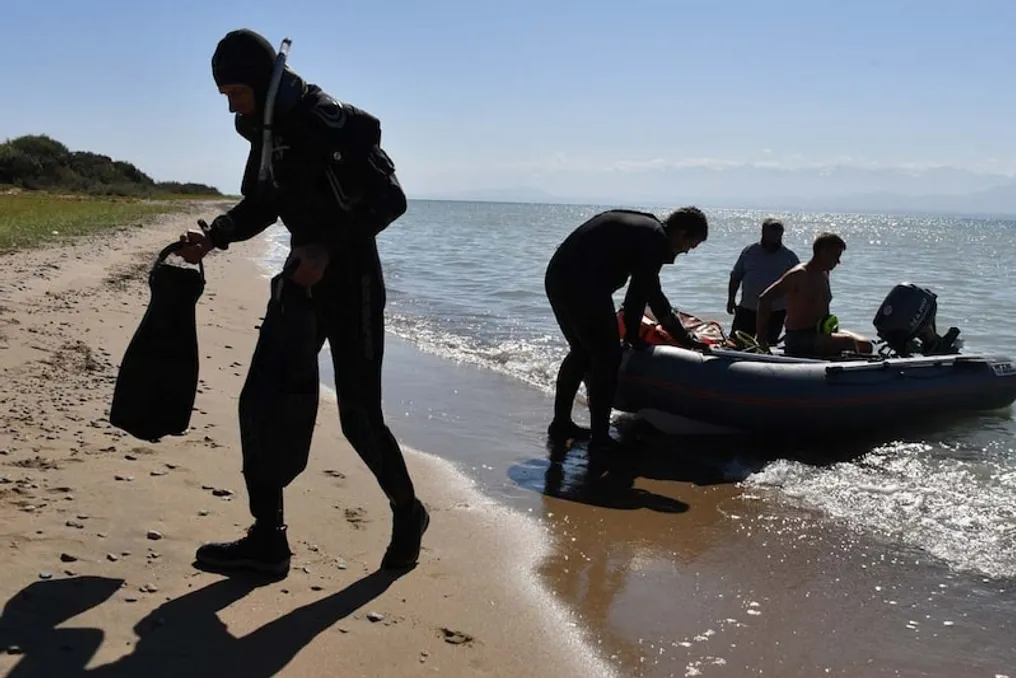
Signs of a city nearly 800 years old have been discovered beneath the largest lake in Kyrgyzstan. A team of scientists and divers is conducting an intensive investigation of the site. This city was found near the Toru-Aigir area in Lake Issyk-Kul, Kyrgyzstan.
Scientists are trying to find out how the people living in this settlement sustained themselves, what their diet was like, and how the city became submerged. It is estimated that this city was connected to the ancient trade routes of the Silk Road, and this discovery could yield new insights into the ancient history of Central Asia.
During the excavation, researchers found pottery fragments, animal bones, remains of ancient graves, and traces of structures. The analysis of these artifacts will reveal the lifestyle of the people at that time and the nature of trade among them.
Although some information about this city was available since the 19th century, scientists are now investigating it systematically. The team of divers and scientists is observing the ancient remains by descending into the lake. This location is situated at a depth of approximately 1 to 4 meters below the water surface, and the discovery work began in 2024.
The Silk Road was a vast network of ancient trade routes through which goods were transported from China to Europe. Silk and other items were exchanged along these routes, and people from different regions became acquainted with each other's cultures, religions, and ideas. This region of Kyrgyzstan was also connected to these trade routes. Scientists hope that the signs of the city found beneath the lake will clarify how trade operated there at that time and what life was like for the people.
Researchers have recovered pottery shards and animal bones from the lakebed. Examining these remains can indicate what people ate during that period and how they used the pottery. The design of the pottery can also help estimate its age.
Additionally, traces of two ancient cemeteries and one large building have been found. Scientists are currently trying to determine whether this building was a mosque, a public bathhouse, or an educational center. Investigating this structure can provide information about the lives and religious beliefs of the residents of that time.
Scientists have not yet definitively determined how this city became submerged. A possible cause could be an earthquake or geological change. Since earthquakes occur in this region, scientists are also investigating whether the city sank due to a natural event. However, further investigation is necessary to know the actual reason for the city's submersion. Scientists hope that the study of the ancient pottery, bones, and structural traces found here will provide detailed knowledge about the city's history, allowing for an understanding of the life and participation of the people in this region during the Silk Road era.