When a water tank installed on a house roof fills up, no one can be aware of it. By the time the problem is noticed, water starts leaking from the tank and falling down. This leads not only to water loss but sometimes also to water accumulation on the roof itself.
If you are also experiencing similar difficulties, a life hack that has gone viral on social media might help you. It is claimed that an alarm for a water tank can be created using an old mobile charger and a motorcycle indicator sound signal for only 20 rupees.
The feature of this homemade device is the use of unnecessary old items available at home. However, before starting the assembly, it is important to understand how this system works and how it can be assembled safely.
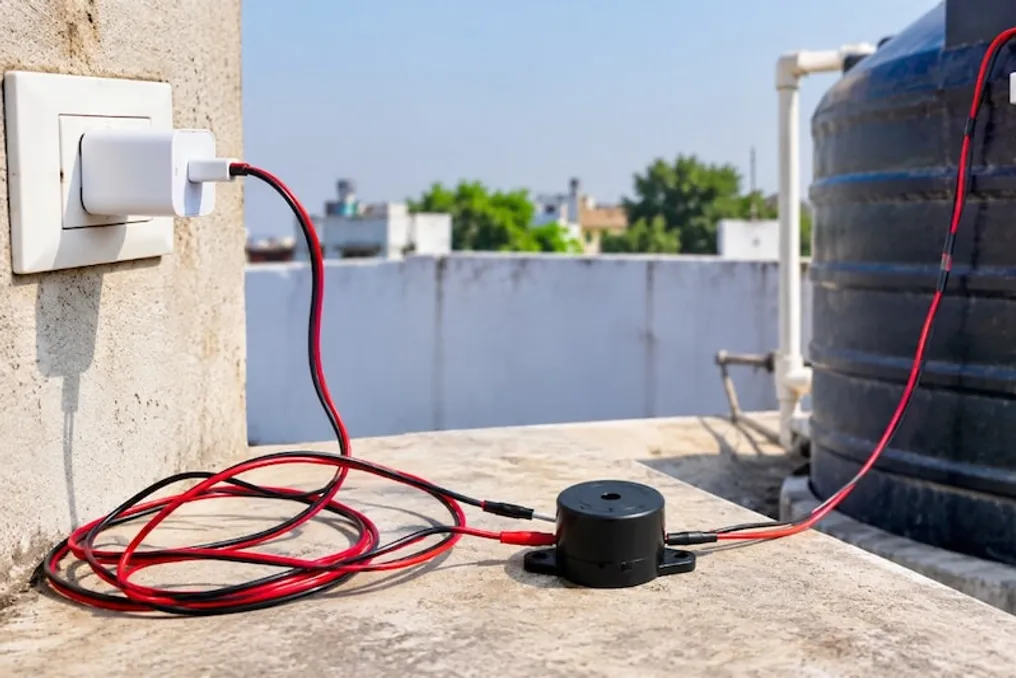
To create the alarm, you need an old 5-volt mobile charger, a motorcycle indicator sound signal that can be purchased for 20–30 rupees, and two long copper wires. The red and black wires from the old mobile charger (positive and negative) must be removed. The motorcycle indicator sound signal also has two wires; the red wire from it is connected to the red wire of the charger. Then, one remaining wire from the charger and one remaining wire from the sound signal are connected using two long wires and secured at the top inside the water tank. All connections are covered with electrical tape. After this, the charger is connected to the board.
Within this DIY solution, it is claimed that as soon as the water reaches the top level in the tank and touches the wires connected to the charger, the sound signal connected to the charger begins to make a sound.
These viral projects on social media talk about using an old mobile charger to provide power and an indicator sound signal as the sound element. However, not all chargers and not all sound signals are the same. Therefore, simply connecting the wires does not guarantee the operation of the alarm.
To create such an alarm, a water level sensor, a sound signal, suitable low-voltage DC power, connecting wires, and, depending on the needs, a switching circuit may be required. An old mobile charger should only be used if its output characteristics meet the requirements of the circuit.
It should also be noted that bringing the mobile charger directly near the water or lowering its open wires into the tank can be dangerous. The combination of water, electricity, and damaged insulation creates a risk of electric shock.