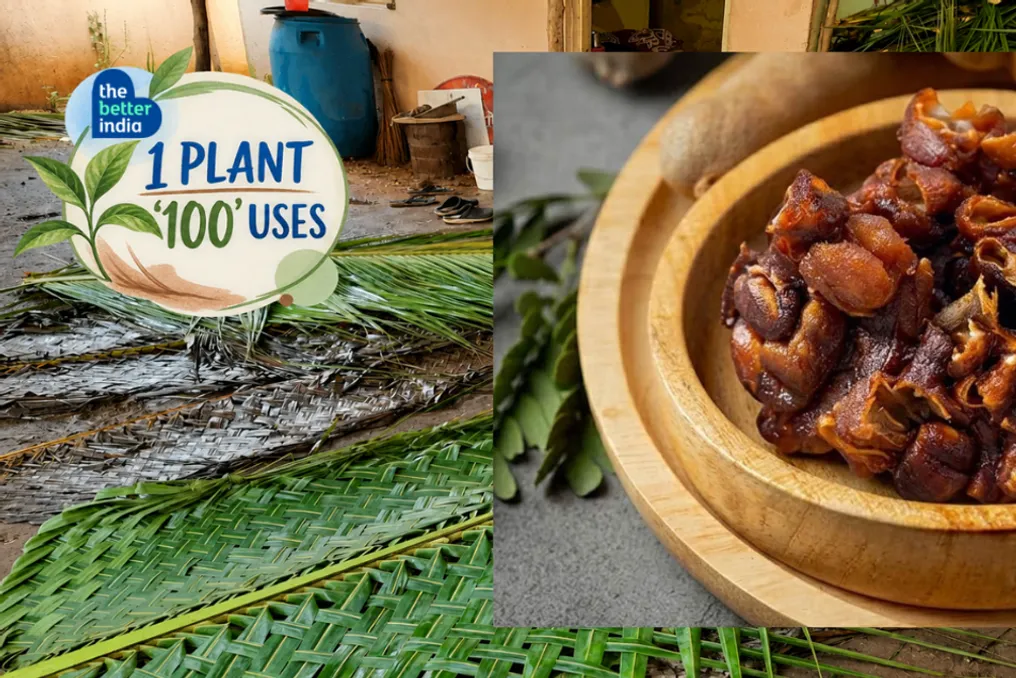
The concept of 'one plant, 100 uses' explores the many ways familiar Indian plants—leaves, fruits, and trees—participate in daily life, from agriculture and food to traditions and natural remedies. Each story focuses on one plant, revealing surprising ways it is useful, often passed down through generations.
If you ask about tamarind, people will likely think of chutney, rasam, or childhood sour candies. While this is true, it is only a small part of this tree's potential. Looking closely at what grows on it, under it, and from it, it becomes clear that the fruit is just one of its many functions.
The Stranger That Remained
Although tamarind seems very Indian, people are often surprised to learn that it is not native. Botanists trace its origin to tropical Africa, and it reached South Asia thousands of years ago via travelers. It has been cultivated here for so long that it is often mistaken for an indigenous species. Even the name reflects this journey, as early visitors thought the fruit originated from the Indian palm.
The Shade Under Which Everything Gathers
Long before anyone considered the pulp, people valued this tree for its canopy. In the World Agroforestry species database, the wide canopy is described as a 'tree for rest and consultation' in villages. The same entry notes that the tree resists storms well, making it an effective windbreak. Anyone who sat under a tamarind on a hot day needs no convincing of this.
Beyond the Rasam Bowl
In the kitchen, the pulp performs far more functions than just adding tartness to curry. According to the World Agroforestry Centre's Agroforestree Database, tamarind is the basis of Indian curries and chutneys. Sour varieties are used to make juices, jams, syrups, and candies, according to PROSEA guidelines for edible fruits. Green pods and flowers are used to add sourness to fish and meat dishes in soup bases. In the Philippines, where the fruit is called sampalok, it is used in sinigang—a sour soup, based on a popular Filipino recipe using young, boiled tamarind broth. Even the tender pods can be eaten as a vegetable, cooked or pickled. The tree is also generous: a productive plant can yield up to 150 kg of fruit per year and continues to bear fruit into old age. The leaves have high feed value, although they are rarely pruned for animals as this reduces fruit yield. In South India, cooked tamarind seeds are regularly fed to draft animals.
Wood, Dye, and Wildlife Home
The hard, dark-red heartwood is used in woodworking, and the tree also provides dye. Almost every part of the tree finds a use—be it food, feed, timber, or fuel, or in the textile and chemical industries. Wildlife also depends on it. In Madagascar, the fruit and leaves can provide up to half of the dietary resources for ring-tailed lemurs.
The Seed That Was Once Thrown Away
The seed is the best argument that nothing on this tree is waste. The husk makes up approximately 70–75 percent of the seed, and after grinding, it turns into tamarind kernel powder. According to a 2025 review, the powder first began to be produced commercially in 1943 as a starch substitute for treating cotton in the Indian textile industry. Sizing is a coating that helps threads withstand the work on a loom. Another review describes this powder as widely used for jute and cotton threads, where it replaced starch because it was cheaper and worked well. It is also used in paper, leather, printing, and food production. The key ingredient is xyloglucan, a starch-like polysaccharide suitable for food use. A Royal Society of Chemistry review examines its potential in food technology and textiles. A 2025 review adds that regulators in several countries, including Japan, the United States, China, South Korea, and Canada, have recognized this seed polysaccharide as a safe food ingredient.
What Laboratories Are Trying to Study
Currently, researchers are investigating other possibilities for the seed. One study created composite films from tamarind xyloglucan and chitosan, which maintained microbial growth below 30 CFU/g in laboratory tests. Food packaging is one possible application. These are early results, not ready-to-shelf products, but they demonstrate how much more there is to learn from this discarded seed.
The Tree That Has Always Been Nearby
Shade, food, feed, wood, dye, textile processing, and a growing list of experiments—all come from one species. Perhaps the most telling part is the seed, which was long considered a byproduct but has now become a mainstay of the textile industry. The tamarind in your area probably does more work than anyone attributes to it.