
Huawei introduces Xingji positioning technology with lane detection in tunnels and floor detection in parking lots
Read more
Pandaily
pandaily.com

Huawei introduces Xingji positioning technology with lane detection in tunnels and floor detection in parking lots

Huawei has presented a detailed overview of the Xingji positioning technology, which it plans to implement in the Mate 90 series and the WATCH GT Runner 2 smartwatches. At the presentation, held on October 12th at a Huawei device technology briefing, the system was introduced by Li Xiaolun, Technical Director of Huawei's Consumer Business Group and Head of Hardware Engineering and Product Development, according to IT Home.

Li noted that traditional positioning methods are no longer sufficient for navigation in modern locations such as underground garages, tunnels, overpasses, shopping malls, running tracks, and ski slopes. Instead of a single breakthrough solution, Xingji is a complex set of methods adapted for each of these scenarios.

Solutions for various use cases

On overpasses, where drivers often miss lane changes without precise guidance, Huawei combines a short-range HiSilicon chip with carrier GNSS phase measurement. The company claims this increases range accuracy by more than ten times and provides sub-meter level lane-level navigation. Furthermore, the fusion of RTK with AI-based pedestrian inertial positioning allows the Mate 90 series to navigate lanes on sports running tracks.

Tunnels present a more complex challenge, as phones inside them typically rely solely on inertial sensors. Huawei solves this problem by combining AI-based speed estimation with geomagnetic matching, which, according to the company, is not limited by tunnel length or driving time. The company asserts that Xingji is the only industry technology capable of providing lane-level positioning inside tunnels.

For runners, the design of a three-dimensional floating antenna increases the GNSS signal power on the WATCH GT Runner 2 by 5.4 dB compared to the first generation model. For skiers, the fusion of GNSS with a ski-specific positioning model makes trails five times more detailed and twice as responsive, achieving 98% distance accuracy. Huawei's wrist-worn ski resort maps cover over 3000 resorts with trail matching accuracy above 97%.

In underground areas, the technology uses 3D road network matching to pinpoint a vehicle's parking location with over 95% floor accuracy and less than 10 meters positional error. The Mate 90 series comes with the Precise Car Finder 2.0 feature, which, according to Huawei, is 50% more accurate than on the Mate 80, and already covers over 30,000 garages.

Indoors, Huawei is collaborating with partners to integrate geolocation services into retail. Xingji now supports 500,000 commercial area geofences and indoor positioning in 17,000 buildings. Meanwhile, Petal Maps offers store-level navigation in over 260 shopping centers and plans to add over 200 monthly.
Similar stories

Richard Yu states that more Huawei phones will receive LogicFolding chips as part of the Tau roadmap
Read more
pandaily.com

Richard Yu states that more Huawei phones will receive LogicFolding chips as part of the Tau roadmap

Richard Yu, CEO of Huawei and Chairman of its Consumer Business Group, announced at an international roundtable that Huawei's LogicFolding chips will not be limited to just a few flagship devices. He stated that more Huawei phones utilizing chips developed according to the Tau scaling law (τ) will be released.

The LogicFolding technology first appeared in Huawei phones with the Mate XT 2 tri-fold model, and Yu noted that it will gradually begin to be integrated into a wider range of the company's smartphones. However, he did not specify particular models or timelines for mass release.

The speed of this expansion, according to Yu, partially depends on production capacity. He expressed hope that China's semiconductor industry can increase its manufacturing capacity so that Huawei can create more advanced products for consumers both domestically and internationally.

Details of the Kirin 9050 Pro chip

At the same roundtable, Yu presented details of the Kirin 9050 Pro chip, which is used in the top-tier Mate 90 models. Huawei independently developed components such as the Balong modem, Image Signal Processor (ISP), Mobile Security Processor (MSP), Lingxi CPU, Maleoon GPU, and an NPU built on the Da Vinci architecture. He emphasized that the overall phone performance is 31% higher than the previous generation, and the in-house development ensured better energy efficiency and system performance despite limited access to advanced manufacturing processes.

Technology Development Roadmap

Comments on the expansion are accompanied by a long-term development plan. According to the trajectory of the Tau scaling law, Huawei chips in 2026 will reach a performance core frequency of 3.1 GHz, which is 12.7% higher than the 2.75 GHz of the Kirin 9030 Pro. Further plans include stable growth in frequency and transistor density, reaching over 400 million transistors per square millimeter and a clock frequency of 5.0 GHz by 2031.

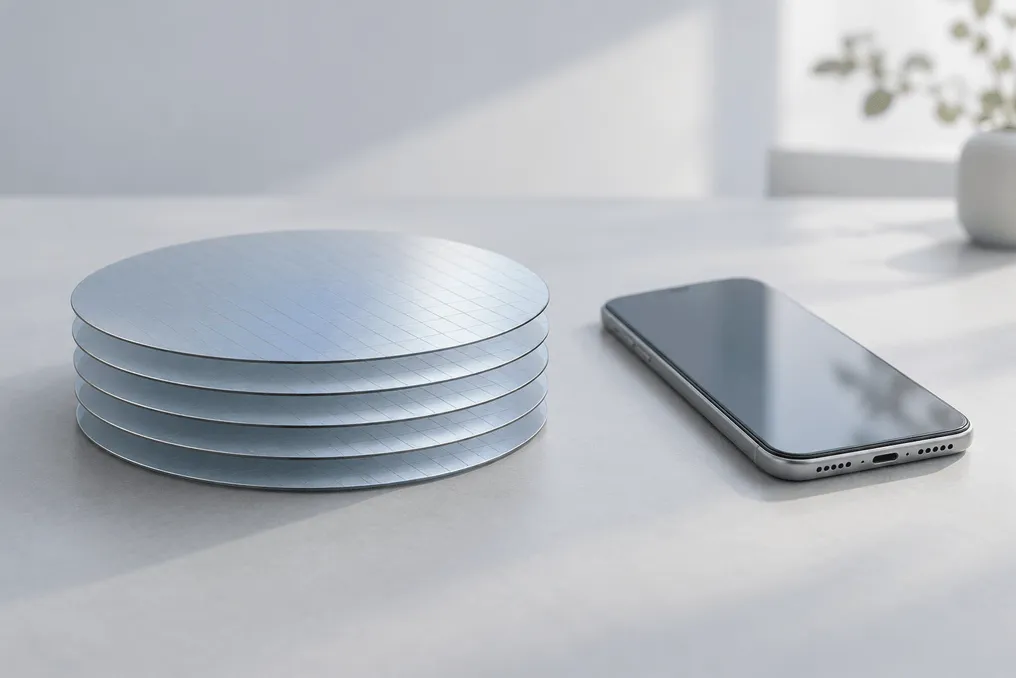
The LogicFolding technology works by vertically stacking logical layers of the chip and using dense inter-layer connections to shorten critical paths and reduce latency, instead of relying solely on reducing transistor size. Huawei has not yet specified which product lines will use this technology in the next phase, or whether mid-range phones will be included.

Popular