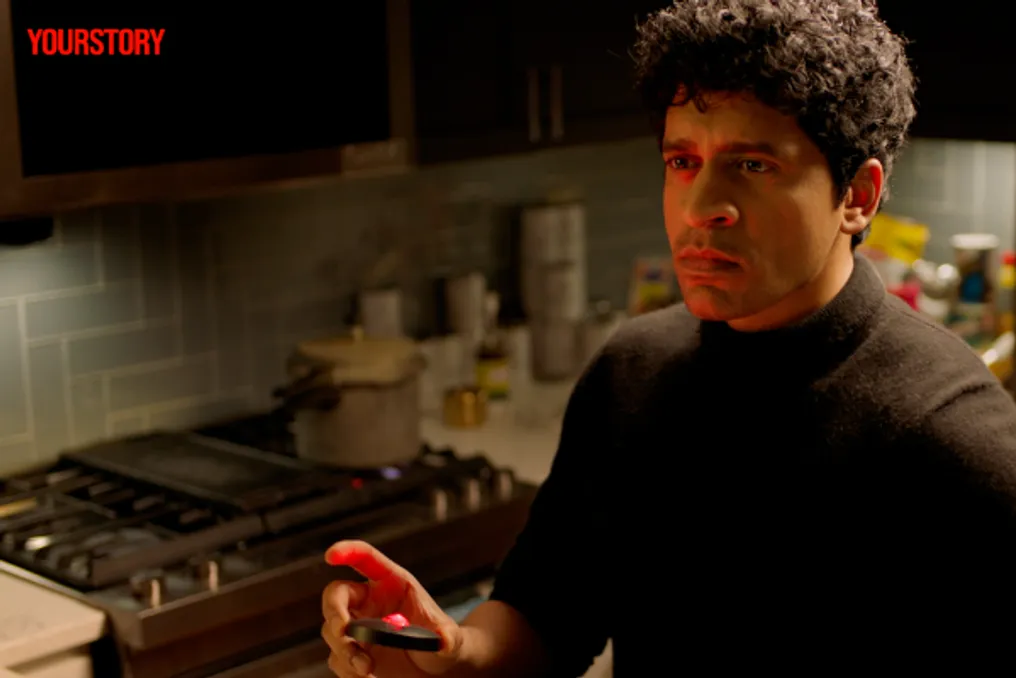
Sriram Emani, founder of IndianRaga—a global platform for Indian performing arts—shared an album on Facebook showcasing all the cups he collected from various Starbucks coffee shops in New York. Each of the 74 photos shows his name being misspelled.
Emani notes that his name is one of the most common in the world, yet it is often mistakenly written as 'Syrian' or 'Shadam,' and no one could write it correctly, unlike names such as Schwarzenegger or Saoirse Ronan. This disappointing experience, which immigrants frequently endure, became the starting point for creating Jam Boy—Emani's first film as a screenwriter, director, co-producer, and lead actor.
The film Jam Boy tells the story of an immigrant model who strives to be chosen but fails to realize the price he pays to himself. Running for 22 minutes and 22 seconds, the picture has already won 'Best Film' and 'Best Web Series' at the DC Independent Film Festival, received Special Recognition at the Boston International Film Festival, and is currently on an international festival tour.
The premiere will take place on October 13th at the South Asian International Film Festival in Toronto, the largest South Asian cinema festival in North America. In 2012, Emani started IndianRaga while attending the Massachusetts Institute of Technology. Over fourteen years, IndianRaga has evolved into a global organization dedicated to performing arts.
IndianRaga's online educational program, Raga Labs Academy, offers instruction in Carnatic and Hindustani vocal music, as well as Bharatanatyam and Kathak dance, through a structured curriculum with certification at each level. IndianRaga's headquarters are in Boston, Massachusetts, and the organization also runs the Raga Fellowship program, which selects artists through an international competition committee to create professionally shot collaborative performances. These artists have performed at the United Nations General Assembly, the Lincoln Center, Jacob’s Pillow, and TEDx.
When Emani first spoke about IndianRaga, the platform was just beginning its journey to introduce Indian classical arts to a new audience. Since then, several events have marked its growth. When the composition 'Shape of You - New Age Carnatic Mix' garnered over a million views in less than a day, critics who doubted the blending of classical music with pop music began to reconsider their stance. Emani recalls: 'Perhaps it really works, and perhaps that is what is needed.'
Another defining moment was the video Shiva Shambho, which became the most viewed Bharatanatyam video globally online. The pandemic forced IndianRaga to move its training, collaborations, and fellowships online. Since then, its artists have performed in iconic venues like the Lincoln Center, as well as at the World Government Summit in Dubai, where three young dancers gained exposure because someone on the organizing team discovered their work on YouTube.
Now, Emani embraces his identity as an actor and filmmaker, striving to present South Asian stories on the global stage. He explains: 'I wanted IndianRaga to stand alone, without my name overshadowing the brand. Over time, I realized people also want to know the person behind it, so I embrace this through acting and filmmaking, telling global stories with South Asian heritage at the center.'
Emani's foray into acting has been very successful. He recounts: 'I played the first South Asian Bob Cratchit in 'A Christmas Carol,' performing in 20 shows for 20,000 people. We held a Hindu tradition funeral for Tiny Tim, and I recited Sanskrit hymns on stage.'
With Jam Boy, Emani begins to explore his next chapter, combining his experience building a platform for South Asian art with broader ambitions to bring South Asian stories into the mainstream of global entertainment. The roots of Jam Boy lie in Emani's experience navigating the South Asian diaspora in the United States.
He often observed that many Indian families remained within their communities. Children hesitated to bring familiar food, such as idli-sambar, to school for fear of being judged for the smell. Even established professionals were reluctant to assert their cultural identity. He noticed that this hesitation permeated the performing arts sector as well.
After graduating from MIT, Emani spent a year living with 50 families in 50 cities. This shaped his understanding of how people interact with Indian performing arts outside the stage. He says: 'For IndianRaga, I wanted to see what people thought about Indian performing arts when they were least guarded: during conversations at the dinner table, on a stressful morning before college admissions, when they need to submit an additional portfolio.'
While interning at the Lincoln Center, he discovered that the Indian diaspora did not know what it needed to present about South Asian culture on stage. He asserts: 'Indians create much of the technology in North America that powers global technology and lead these companies, but they are just faces. Nobody knows what is behind it.'
Hollywood was no exception, Emani noted. Actors of South Asian descent were often relegated to comedic roles rather than romantic leads, detectives, or action heroes. He understood this was linked to the lack of stories reflecting the complexity of South Asian life. 'The diversity, richness, and texture I want to portray can only emerge if I write the story,' he says. This conviction gave rise to Jam Boy.
Jam Boy is set in a near future where immigrant workers promising freedom are secretly in debt bondage. The film follows an Indian coder who smuggles forbidden tamarind rice from his mother into work and learns why the company wants him to forget home. Emani explains that Jam Boy is speculative fiction playing on the theme of the immigrant model being rewarded for a striking appearance. 'But being striking is not the same as being fully seen. It is a character who did everything possible to be chosen but does not realize the cost of choosing himself. He was told that if he reached the next milestone, he could go home or get certain things. But the goal constantly changes because they know that immigrant models keep working, working, working.'
The science fiction element in the film also allows viewers to see what might be happening in reality but remains unnoticed, imposing boundaries through exaggerated worlds. Emani points out that the film is based on the real stories of many of his friends, some of whom had to forgo promotions to protect their positions due to H-1B visas that keep them in technical roles. There is also a segment on food-related racism experienced by Indians in the US, as well as internal gaslighting.
'There is a scene that resonated most with children raised here: the protagonist opens his pressure cooker and wants to smell the food but worries the smell will get on his shirt. So he wears a raincoat and comes to work looking like that. Every child from four to sixteen who watched it said, 'Wow, that is so true.' That is what the next generation takes from this film.' The film also carries a deep personal connection—Emani's mother plays his mother in Jam Boy. She has already appeared in two IndianRaga videos that have garnered over 2 million views on different platforms. 'On a spiritual level, it feels like a blessing from ancestors to have my real mother in my first film about my culture,' he says.
The international premiere in Toronto is a significant milestone for Emani, as the city has a large South Asian community. He reports: 'We look forward to getting the opportunity to attend a festival in India to come to the country that way first. Then I have a plan to release it online next year.'
Meanwhile, the short film opens doors to bigger opportunities: the feature-length version of Jam Boy. He is currently working with the Rickshaw Film Foundation writers' room on revising the script, exploring adaptation as a web series. Besides Jam Boy, Emani is developing thrillers featuring South Asian protagonists in global settings. As a trust and storytelling fellow at Boston University, his mission is to use narrative devices to build trust in institutions and people. He calls his project 'Ancestors and Algorithms.' He explores what we inherit and what happens to it as the surrounding world changes: inheritance through migration, technology, and cultural shifts.