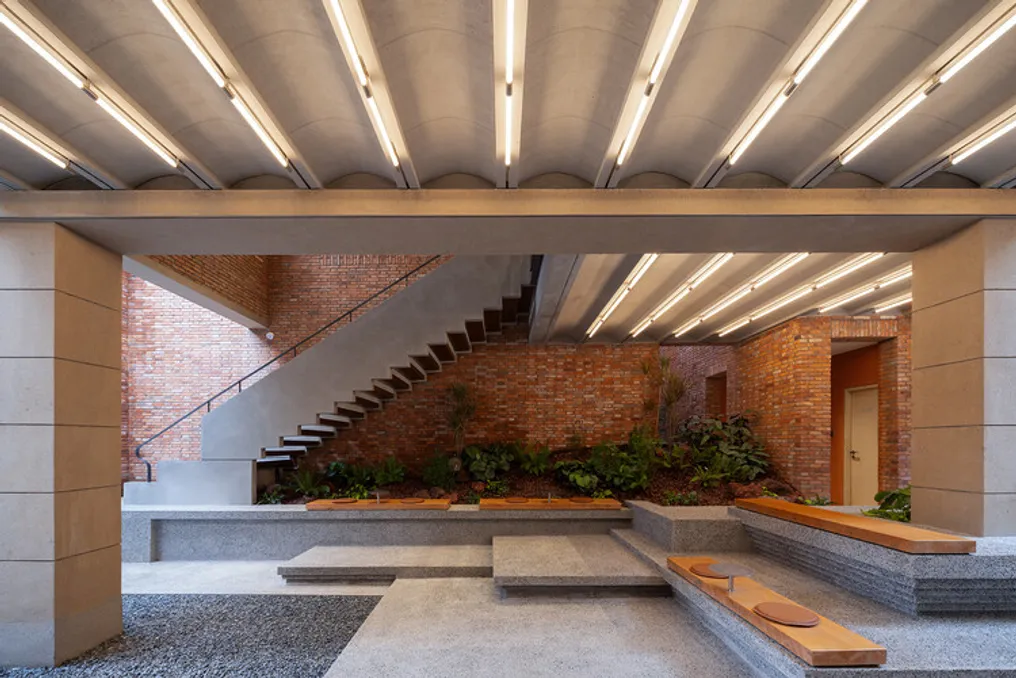
The design team described Yanqing Li, located in the historic district of Hankou, at the intersection of Shengli and Eryao Xiaolu streets. This complex consists of seven buildings that harmonize Oriental and Western styles, arranged around four interconnected alleys. Originally built in 1933 by Zhong Yansheng, the site was named after its founder. After suffering war damage and demographic changes, it is undergoing a process of urban regeneration.
The client's proposal aims to convert the space into an open commercial area while maintaining its historical identity and serving as a model for the renewal of the Sanyang district.
The development of the project began with a detailed analysis of the lifen typology and local urban memories. It was found that residents' memory does not refer to the original standardized configuration of row houses, but rather to a mixed community that developed naturally, similar to Beijing's hutongs and Shanghai's lilongs, where housing and commerce were intertwined.
The residential units were adapted into corridors or common areas, divided into smaller parts, while residents' furniture and plants advanced through the collective spaces. Over time, the rigid and closed environments became more open and dynamic, creating a lively and animated atmosphere. This process is seen as a 'spatial evolution' supported by an 'original structural skeleton,' ensuring the preservation of history while meeting flexible and small-scale commercial needs.
This concept of natural evolution balances heritage conservation with the commercial program, allowing the lifen to persist as an urban organism in constant renewal.
To highlight this historical trajectory, the commercial circulation was restructured. Courtyards, staircases, and original units were transformed into public spaces that integrate with the old alleys, converting the initial network of four lanes into multiple continuous public domains connected to the city streets. Open stairs and second-level walkways create a three-dimensional path that encourages visitor stay and enriches the spatial experience.
Along these paths, the interiors take on an elastic and open character: greater visibility allows commercial units to be reduced and combined flexibly. Some stairs and rooms expand to form meeting points intended for exhibitions, fairs, and events. Furthermore, previously fragmented courtyards, upper rooms, and preserved terraces are integrated into a continuous narrative of discovery, making the journey itself a reading of history.
It was chosen to avoid excessive interference with the design, allowing the historical aspect to stand out and leaving room for commercial activities. Subsequent landscaping, interior design, and signage can add light and varied touches to the historical fabric. Merchants act as 'residents,' using their furniture, plant pots, and small decorations in the reserved open spaces, recreating scenes of urban memory coexistence. The contrast between the old and the new highlights emerging lifestyles, uniting the historical environment with contemporary daily life. This generates a sense of belonging for older people and attracts young people to new encounters, stimulating new cultural possibilities.
Yanqing Li represents a deep investigation into urban regeneration. It is a practice that guides 'growth' following historical rhythms, and not just conservative preservation or a visual spectacle focused on trends. The project draws from genuine urban memories to translate them into spatial experience and narrative. The architecture accommodates commerce while allowing the historical context to continue to exist, adapt, and grow in daily life. This approach is seen as the deepest respect for the old urban fabric, demonstrating that history and culture constantly evolve in contemporary life.