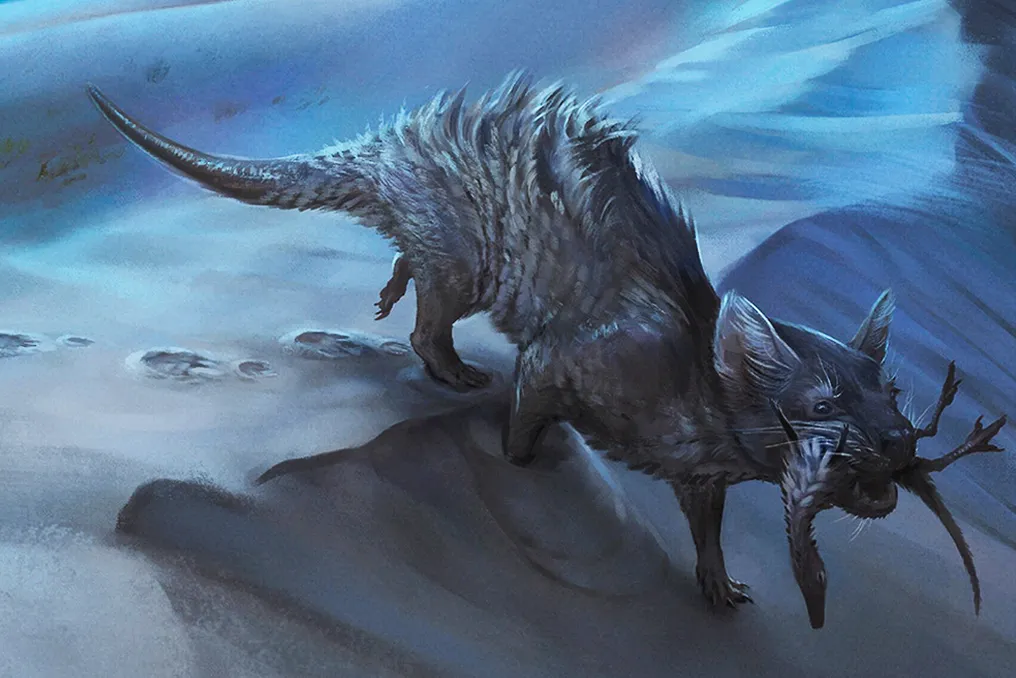
While dinosaurs dominated the continents, mammals were timid, small, and agile creatures, often hunted by large reptiles. However, an enigmatic mammal that traversed the dunes of present-day southern Brazil 130 million years ago possessed enough size to confront some of these giants.
Its footprints differed significantly from those of its contemporaries, measuring over 10 centimeters in length and 13 centimeters in width, surpassing any other known mammal track in that geological formation. Researchers suggest that this creature may represent the largest mammal that coexisted with the dinosaurs.
These footprints were discovered in the Botucatu Formation, located in the Paraná Basin, a site notable for its fossil remains, although scarce in skeletons. At that time, the area was part of an extensive desert covering Brazil and parts of southwestern Africa, regions that were part of the supercontinent Gondwana.
The sandstone rocks contain traces of dinosaurs, mammals, lizards, pterosaurs, and arthropods. However, previously recorded mammal tracks were generally much smaller, with dimensions of approximately 4.5 to 5 centimeters in length and just over 6 centimeters in width.
The new discoveries break this pattern, presenting tracks almost twice the size of previous ones. Based on the morphology of the tracks and the proportions of other mammals of the period, it is estimated that the animal could have reached up to 1.55 meters in length, comparable to the size of a capybara or a leopard.
Despite this, without bone evidence, the exact identity of the animal remains unknown. Aline Ghilardi, a paleontology professor at the Federal University of Rio Grande do Norte (UFRN) and author of the study, clarifies that the confirmation is not based on a single trait, but rather on the combined analysis of the footprint anatomy and how they are arranged in the trail.
Researchers argue that the tracks were left by a mammal because the prints are wider than they are long, possess four short, rounded toes, and form narrow trails, consistent with quadrupedal locomotion. These characteristics are typical of mammaliaforms, a group that includes both modern mammals and their distant ancestors.
Precisely identifying which animal left these tracks is an even greater challenge. Ghilardi points out that the footprints do not function as direct fingerprints of a species, mainly because there are no skeletons of mammaliaforms of that age in Brazil. She speculates that the responsible parties could be triconodonts or cladotheres; while triconodonts were an extinct lineage known for three-pointed aligned teeth, cladotheres belong to the ancestral group of most modern mammals, including humans.
The reason why this mammal was considerably larger than others of its time is also a mystery. Pedro Buck, the first author of the study and a professor at the State University of Minas Gerais (UEMG), explains that intense competition with dinosaurs, which were extremely varied, may have kept most mammals at reduced sizes throughout the Mesozoic Era.